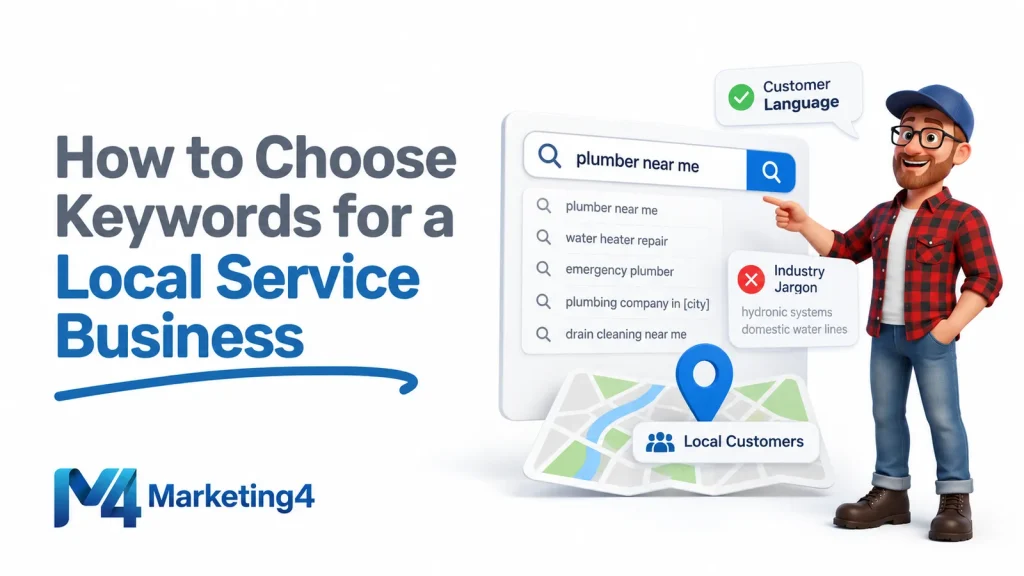

Ask a plumber what a service is called and you might get a technically correct answer such as trenchless lateral rehabilitation.
Ask the homeowner with a broken sewer pipe what they are looking for and you may hear something completely different: Can you fix this without digging up my whole yard?
Both people are talking about the same problem. They are just using different language.
That is the basic idea behind keyword research. A keyword is not a magic phrase that makes Google rank a website. It is simply a word or phrase people use when they search for something. For a local service business, choosing the right keywords means understanding how the right customers describe the work you actually want.
TL;DR
Start with the services, customers, project sizes, and locations your business wants more of. Then learn how customers describe those services and the problems that lead them to search. Use keyword tools to check and expand your thinking, but do not let search volume decide your business strategy.
A useful final test is simple: if this search brought us a lead tomorrow, would we actually want the lead?
A Keyword Is Just Customer Language
SEO terminology can make keyword research sound more technical than it needs to be. If someone searches emergency plumber Burlington, that phrase is a keyword. If they search why is water backing up into my basement drain, that is also a keyword. If they ask an AI tool to find a plumber who works on sewer lines in older Burlington homes, the language is longer, but the underlying job is similar: they are trying to find useful information or a business that can help.
Google’s own SEO Starter Guide tells website owners to think about the words different users might search for. Someone who knows the industry may use one term, while someone new to the subject may use another. Google also says its language systems can understand how a page relates to many searches even when the exact wording is not repeated on the page.
That gives a service business some breathing room. You do not need to discover every possible variation and force each one into your website. You do need to understand the language customers use well enough that your website clearly connects their problem to your service.
If you want a broader explanation of how this fits into search, our plain-English guide to what SEO actually is is a useful starting point.
Start With the Work You Actually Want
One of the easiest ways to build the wrong keyword list is to open an SEO tool before deciding what the business is trying to sell.
Imagine a landscaping company that offers lawn cutting, spring cleanups, interlock, pools, landscape design, and large backyard construction projects. A keyword tool might show plenty of searches for lawn cutting. That does not mean lawn cutting should become the centre of the SEO strategy.
If the company is trying to grow $50,000 to $150,000 landscape construction projects, ranking for a large number of lawn-maintenance searches could generate more traffic while moving the business in the wrong direction.
Before researching phrases, answer the business questions first:
- Which services do we want more of?
- Which services are profitable enough to pursue?
- What size of project fits the company?
- Which customers are the best fit?
- Where do we genuinely want to work?
- Do we have the capacity to sell and deliver more of this work?
- Are there services we offer but do not particularly want to grow?
This is why Marketing4 treats SEO as part of the wider business and marketing strategy. A search term can look attractive in a spreadsheet and still be wrong for the company.
Listen to How Customers Describe the Problem
The business already has one of the best sources of keyword research available: conversations with customers.
Listen to the words people use on sales calls, in contact forms, in emails, during estimates, in reviews, and when they speak with technicians. Those phrases often reveal a gap between the way the company describes a service and the way the customer thinks about it.
A basement waterproofing company may sell interior weeping tile systems. The homeowner may start with water coming through basement wall.
An HVAC company may sell heat pump diagnostics and repair. The homeowner may search heat pump blowing cold air.
A plumber may call a service sewer lateral replacement. The homeowner may search replace sewer pipe to street, broken sewer line, or sewer keeps backing up.
The service name matters because some customers already know what they need. The problem language matters because many do not.
A useful website usually needs both. It should be technically accurate enough to show that the company knows the work, while still using language that makes sense to the person who has the problem.
The Biggest Keyword Is Not Always the Best Keyword
Search volume is tempting because it gives you a number. If one phrase gets 2,000 searches and another gets 70, the first one can look 28 times more valuable.
That is not how the business value necessarily works.
Consider a landscape contractor comparing these searches:
- backyard ideas
- landscaping ideas
- interlock driveway contractor Burlington
The first two may attract far more people. They may also include students, do-it-yourself homeowners, people collecting photos, and homeowners who are years away from hiring anyone. The third phrase is much narrower, but the person searching it is giving you several useful clues: they have a specific project, they are looking for a contractor, and they care about a specific market.
That does not make broad informational searches useless. Good educational content can help a business become known, answer questions, and build authority. But informational traffic and sales opportunities are not the same thing.
Our article on the customer journey for local service businesses goes deeper into how people move from recognizing a problem to comparing companies and eventually contacting someone.
For keyword research, the practical lesson is to consider both demand and the kind of person behind the search. Twenty searches from people who are close to hiring can be more useful than hundreds from people who were never likely to become customers.
Do Not Create a Page for Every Wording Variation
Keyword tools can produce long lists of phrases that look different but mean almost the same thing:
- bathroom renovation contractor
- bathroom remodel contractor
- bathroom renovation company
- bathroom remodeling company
- bathroom renovator
Those phrases do not automatically need five different pages.
If the same customer is looking for essentially the same service, with the same questions, the same proof, and the same buying decision, one strong page can usually explain the service naturally using several ways people talk about it.
Creating a separate page for every tiny wording variation often leads to a website full of thin pages competing to explain the same thing.
There are also cases where two related searches really do deserve different pages. A plumbing company may offer both drain cleaning and sewer-line replacement. The customer problems, equipment, pricing, process, urgency, and project size can be different enough that separate pages make sense.
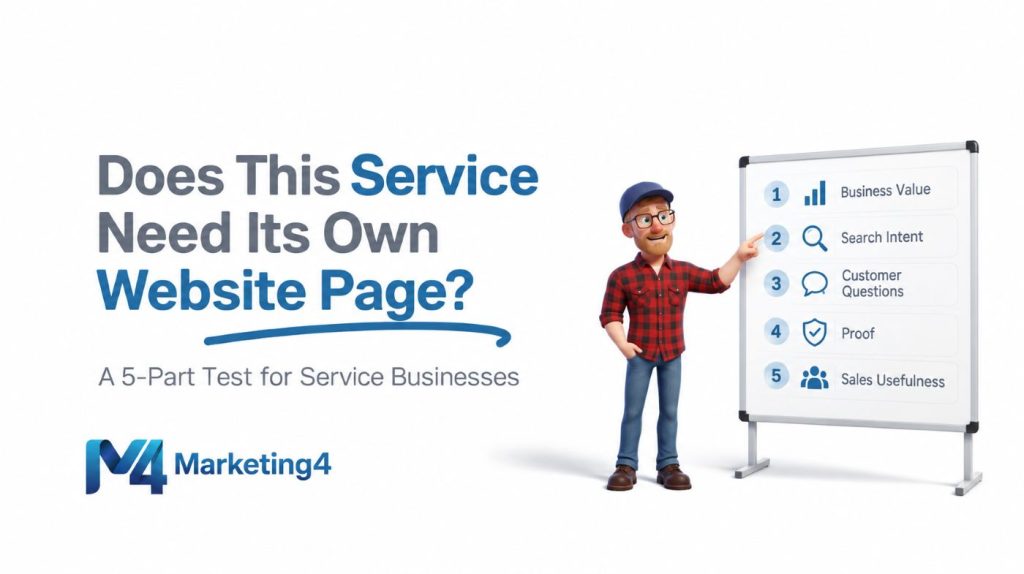
We use a five-part test for deciding whether a service deserves its own website page because the decision should involve more than finding another keyword.
Geography Changes the Search, but Do Not Force It
A local business also has to think about where the search is happening.
A customer might type electrician Hamilton, electrician near me, or simply panel upgrade electrician. Google can use the searcher’s location and other context even when the city name is not included.
That means the keyword list does not need every service multiplied by every city, neighbourhood, and spelling variation.
It does need to reflect the markets where the business genuinely wants work.
If a contractor does meaningful work in Hamilton, Burlington, and Oakville, those markets may deserve consideration in the site structure. If the company almost never travels to Barrie, adding “Barrie” to a page because a tool showed search volume is unlikely to create a good customer experience even if it generates a few enquiries.
Location pages can be useful when there is a genuine reason for them to exist. Our guide to local landing pages for service-area businesses explains that idea in more detail. The goal is not to create 50 copies of the same page with different city names.
Use Keyword Tools as Research, Not Instructions
Keyword tools are useful. They can show you phrases you had not considered, approximate search demand, related wording, seasonal patterns, and the way people combine a service with a location or problem.
Google’s own Keyword Planner, for example, can generate keyword ideas and historical search information. Google also describes its forecasts and search-volume figures as estimates, which is a useful reminder that the numbers are inputs for a decision, not precise measurements of how many customers are waiting for you.
The tool also does not know anything about your margins, your crew, your sales process, your preferred project size, or the work you are trying to stop doing.
Suppose a roofing company sees large search volume around roof repair and much smaller volume around commercial flat-roof replacement. If commercial replacement is the company’s strongest and most profitable work, the lower-volume phrase may deserve far more strategic attention.
The best use of a keyword tool is usually to challenge and expand the thinking you already did about the business, not to replace that thinking.
A Simple Keyword Process for a Service Business
You do not need a 4,000-row spreadsheet to make good initial decisions. Start with the services that actually matter.
- List the work you want more of. Start with five to ten meaningful services, not every task the company has ever performed.
- Write down the customer’s language. Include the service name, plain-English alternatives, and phrases customers already use with your team.
- Add the problems that lead to the service. Think about what is happening when the customer realizes they need help.
- Add the markets you genuinely serve. Focus on areas where the company wants and can deliver the work.
- Research the search language. Use search data and keyword tools to find additional phrases, compare demand, and check whether your assumptions are reasonable.
- Group searches that mean the same thing. Do not create a new page just because the wording changed slightly.
- Map each meaningful group to a page. Decide whether the search belongs on a service page, location page, article, case study, or another useful part of the website.
Take sewer-line replacement as an example. The company might start with the service itself, then collect customer language such as sewer pipe replacement, broken sewer line, and replace sewer line to street. Common problems might include repeated backups, tree roots, collapsed pipe, or an old clay sewer line. The company then considers the actual service area and decides which page should explain the service thoroughly.
That one exercise can also reveal useful supporting content. Customers may ask how much sewer replacement costs, whether the whole yard needs to be excavated, how long the work takes, or when repair is still possible. Those questions can become useful sections on the service page or separate articles when there is enough to say.
AI Search Does Not Change the Basic Job
People are increasingly comfortable asking search engines and AI assistants longer questions. Instead of typing roofer Hamilton, someone might ask for a reputable roofing contractor near Hamilton that replaces asphalt roofs and has experience with older homes.
You do not need to create a page targeting that exact sentence.
You need a website that makes the underlying facts clear. Do you replace asphalt roofs? Where do you work? What kinds of homes do you work on? Can people see real projects, reviews, qualifications, or other evidence that supports the claim?
That is one reason our broader guide to local SEO for service businesses focuses on being easy to find, understand, verify, and choose. Natural customer language helps people and search systems understand the business, but the rest of the online footprint still has to support what the website says.
Choose the Customer Before You Choose the Keyword
A business can rank for a phrase and still wish it did not.
If a keyword attracts work that is too small, too far away, unprofitable, outside the company’s expertise, or simply not part of the direction the business is trying to grow, higher rankings may create more noise rather than better opportunities.
So before putting a phrase at the top of an SEO plan, ask what happens if the strategy works.
If ten leads came in next month from people searching that phrase, would the sales team be excited to call them back? Would the company want to quote the work? Could operations deliver it profitably? Does it move the business toward the kind of company the owner is trying to build?
If the answer is yes, you probably have a useful keyword to investigate.
If the answer is no, a big search-volume number does not make it a good target.
Start with the work you want. Understand how the right customer talks about it. Then use search data to connect the two.