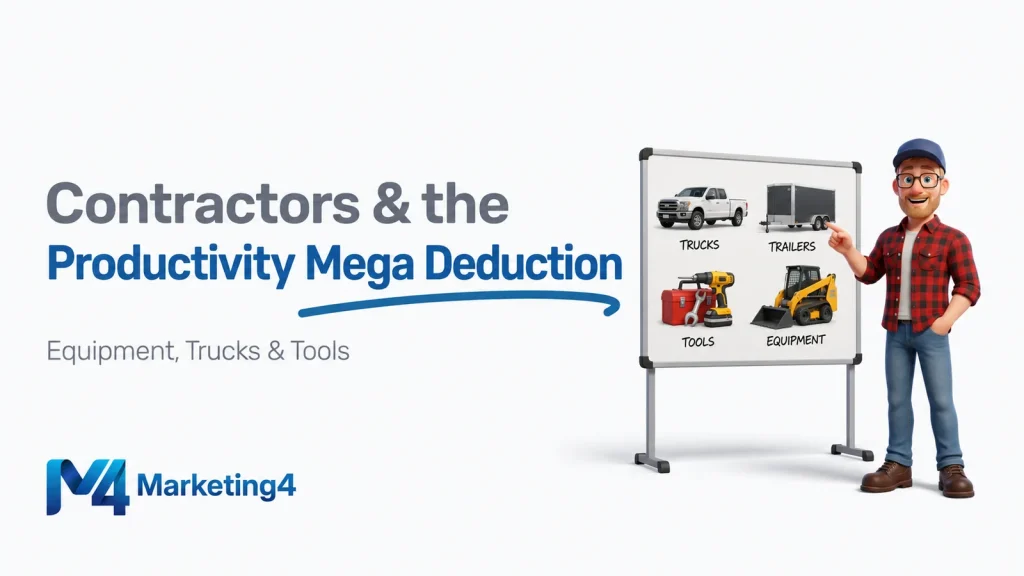

A contractor can look at Canada’s proposed 100% investment write-off and immediately think of the purchases that take the biggest bite out of cash: a mini-excavator, another work truck, a trailer or a replacement set of expensive tools. Those purchases don’t all receive the same tax treatment. In particular, a pickup truck can be more complicated than the excavator it tows.
The federal government announced the Productivity Mega Deduction on September 15, 2026. The proposal would let businesses deduct the full eligible capital cost of a much wider range of depreciable property in the year it becomes available for use. For contractors, the practical question is which assets qualify, what you could already deduct under existing rules and whether the purchase makes sense for the work you expect to perform.
TL;DR
Under the proposed Productivity Mega Deduction, many qualifying contractor assets, potentially including excavators, certain machinery, trailers and higher-cost tools, could receive a 100% capital cost allowance (CCA) deduction when they become available for use, provided the purchase meets the rules. Trucks require a separate review: some passenger vehicles and specified motor vehicles in Classes 10 and 10.1 are excluded if previously used or assembled outside Canada. Ordinary small tools may already be fully deductible, while buildings and certain other property remain excluded. This was a proposal, not enacted law, when reviewed on September 17, 2026. The deduction is not a reimbursement of the purchase price.
For the wider announcement, read our small-business guide to Canada’s proposed investment write-off. Our purchase-by-purchase guide covers other industries and asset types. Here we’re concentrating on decisions a construction or trade business actually makes.
Start with what the contractor is buying
A construction business might buy a $100,000 excavator, a $65,000 pickup, a $9,000 equipment trailer and $4,000 of testing tools in the same month. It’s tempting to treat the total as one equipment investment, particularly if everything appears on a capital-spending plan. Tax rules look at the individual assets and their classifications.
Capital cost allowance is the system through which businesses generally deduct the cost of equipment and other longer-lived depreciable property. The CRA assigns property to classes; ordinary rates and any existing accelerated allowances depend on those classes. The proposed measure would expand immediate expensing for most depreciable property acquired on or after September 15, 2026, but it lists exceptions. Its official Department of Finance backgrounder describes the broad rule and exclusions.
Separate each line item on your quote. If you purchase a truck, mounted equipment, a trailer and a tool package, ask your accountant to classify them individually before assuming the entire invoice qualifies.
Excavators, skid steers and earth-moving equipment
Consider a small excavation contractor replacing a machine that has become unreliable. A qualifying excavator or skid steer may be a strong candidate under the broad immediate-expensing proposal, but the exact class depends on the machine’s design and use. CRA guidance places most power-operated movable equipment acquired after 1987 and used to excavate, move, place or compact earth, rock, concrete or asphalt in Class 38, which ordinarily has a 30% CCA rate. Some machinery falls into other classes.
If a $100,000 machine is qualifying property under the final measure and becomes available for use during the tax year, the proposal could permit a $100,000 first-year deduction. At a purely illustrative 20% income tax rate, sufficient taxable income and no other tax effects, that deduction could reduce tax by $20,000 relative to claiming no deduction that year. The contractor still has to pay $100,000 for the machine. The incremental first-year advantage is also less than $20,000 if the existing rules already allowed a deduction for the same asset.
Now consider why the contractor wants the excavator. A machine that replaces expensive rentals, prevents breakdowns or allows a crew to complete more profitable work may have a clear business case. A machine that sits idle because the company lacks operators or signed work still creates financing, insurance, storage and maintenance costs. Calculate those costs before treating tax savings as the reason to buy.
Attachments, compressors, lifts and other specialized equipment
Contractors don’t buy only headline machinery. A plumber may need a pipe-inspection camera; an electrician may invest in a large testing instrument; a concrete contractor may buy specialized equipment; an HVAC company may add a recovery machine or fabrication equipment. Many purchases of this sort are depreciable business assets and potential candidates, subject to their individual CCA classifications.
Attachments and accessories can complicate the invoice. A bucket or hydraulic attachment purchased with an excavator is not necessarily classified in the same way as a freestanding compressor or an installed piece of equipment. Equipment fixed permanently into a building can raise a different question from movable equipment. Keep a detailed quotation showing each major item, delivery, installation and other charges so the applicable capital cost can be determined correctly.
The word ‘equipment’ isn’t a tax class. Your accountant should confirm the appropriate CCA class, whether any exclusion applies and what first-year deduction is already available.
Tools: a $250 tool and a $4,000 instrument are different purchases
The announced change may sound especially attractive to trades that purchase tools constantly. However, many inexpensive tools didn’t need a new law to be deducted in the first year.
CRA guidance generally places tools costing less than $500 each in Class 12, which has a 100% CCA rate; most ordinary small tools in this class were already fully deductible in the year of purchase. Tools costing $500 or more are commonly Class 8 assets, ordinarily depreciated at 20%, though specific items and exceptions need review. See the CRA’s capital cost allowance guidance.
| Illustrative purchase | Question to ask |
|---|---|
| $250 hand tool | Is it an ordinary Class 12 tool already eligible for full deduction? |
| $1,800 professional testing instrument | Is it qualifying depreciable equipment, and what first-year deduction would current rules allow? |
| $4,000 specialist cutting or diagnostic equipment | Does its precise classification and available-for-use date satisfy the proposal? |
| Consumable blades, fasteners and supplies | Are these ordinary operating expenses or inventory rather than capital assets? |
Don’t combine a crate of inexpensive hand tools into one supposed $5,000 capital asset just because they arrived on one invoice, or split an actual single asset into artificial components to claim a more favourable class. Classify the property according to what was genuinely acquired.
Work trucks: the pickup is where the details become uncomfortable
A contractor sees an excavator, a cargo van and a pickup as work equipment. The tax system distinguishes motor vehicles from passenger vehicles, and the proposed immediate-expensing rules add a further distinction for selected vehicles.
Under the September 15 draft legislation, an excluded vehicle is a vehicle in Class 10 or 10.1 that meets a specified vehicle definition, including passenger vehicles, and was either used before acquisition or assembled outside Canada. Certain other specified motor vehicles are covered. A qualifying new vehicle in those categories assembled in Canada may be treated differently. Not every commercial truck is covered by that exclusion, and not every vehicle bought by a contracting company qualifies for immediate expensing.
The first job is establishing what your specific truck actually is for income-tax purposes. The CRA’s vehicle-definition guide explains that some pickups and vans are motor vehicles rather than passenger vehicles when they meet seating and actual-business-use conditions. For example, a pickup seating no more than the driver and two passengers that is used more than 50% to transport goods and equipment to earn income can be treated differently from a passenger-use pickup. A multi-passenger pickup may need to meet a different, more demanding use test. The actual configuration and use during the acquisition year matter.
| Contractor vehicle | What needs checking |
|---|---|
| Single-cab pickup carrying tools and materials | Seating capacity, qualifying transportation use, Class 10 classification and whether any special exclusion applies. |
| Extended-cab pickup carrying a crew and personal passengers | Passenger-vehicle definition, actual usage percentage, prior use and country of assembly. |
| Cargo van fitted with shelving | Seats, actual goods/equipment use, vehicle class and whether it meets an excluded-vehicle definition. |
| Heavy freight truck | Gross vehicle-weight rating and applicable class, which may differ from passenger-vehicle classes. |
| Used company truck | Vehicle-specific exclusion plus the general used-property and related-party rules. |
For 2026, the federal Class 10.1 passenger-vehicle CCA ceiling is $39,000 before tax for vehicles acquired on or after January 1, 2026, and a different prescribed ceiling applies to qualifying zero-emission passenger vehicles. That limit can constrain the depreciable cost even where an immediate-expensing rule otherwise applies. The Department of Finance’s 2026 vehicle-limit announcement provides the prescribed amounts.
Don’t rely on a dealership’s promise of a ‘100% business write-off.’ Ask for the exact vehicle identification number, model, seating specification and assembly-country information, and give your accountant an honest description of how the truck will be used. Purchasing it in Canada is not the same as it having been assembled in Canada. Claiming that a family vehicle is a company truck also doesn’t convert personal driving into business use.
What about equipment trailers and commercial freight vehicles?
A trailer is not automatically the same asset as the pickup pulling it. Depending on its design and use, it may be classified differently. Heavy freight trucks can also have different CCA treatment from ordinary pickups; the CRA’s CCA property index distinguishes trucks, freight trucks and trailers. The proposed vehicle exclusion is defined using particular vehicle types and classes, not an everyday category called ‘things with wheels.’
Suppose a landscaping company orders an equipment trailer and a crew-cab pickup together. Treat them as separate assets for the eligibility review. A potentially qualifying trailer should not be ruled out solely because the truck receives a restricted treatment; equally, the truck should not inherit the trailer’s eligibility merely because they are bought together.
Can contractors buy used equipment?
Potentially. The government’s proposal allows some previously used property, subject to restrictions. The buyer and a non-arm’s-length person cannot have previously owned the asset, and the acquisition cannot involve a prohibited tax-deferred rollover. An unrelated dealer’s used skid steer may therefore be treated differently from a machine shifted between an owner and their own corporation.
Vehicles require an additional review: a previously used vehicle that falls within the draft’s excluded-vehicle definition is excluded even if it otherwise passes the general used-equipment conditions. The shortcut ‘used equipment qualifies’ is too broad, as is ‘all used assets are excluded.’ Keep the purchase contract, seller identity, serial number, transfer documents and equipment history. See the federal proposal’s used-property conditions.
Buildings, shops and yard improvements are not automatically equipment
An electrical contractor might purchase a new pipe-bending machine and build an addition to the workshop that houses it. Those are separate investments. The Productivity Mega Deduction proposal excludes ordinary buildings and additions in Classes 1 and 3. Land is not depreciable. Certain paving and surface improvements can belong to different CCA classes, while routine repairs may be deductible under existing expense rules. The type of work determines the tax treatment.
A workshop invoice covering a new machine, electrical service upgrades, fixed systems and building construction shouldn’t be reported as one fully eligible ‘equipment upgrade.’ Break down the work and have its classification reviewed. Being excluded from this particular incentive does not mean the building or improvement has no tax treatment under existing rules.
When does the first-year deduction actually happen?
The proposed acquisition-date threshold is September 15, 2026. But ordering a machine, paying a deposit and putting it into service are not necessarily the same event. The deduction is generally associated with the taxation year the property becomes available for use. Under the CRA’s available-for-use guidance, equipment can qualify when delivered and capable of producing a saleable service, even if it hasn’t performed its first paid job; specific statutory timing rules and exceptions can also apply.
A contractor who places an excavator order in September but receives a non-operational machine after their fiscal year-end should not assume the invoice date secures that year’s full deduction. Record acquisition, delivery, commissioning and first-use dates rather than relying on the quotation alone.
A 100% deduction is not an extra 100% profit
Assume an eligible $100,000 machine and a profitable business with an illustrative 20% income tax rate. Deducting the entire eligible $100,000 could reduce first-year tax by $20,000 relative to making no deduction that year. The company still funds the $100,000 machine, and $20,000 is not necessarily the incremental benefit of the proposal because the earlier CCA rules already provided some depreciation deduction, sometimes accelerated.
Financing doesn’t change that basic point. If the business makes a down payment and borrows the balance, the lender still expects principal and interest to be repaid. The amount potentially deductible as capital cost isn’t simply the down payment, and loan principal isn’t a second deduction of the purchase price. Insufficient taxable income, loss restrictions for individuals and certain partnerships, business-use limits and possible tax consequences on resale can all change the result.
Our earlier guide explains why a 100% tax write-off isn’t a 100% refund, including how earlier deductions affect cash flow. Have an accountant compare the precise asset’s previous first-year treatment with the proposed treatment instead of comparing the new deduction against zero.
Evaluate the machine against the actual work pipeline
There are two different reasons a contractor might buy a machine. One business has booked excavation work, regularly rents machinery and loses time waiting for availability. Owning a suitable machine could remove an operating constraint. Another wants to ‘take advantage of the write-off’ but has no jobs requiring the machine and no trained operator. Both may have identical invoices; only one has demonstrated demand.
Build a simple forecast: expected billable or productive hours, rental costs avoided, maintenance, fuel, insurance, transport, operator availability, financing, resale value and realistic revenue from additional work. Compare that forecast with the business’s existing cash commitments. If the investment requires new customers, determine how those customers will be won and whether the work is profitable enough to support the equipment. That’s a business and marketing strategy decision, not something an accelerated deduction can answer.
A large tax deduction changes the timing of tax relief. It doesn’t create a backlog of work, an equipment operator or the cash to pay this month’s loan instalment.
What to take to your accountant before signing
- The actual quote: identify each machine, trailer, vehicle, tool package and installation cost separately, with model and serial number where available.
- Vehicle information: provide configuration, seats, VIN, assembly country, new or used status and expected business-use details.
- Acquisition and use dates: document the agreement, delivery, commissioning and fiscal year-end.
- The ownership and seller relationship: disclose related-party transfers and any planned trade-ins or rollovers.
- Two tax calculations: request the first-year deduction under the existing rules and under the proposed rules, including applicable federal/provincial differences, vehicle caps, GST/HST input tax credits and assistance that reduces capital cost.
- A cash-flow forecast: include debt payments, operating costs, demand, utilization and the expected timing of any tax reduction.
If an accountant cannot yet give a definitive answer because the measure hasn’t become law, that uncertainty belongs in the purchase decision. Get the equipment the business needs, classify it accurately and calculate the tax effect using the legislation that ultimately applies.
Sources and legislative status
This article was researched September 17, 2026, using the Department of Finance Productivity Mega Deduction backgrounder, the September 15 draft legislative proposals, the CRA CCA classes, the CRA vehicle definitions and the 2026 vehicle deduction limits. The Productivity Mega Deduction was a proposed federal measure at that review date; confirm any subsequent legislative changes and the applicable provincial treatment before relying on it for a particular purchase. This is general information, not transaction-specific tax advice.