
If your company offers 20 different services, do you need 20 different service pages?
Maybe.
But probably not just because you offer them.
One of the easiest ways to make a service business website unnecessarily complicated is to create a page for every possible thing the company can do.
At the other extreme, some businesses put everything they do on one generic Services page with two sentences about each service.
Neither approach is particularly strategic.
In our article on what pages a service business website should have, we talked about giving important services their own pages.
The harder question is:
Which services are actually important enough to deserve one?
At Marketing4, we think a service should earn its own page.
That decision should consider more than whether you can find a keyword related to it. It should consider the importance of the service to the business, how customers search for it, what they need to know before buying, what proof you have, and whether the page will actually help your sales process.
TL;DR
Not every service your business offers needs its own website page.
A service is a strong candidate for an individual page when it:
- Matters financially or strategically to the business.
- Represents its own customer search intent.
- Has meaningful questions or buying considerations of its own.
- Has enough expertise, experience, or proof to support a useful page.
- Would genuinely help your sales team explain or sell the service.
The goal isn’t to create as many service pages as possible.
The goal is to build the right pages around the services your business actually wants to sell and the way your customers actually look for them.
Don’t Turn Your Service List Into Your Sitemap
Most businesses have an internal way of organizing what they do.
An HVAC company may have a price book containing hundreds of individual tasks.
A landscaper might divide work between design, construction, maintenance, planting, irrigation, lighting, grading, drainage, excavation, and dozens of smaller services.
A plumber could probably create a very long list of every type of work their technicians are capable of completing.
That doesn’t mean every line item needs a URL.
Your website isn’t your estimating software.
It isn’t your internal service catalogue either.
Your website should be organized around how customers understand, search for, evaluate, and ultimately buy your services.
That distinction is important.
A customer may see several technical services as one broader problem they need solved. In other situations, two services that seem closely related to you may represent completely different buying decisions to the customer.
That’s why we need a better test.
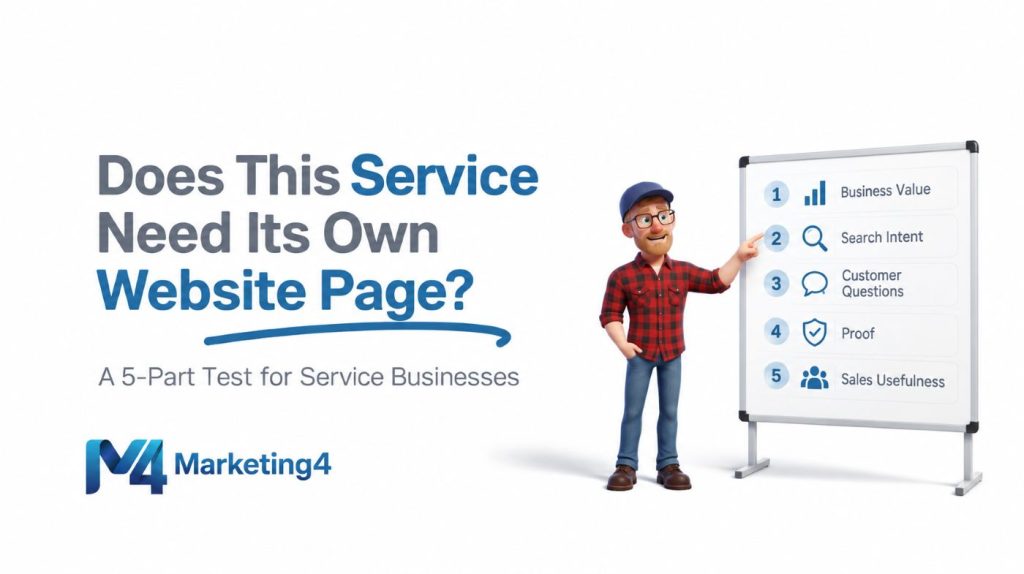
The M4 5-Part Service Page Test
1. Does This Service Matter to the Business?
Start with the business before you start with SEO.
Is this actually a service you want more of?
A business may offer something because an existing customer occasionally asks for it. That doesn’t necessarily make it a service worth actively marketing.
Think about the service’s:
- Revenue potential
- Profitability
- Typical project size
- Strategic importance
- Capacity
- Fit with your ideal customer
- Potential for repeat or related work
- Importance to where you want the business to go
Imagine a landscape contractor that offers full backyard transformations, pools, interlock, landscape lighting, garden bed edging, spring cleanups, and mulch installation.
All of those services are real.
But they probably don’t deserve equal weight on the website.
If the business wants $75,000 backyard projects, building a large portion of the website around $500 maintenance jobs doesn’t make much strategic sense just because those services technically exist.
This is something we think is often missed in SEO.
Search volume can tell you that people are looking for something.
It cannot tell you whether you should build your business around providing it.
A service page should support the direction of the business, not simply chase whatever keyword an SEO tool happens to find.
2. Do Customers Search for This as Its Own Service?
Next, move from the business’s perspective to the customer’s.
Would a potential customer actually think about this as a separate service?
More importantly:
How would they describe it when they search?
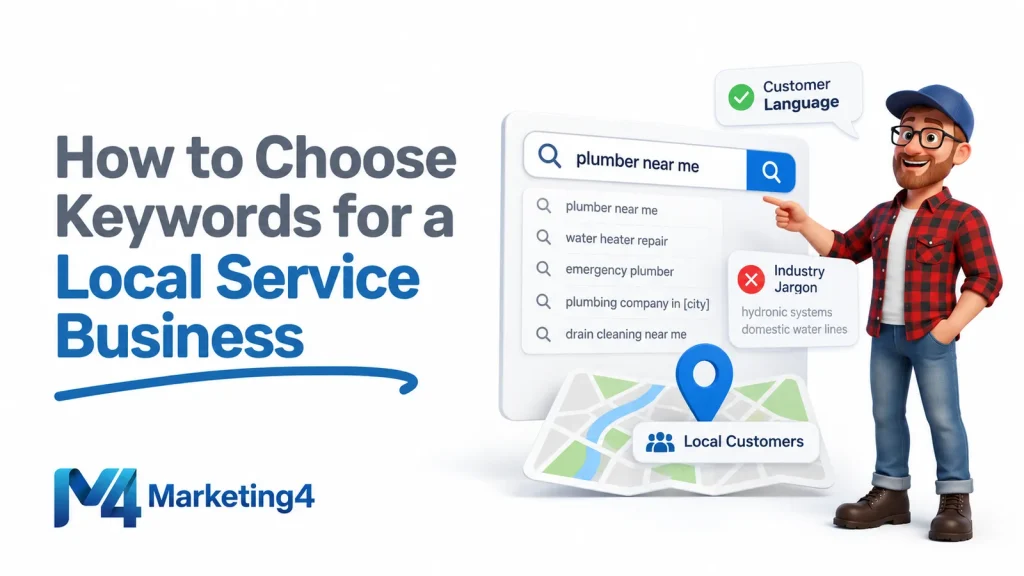
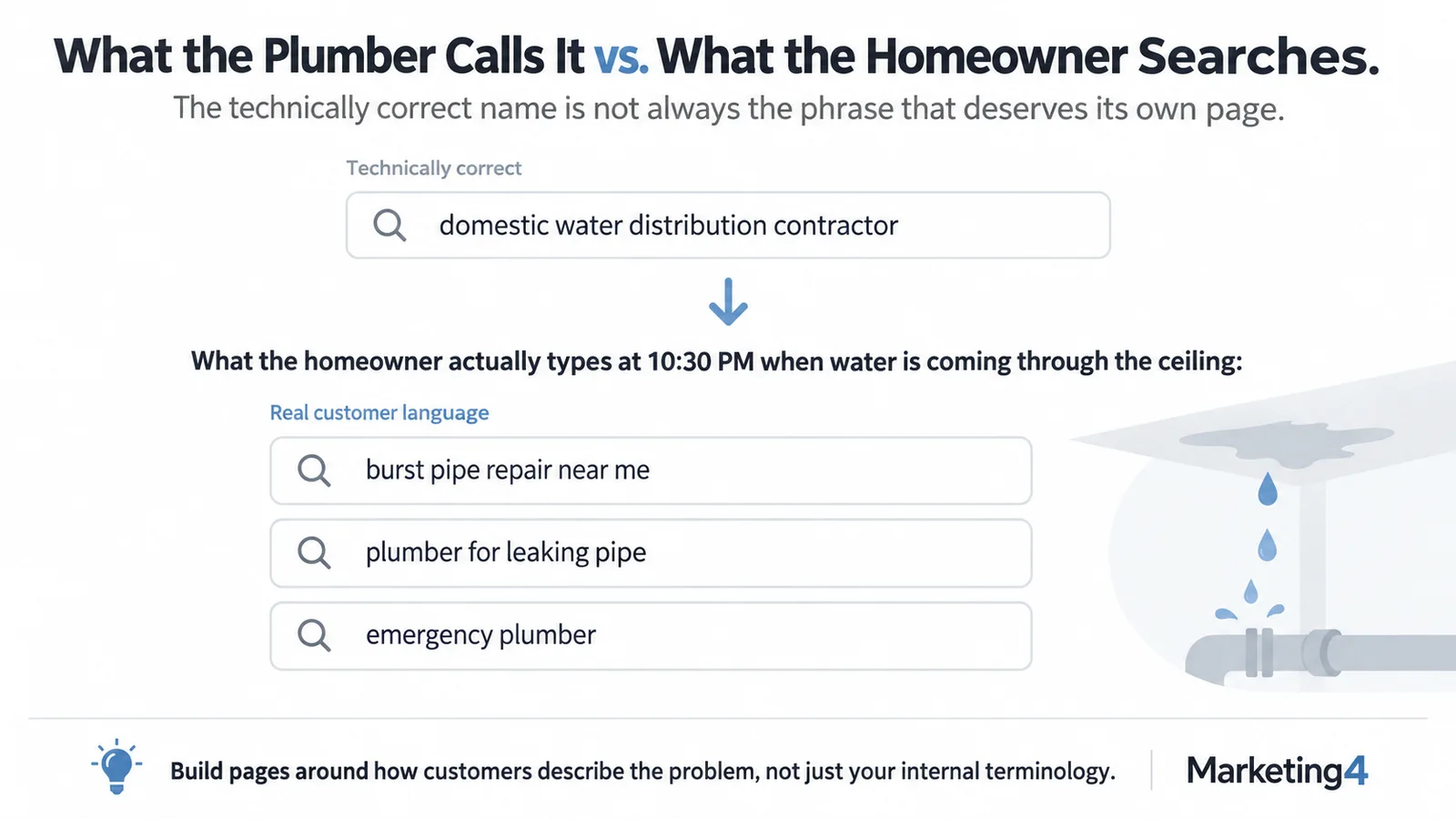
Businesses often use language that makes perfect sense inside their industry but means very little to the average customer.
A plumber may think in terms such as domestic water distribution, sanitary piping, fixture replacement, drainage systems, or backflow prevention.
Those terms can be technically correct.
But imagine a homeowner standing in their kitchen with water coming through the ceiling.
They probably aren’t reaching for their phone and searching:
domestic water distribution contractor
They’re much more likely to search something like:
- plumber for leaking pipe
- burst pipe repair
- emergency plumber
- water leak plumber near me
The same thing happens with other problems.
The plumber might think of a job as sanitary drainage service.
The homeowner might type clogged drain plumber.
The plumber might call the work fixture replacement.
The homeowner might search toilet replacement or install new kitchen faucet.
This doesn’t mean you should eliminate proper industry terminology from your website.
Technical language can demonstrate expertise, help explain the work properly, and may be exactly what a commercial buyer, engineer, general contractor, facility manager, or other knowledgeable customer searches for.
The point is to understand your particular customer.
For a residential service business, the language your technicians use internally may be very different from the words homeowners type into Google.
For a specialized B2B contractor, the technical term may be exactly what the customer uses.
You need to know the difference.
This is one reason keyword research and SEO should be part of website planning.
Keyword research isn’t just about finding high-volume keywords. It can help you understand the language customers use, whether two terms represent the same intent, and whether a service really has enough distinct search behaviour to justify its own page. Our guide to choosing keywords for a local service business shows how to approach that research without chasing search volume for its own sake.
A simple question to ask is:
If I needed this service but didn’t work in my industry, what would I type into Google?
That question can be surprisingly revealing.
Search Intent Matters More Than Slightly Different Keywords
Different keywords don’t always mean different pages.
Someone searching:
plumber for clogged drain
and
clogged drain repair
may be using different words, but they are probably looking for essentially the same thing.
You don’t need two nearly identical pages just because an SEO tool shows two keyword variations.
The opposite can also happen.
An electrician may see electrical work as one broad category, while customers searching for:
- EV charger installation
- electrical panel upgrade
- backup generator installation
are trying to solve three very different problems.
Those searches can involve different questions, different budgets, different proof, and different buying decisions.
That is meaningful search intent.
And that is a much stronger reason to create individual service pages.
3. Does the Customer Need Different Information to Buy This Service?
Now forget Google for a minute.
Would someone buying this service need information that is meaningfully different from your other services?
Consider an electrical contractor.
Someone looking for an EV charger installation might want to understand:
- Whether their existing electrical service has enough capacity
- Level 1 versus Level 2 charging
- Charger location
- Cable length
- Electrical panel capacity
- Permitting
- Installation process
- Whether a panel upgrade could be required
Someone looking for a backup generator has a completely different set of questions.
Even though both services involve electrical work, they represent different customer decisions.
That makes separate pages useful beyond SEO.
This is where understanding the customer journey becomes important.
A strong service page should help someone move from:
I think I need this.
to:
These people understand what I need, they’ve done it before, and I feel comfortable contacting them.
If two services require substantially different information to create that confidence, separating them often makes sense.
If you would simply copy the same page, change the service name, and rewrite a few sentences, that’s a warning sign that they might not need separate pages.
4. Do You Have Enough Expertise and Proof to Support the Page?
A service page should do more than say:
We provide high-quality service with great customer service. Contact us today for a free quote.
That sentence could be placed on almost any contractor’s website.
If you’re going to create a page specifically about a service, use the opportunity to prove that you actually know something about it.
Depending on the service, that might include:
- Relevant projects
- Before-and-after photos
- Technical expertise
- Certifications or qualifications
- Common problems you’ve encountered
- Customer questions
- Your process
- Equipment or methods you use
- Relevant case studies
- Testimonials from customers who purchased that service
- Decisions customers need help making
This is where good website architecture starts contributing to genuine authority.
A service page explains what you do.
Related articles demonstrate what you know.
Case studies prove you’ve actually done it.
Those pages can then link together.
For example, if a landscaping company has a dedicated pool installation page, that page might link to completed pool projects and helpful articles about pool installation timing, backyard design, costs, access requirements, or choosing surrounding hardscape.
Now you aren’t simply creating more pages.
You’re building depth around a subject.
That’s a much healthier approach to topic authority than publishing dozens of disconnected articles because an SEO tool produced a list of keywords.
5. Would You Actually Send This Page to a Customer?
This may be our favourite test because it strips away a lot of SEO theory.
Imagine a prospective customer calls tomorrow asking about this service.
Would someone on your team ever say:
“I’ll send you a link that explains how we handle that.”
If the answer is yes, that’s a very good sign the page has a real purpose.
A useful service page can support sales before and after the first conversation.
A salesperson can send it after a phone call.
An estimator can send it before a site visit.
A referral partner can send someone directly to the relevant service.
An existing customer can forward it to someone they know.
A prospect can discover it through Google and understand the service before ever contacting you.
This is what we mean when we say a website should become part of the sales system.
The page isn’t valuable because it exists.
It’s valuable because it helps someone make a decision.
So, How Many Tests Does a Service Need to Pass?
We wouldn’t turn this into a rigid mathematical score.
There will always be judgment involved.
But as a practical guide:
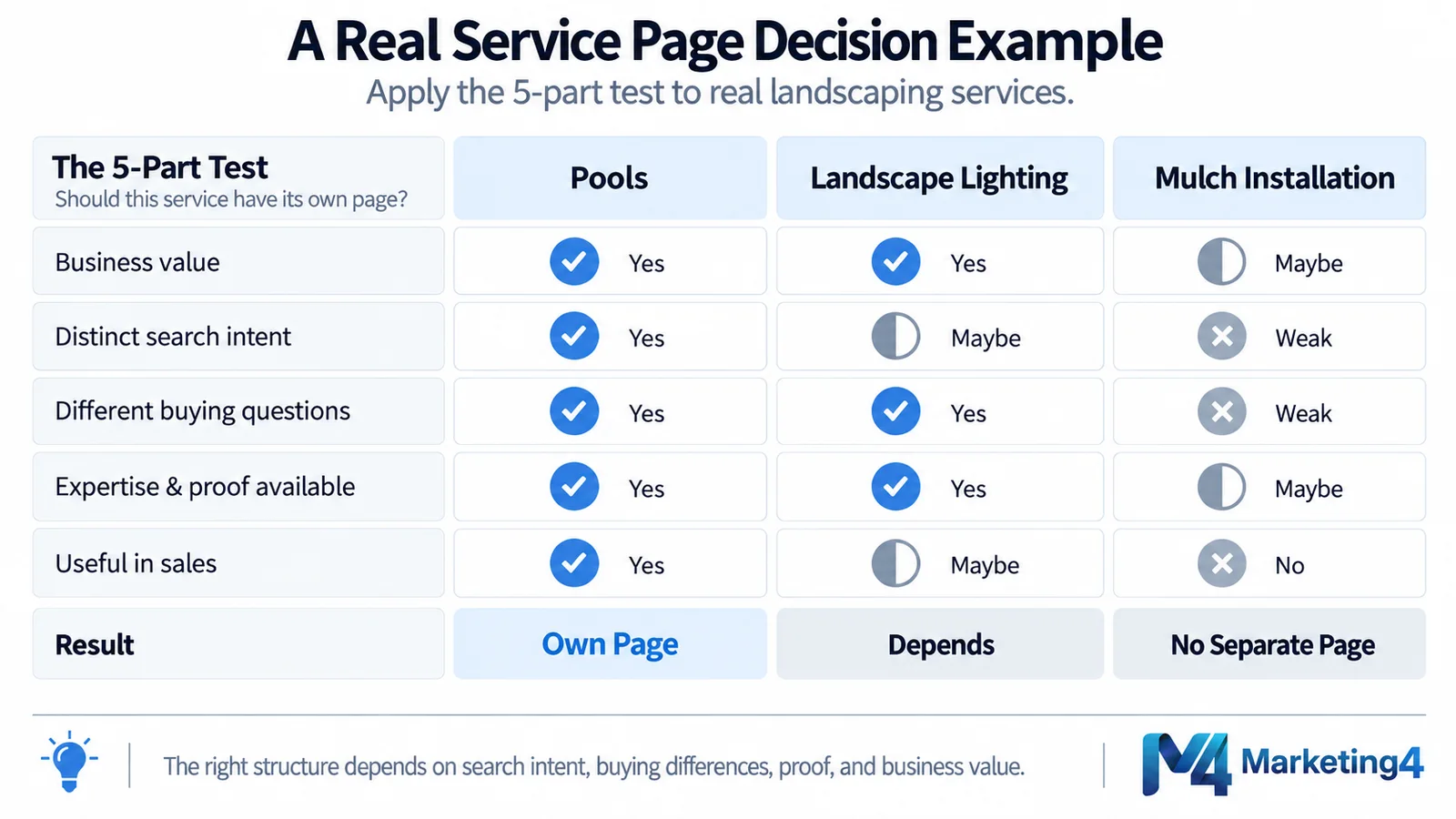
If you have strong answers to four or five of these questions, the service probably deserves serious consideration for its own page.
If only two or three are true, the service may belong as a substantial section on a broader service page instead.
If you can barely answer yes to one, creating a standalone page is probably unnecessary.
The important part is the reasoning.
A very profitable specialty service with low search volume may still deserve a page because the page is incredibly useful in sales.
A heavily searched service may not deserve much attention if you don’t really want the work.
A technically distinct service may belong within a broader page because customers don’t see it as a separate buying decision.
There isn’t one rule that works for every business.
A Landscaper Example
Let’s make the test practical.
Imagine a landscape construction company offers:
- Landscape design
- Full backyard transformations
- Pools
- Interlock
- Outdoor kitchens
- Landscape lighting
- Grading
- Drainage
- Planting
- Mulch installation
- Garden edging
- Spring cleanup
- Pressure washing
Should that be 13 service pages?
Probably not.
Pools could easily deserve its own page. It’s a significant purchase, customers search for it independently, they have lots of questions, there should be substantial proof available, and a salesperson would absolutely send the page to a prospect.
Interlock could also make sense as an individual service. It has distinct search demand, project examples, customer questions, material choices, installation considerations, and significant revenue potential.
Landscape lighting depends on the company. If it is a meaningful standalone service the company wants to grow, perhaps it deserves a page. If it is normally just a small component of larger landscape projects, it might be better explained within those broader pages.
Mulch installation may be a legitimate service without needing a dedicated SEO page.
That isn’t an insult to mulch.
It simply means your website structure should reflect business priorities and customer buying behaviour.
Don’t Build a Page Just Because You Found a Keyword
SEO software can produce an almost unlimited number of keyword ideas.
That doesn’t mean you need an unlimited number of pages.
If you keep creating pages every time you discover another search phrase, eventually you can end up with:
- Multiple pages competing for essentially the same search
- Thin pages without much useful information
- Confusing navigation
- Repetitive content
- Services receiving disproportionate attention simply because keywords exist
- A website that no longer reflects how the business actually operates
More pages do not automatically equal more authority.
Useful depth is more important than page count.
This principle is part of the reason our Paladin Mechanical case study focused on six core service pages rather than creating a page for every individual HVAC task Paladin could possibly perform.
The services were mapped intentionally around the business and what customers were actually searching for.
That is the goal.
Your Service Pages Should Work Together
Once you’ve decided which services deserve their own pages, don’t treat those pages as isolated SEO landing pages.
Connect them to the rest of the website.
A strong service page might connect naturally to:
- Related services, where customers commonly need more than one type of work.
- Case studies and projects, to demonstrate that you’ve done the work before.
- Helpful articles, to answer deeper questions customers commonly ask.
- Location information, where geography genuinely matters and a local landing page serves a different search intent than the service page itself.
- Your About page or team expertise, where qualifications affect the buying decision.
And those pages should link back where useful.
This creates a website where someone can move naturally from understanding a service, to learning more about an important question, to seeing real proof, to contacting the company.
It also helps search engines understand the relationships between the subjects your business has genuine expertise in.
That is topic authority with a business purpose behind it.
Start With the Business, Then the Customer, Then SEO
We deliberately put SEO second in this process, not first.
Before deciding to create a service page, ask:
Do we actually want more of this work?
Then:
Does the customer see this as its own service or problem?
Then:
What words would that customer actually use to describe and search for it?
Then:
What do they need to understand before they’re comfortable hiring us?
Then:
Can we prove that we know what we’re doing?
Then:
Would this page actually help us sell?
SEO research can make those decisions better.
It shouldn’t make those decisions for you.
That’s an important distinction.
Key Takeaway
A service doesn’t deserve its own website page simply because your company offers it.
And it doesn’t deserve one simply because somebody found a keyword for it.
A strong service page sits at the intersection of three things:
The business wants the work.
The customer recognizes and searches for the service.
The page helps that customer make a buying decision.
When those things line up, an individual service page can become a valuable long-term asset. It can help you show up in search, demonstrate expertise, support sales conversations, connect to related content, and make it easier for the right customer to understand why they should contact you.
When they don’t line up, another page probably isn’t the answer.
Your website doesn’t need a page for everything you can do.
It needs strong pages for the things that matter.
Main Takeaways
- Don’t automatically turn your internal service list into your website sitemap.
- Prioritize services that matter to the future revenue, profitability, and direction of the business.
- Think about how customers describe the service, not just the technical terminology your industry uses.
- Different keywords only justify separate pages when they represent meaningfully different search intent.
- Give a service its own page when customers have different questions, concerns, or buying considerations.
- Use real experience, projects, photos, expertise, qualifications, and case studies to make service pages credible.
- Ask whether your sales team would genuinely send the page to a prospective customer.
- Don’t create pages purely because an SEO tool found another keyword.
- Connect service pages with relevant articles, case studies, related services, and other useful website content.
- A service page should support the business, the customer, and search visibility at the same time.