
TL;DR
The customer journey for local service businesses is usually not fast, flashy, or driven by gimmicks. Most people ask for referrals, search Google, check websites, look at reviews, compare a few companies, and then try to narrow the list down by removing businesses that seem risky or unprofessional.
That means your marketing needs to do more than just “get attention.” It needs to build trust quickly. Customers want to know that you offer the service they need, work in their area, have real experience, and seem like a safe choice. For local service businesses, strong marketing is really about credibility, clarity, and follow-up.
I think a lot of business owners are too close to their own business to clearly see the customer journey for local service businesses.
That is not an insult. It is just what happens when you do something every day for years. You stop thinking like a buyer and start thinking like an operator. You know your tools, your process, your terminology, your scheduling issues, your service area, your margins, and your competitors. Meanwhile, your customer knows almost none of that. They just have a problem, some anxiety, and a short list of companies they are trying not to regret calling.
That is why the customer journey for local service businesses matters so much. If you misunderstand how people actually shop for a plumber, electrician, mover, landscaper, builder, or repair company, your marketing starts drifting into fantasy. You end up building a website for yourself, not for the person trying to decide whether you seem credible enough to let into their home, onto their property, or into a high-value project.
And this is where service business marketing really separates itself from retail or ecommerce. People are not impulse-buying a pair of shoes or clicking “add to cart” because your button was orange instead of blue. They are trying to reduce risk. They are trying to avoid embarrassment. They are trying to make a choice they can defend to their spouse, their boss, or even just to themselves.
That is why service business marketing depends so heavily on trust, credibility, and EEAT: Experience, Expertise, Authoritativeness, and Trustworthiness. In practice, that means your marketing has to help people feel that you know what you are doing, that you do it often, that others trust you, and that calling you is unlikely to be a mistake.
Start Here: Shop for a Different Service Like a Normal Person
One of the easiest ways to understand the customer journey for local service businesses is to stop thinking like the owner of your business and start thinking like the buyer of somebody else’s.
If you own a plumbing company, ask yourself this: how would you go looking for an electrician?
You probably would not open ten tabs and study electrical code updates for two hours. You would do what most people do. You would ask someone you trust if they know anyone good. You would look at a few company websites. You would search Google. You would check reviews. You would scan photos. You would look for clues that the company is real, professional, local, and familiar with the kind of work you need done.
That little exercise is useful because it gets you out of your own head. It reminds you that customers are not carefully admiring your internal process map or your favorite industry wording. They are scanning for confidence. They are looking for reasons to keep you on the list, or reasons to quietly close your tab and move on.
What the Customer Journey for Local Service Businesses Usually Looks Like
Every market is a little different, and not every buyer follows the exact same path. Still, for most local service businesses, the pattern is surprisingly consistent.
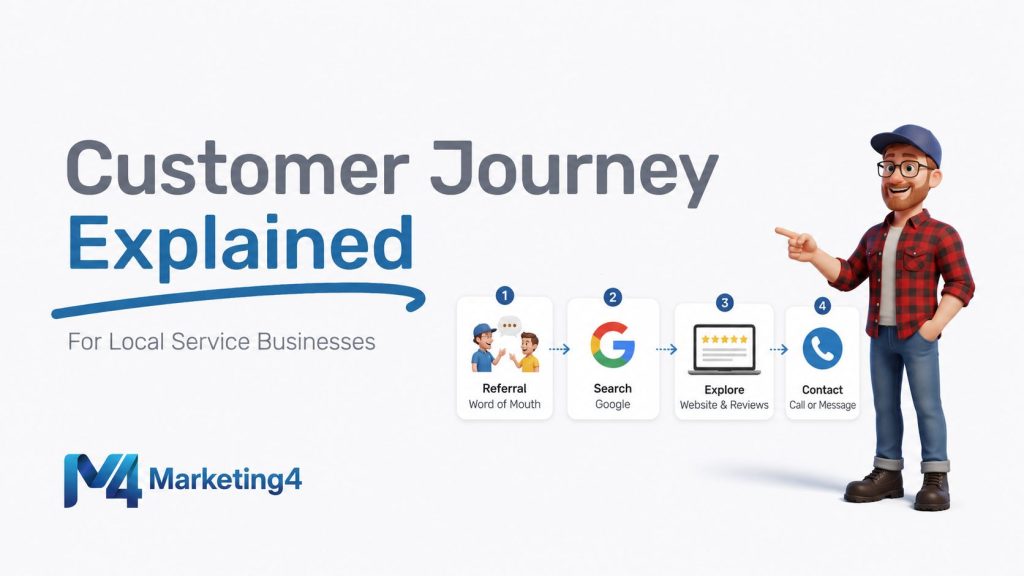
- They realize they have a problem, a need, or a project.
- They ask friends, family, coworkers, or neighbors for recommendations.
- They get one or two names from referrals.
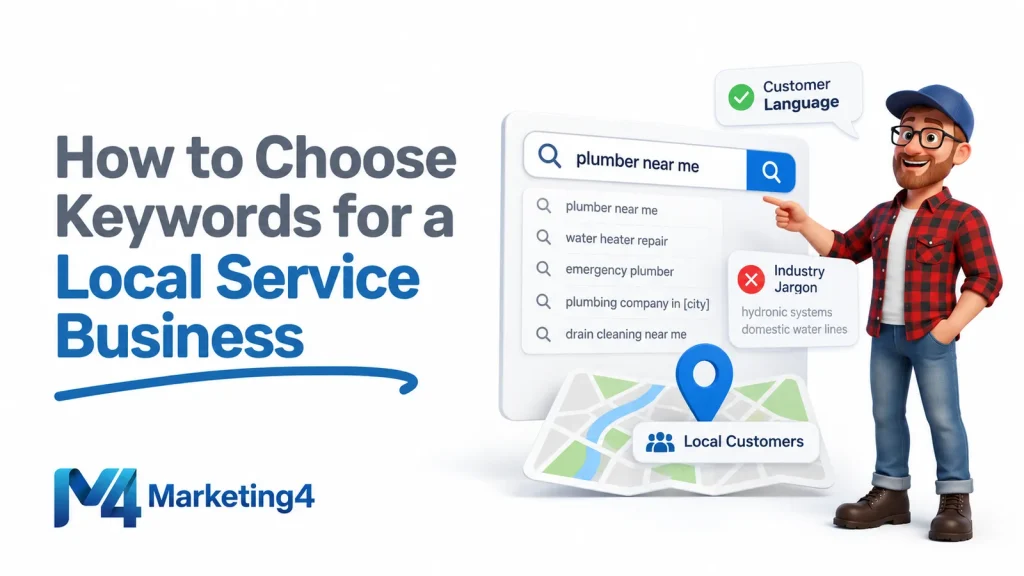
- They search Google for something like “plumber near me,” “best landscaper in Hamilton,” or “electrician for panel upgrade.”
- They look at both websites and Google Business Profiles.
- They open a handful of tabs, often three to five companies.
- They do a quick scan of each one.
- They narrow the list down to a shortlist.
- They contact one company first, or two to three if the project is larger.
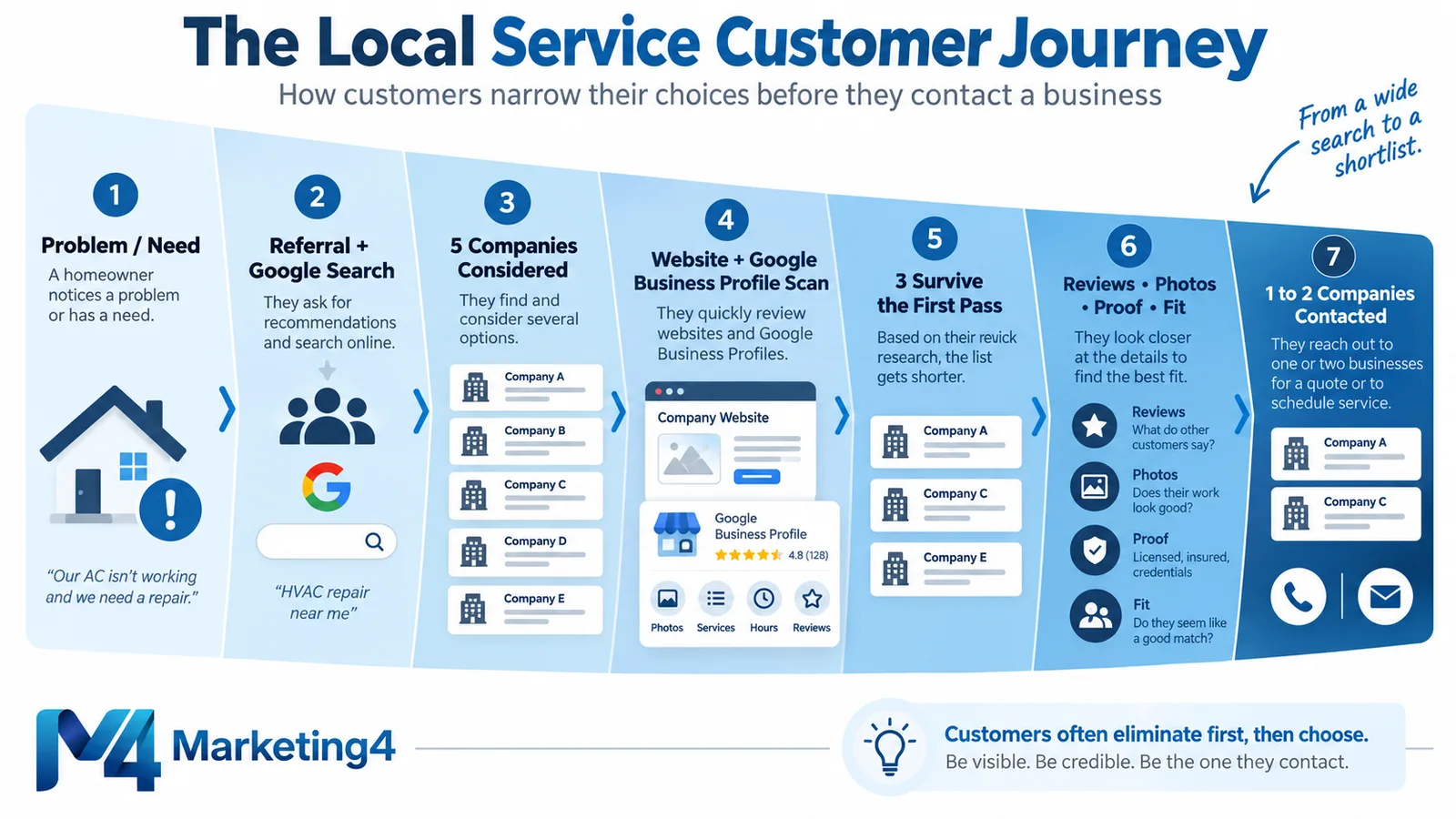
That is the broad version. The more important part is what is happening inside each step.
The First Pass Is Fast
When someone first lands on your website, they are not usually reading every word. They are triaging.
They want two basic questions answered almost immediately:
- Do you provide the service I am looking for?
- Do you provide that service in my area?
If those answers are not obvious, a lot of people will leave before they ever get to your carefully written “About” page or the nice paragraph you wrote about craftsmanship.
This is one reason why website strategy for service businesses is different from website strategy for product businesses. A service business site has to reduce uncertainty quickly. It has to make the visitor feel oriented. Clear service pages, obvious locations, straightforward navigation, and useful proof points matter more than clever design flourishes.
Not every service needs its own page, though. The strongest service pages are the ones that reflect a distinct customer need, buying decision, and business priority. Our 5-part service page test explains how to decide which services deserve a dedicated page.
I am not saying design does not matter. It absolutely does. But design in this context is not art for art’s sake. It is communication. It is the difference between “this company seems legitimate” and “I am not quite sure what these people even do.”
People Are Usually Trying to Disqualify You
This is the part many owners miss.
They assume their website’s job is to persuade people to choose them. And yes, that is part of it. But before that happens, the customer is usually doing something more defensive. They are trying to disqualify companies from the list.
That means they are scanning for red flags.
They notice whether the site feels outdated or sloppy. They notice whether there are real project photos or obvious stock images. They notice whether the writing feels specific or generic. They notice whether reviews seem recent. They notice whether your service area is vague. They notice whether your contact info is easy to find. They notice whether your company looks established, organized, and normal.
Normal matters more than people think.
Most customers are not looking for a magical brand experience. They are looking for competence without chaos. They want to feel that you have done this before and that hiring you will not create a weird side quest in their life.
That is also why things like your Google Business Profile, responding to Google reviews, and having clear explanations of your services are not “extra marketing stuff.” They are trust infrastructure.
Google Business Profile Is Part of the Journey, Not a Side Note
A lot of owners still treat Google Business Profile like a little directory listing that sits off to the side while the real marketing happens somewhere else. I do not think that is the right way to look at it.
For many local service businesses, your Google Business Profile is one of the first serious checkpoints in the customer journey for local service businesses. In some cases, it is more important than your homepage on the first pass.
Why? Because it helps people answer practical trust questions very quickly:
- Are you nearby?
- Do you have good reviews?
- Do you look active?
- Do your photos seem real?
- Do you respond to customers?
- Does your category and service offering make sense?
If you want to understand why this matters, read Google’s own guidance on improving local ranking and the guidelines for representing your business on Google. Those are not abstract documents for marketers to argue about. They are practical clues about how Google wants local businesses to present themselves.
Reviews Do More Than Boost Visibility
Business owners often talk about reviews as if they are only an SEO factor. That is too narrow.
Reviews matter because they help people justify their decision.
Remember, customers are emotional and ego-driven. That is not me insulting anyone. It is just reality. People do not want to feel foolish. They do not want to pick the company that turns out to be unresponsive, careless, overpriced, or unpleasant. So when they read reviews, they are looking for reassurance that other people already took the risk and survived just fine.
Better than fine, ideally.
They are looking for specifics. Did the company show up on time? Did they communicate well? Was the workmanship solid? Did they clean up? Were they professional? Did they stick to the quote? Would the customer use them again?
That is one reason review strategy should be an ongoing business habit, not a once-a-quarter scramble. If you want more perspective on that, our article on why you need to respond to Google reviews is worth reading.
Low-Value Service Calls and High-Value Projects Behave Differently
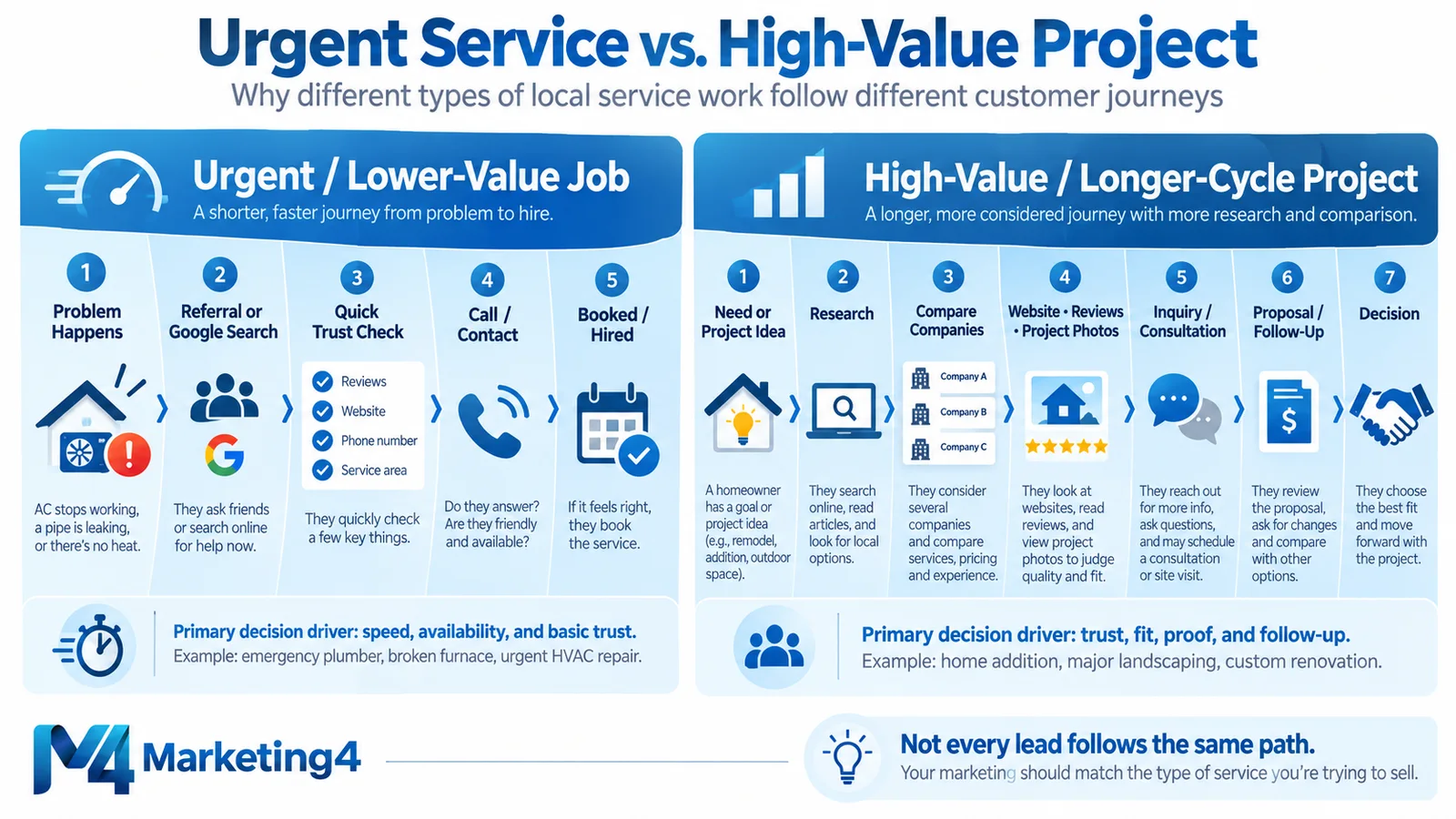
This is where the customer journey for local service businesses branches a bit.
If the customer needs a one-time, lower-value service, like a simple plumbing repair, a garage door fix, an appliance repair, or routine HVAC maintenance, they are often moving fast. In that situation, speed and availability matter a lot. They may call the first credible company on the list. If nobody answers, they move on. Not next week. Not after reflection. Immediately.
And here is the brutal part: for that particular need, they often do not come back.
That means missed calls are not just missed calls. They are often lost revenue that quietly chose somebody else.
Now compare that to a larger, longer-cycle service like a renovation, custom home project, landscape construction job, commercial build, or more involved moving contract. In those cases, the customer usually expects to speak with more than one company. They are more willing to fill out a form, leave a message, book a site visit, or schedule a consultation. They are already more invested at that point because they have spent time qualifying you. For those higher-value projects, the proposal itself becomes part of the buying experience, not just a price document.
In other words, the first journey is speed-sensitive. The second is trust-sensitive and follow-up-sensitive. Both matter, but they are not the same.
Your Website Is a Pre-Meeting
I think this is a useful way to frame it.
For a service business, your website is often a pre-meeting. It is the digital version of someone forming an impression before they ever speak to you.
So what are they looking for in that pre-meeting?
- Professionalism
- Clarity
- Evidence of real experience
- Relevant services
- Past projects or examples
- Signs that you understand their type of job
- Proof that other people trust you
- An easy next step
This is also why “flashing button” marketing rarely works very well for serious service businesses. The issue is not whether the button color is technically more clickable. The issue is whether the customer feels comfortable taking the next step with you.
That is a trust problem, not a gimmick problem.
EEAT Is Not Just an SEO Acronym
A lot of people hear EEAT and mentally file it under “Google stuff.” That is understandable, but incomplete.
Yes, Google’s own documentation around helpful, reliable, people-first content and broader discussions of EEAT are relevant for search visibility. But even if search engines did not exist, the principle would still matter for service businesses.
Experience means people want to see that you have done this work before. Expertise means they want to feel that you know what you are talking about. Authoritativeness means your business looks established enough to take seriously. Trustworthiness means the whole package feels credible and safe.
That is not just ranking theory. That is buying psychology.
If you post real project photos, explain services clearly, show the areas you serve, earn strong reviews, answer customer questions honestly, and write content that sounds like it came from someone who actually understands the work, you are not just doing SEO. You are aligning your marketing with how normal people decide who seems like the right fit.
If you want a simple companion read on that idea, our article on what SEO is for local business owners and our page on SEO for local businesses both help frame this in practical terms.
What This Means for Your Marketing
Once you understand the customer journey for local service businesses, your marketing decisions get a lot clearer.
You stop asking, “What trendy tactic should we try next?” and start asking better questions:
- Is it obvious what we do?
- Is it obvious where we do it?
- Do we look credible at a glance?
- Do we have enough proof to survive the disqualification phase?
- Can people contact us easily?
- Do we answer quickly enough for urgent jobs?
- Do we follow up well enough for larger opportunities?
That is a much healthier way to think about marketing.
It also helps explain why good marketing for local businesses usually includes a mix of things working together: a solid website, local SEO, an active Google Business Profile, review generation, and a clear sales process with thoughtful follow-up. Not because marketers like making life complicated, but because the customer journey itself has multiple checkpoints.
That is exactly why pages like Lead Generation & Funnels, Google Business Profile for Local Businesses, and Marketing Strategy for Local Businesses matter. They are not separate little marketing toys. They support different moments in the same decision-making process.
A Simple Exercise for Business Owners
If you want to get practical with this, try this exercise this week.
Pick a service you do not offer, but that is similar in seriousness to your own. Again, if you are a plumber, pretend you need an electrician. If you are a landscaper, pretend you need a roofer. If you are a builder, pretend you need a moving company for a complicated relocation.
Then do what a customer would do:
- Search Google.
- Open five tabs.
- Look at each homepage for ten seconds.
- Check their Google reviews.
- Look for project photos.
- Notice what makes you trust one company more than another.
- Notice what makes you leave.
You will learn more from that exercise than from a surprising amount of generic marketing advice.
Why? Because it forces you to feel the decision instead of just theorizing about it.
The Real Takeaway
The customer journey for local service businesses is not usually flashy. It is not built on gimmicks. It is not a magic funnel where strangers become buyers because of one clever headline.
It is usually much more human than that.
People ask around. They search. They compare. They scan. They get cautious. They look for proof. They narrow the list. Then they contact the company that seems easiest to trust.
That is the real game.
So if you own a local service business and your marketing feels scattered, step back and ask a more grounded question: if I were the customer, trying to hire a company like mine, what would I need to see to feel confident?
That question will often take you further than a hundred trendy marketing tips.
And if you want to keep exploring this topic, I would suggest reading Service Business Marketing Explained, Website Strategy: Service Business vs. Product Business, and 3 Marketing Musts for Local Service Businesses. Those pieces connect nicely with this one and help turn the idea into action.
Remember:
- The customer journey for local service businesses is based more on trust and risk reduction than impulse buying.
- Most customers ask for referrals, search Google, check reviews, and compare several companies before reaching out.
- Your website needs to answer two questions quickly: what do you do, and where do you do it?
- People are often trying to disqualify companies, not immediately choose one.
- Your Google Business Profile, reviews, photos, and overall professionalism all shape whether you make the shortlist.
- Lower-value service calls often go to the first credible company that answers the phone.
- Higher-value projects usually involve a longer decision process and multiple consultations.
- EEAT matters because customers want proof that you are experienced, credible, and trustworthy.
- One of the best ways to understand your customer journey is to shop for a similar service yourself and observe how you make decisions.