
Listen to a podcast from NoteBookLM on this content:
Watch a video from NoteBookLM on this content:
High-end proposals are not just prettier estimates. For contractors and premium service businesses, they are decision tools that help serious buyers understand the project, feel understood, compare options, reduce uncertainty, and move forward with more confidence.
TLDR
A high-end client usually does not need a proposal to prove that your company is basically competent. By the time you are preparing a full proposal, you have likely already had several conversations, walked the property, answered questions, shown past work, and passed some level of trust.
The real job of the proposal is to show that you understood what the client said, what they meant, what they are worried about, and what kind of experience they are trying to create.
A strong high-end proposal should:
- Translate the client’s goals into a clear recommended direction
- Reduce uncertainty without overwhelming the client with every detail
- Present options in a way that helps the client make a decision
- Explain the investment without turning the proposal into a supplier invoice
- Show proof that is relevant to the specific type of project
- Make the next step feel simple, natural, and professional
Why High-End Proposals Matter More Than Most Contractors Realize
Most contractors treat a proposal like the final step in the estimating process.
They meet the client. They look at the site. They discuss the project. Then they go back to the office, price the work, write up the scope, attach the terms, and send over the number.
For simple jobs, that might be fine.
For high-end projects, it often falls short.
When a client is considering a six-figure landscape project, luxury renovation, custom home, major outdoor living space, or other premium service, they are not just asking for a price. They are trying to make a large, personal, expensive decision without feeling like they are about to make a mistake.
There is a difference.
By the time you are preparing a full proposal for a high-end client, you have probably already done a lot of the trust-building work. That proposal sits late in the customer journey, after the client has already researched, compared, and qualified your company. You have met with them. They have looked at your past projects. They have asked questions. They may have checked reviews, references, credentials, insurance, and experience.
At that point, the proposal is not starting the sale from scratch.
The proposal is where the client decides whether you truly understood them.
The best high-end proposals make the client think, “They understood what we meant.”
That feeling has real value.
A Quote Tells the Price. A Proposal Helps the Client Decide.
There is a difference between an estimate, a quote, and a proposal.
- An estimate says, “Here is roughly what this may cost.”
- A quote says, “Here is our price for this scope.”
- A proposal says, “Here is the project we believe you are trying to create, here is how we recommend approaching it, here is what is included, here are the options, here is the investment, and here is the next step.”
High-end clients need the third one.
Not because they are incapable of reading a line-item estimate. Many high-end clients are sophisticated buyers. Some are business owners, executives, professionals, developers, or experienced homeowners.
They can read numbers.
The issue is not intelligence. The issue is decision pressure.
A high-end project carries more risk than a small project. The client is not only thinking about the cost. They are thinking about disruption, regret, quality, communication, timeline, spouse approval, property value, guests, neighbours, family use, and whether the finished project will match what they pictured in their head.
A basic estimate does not help them process all of that.
A strong proposal does.
Premium Buyers Are Not Only Price-Sensitive. They Are Consequence-Sensitive.
Contractors often assume that if a high-end client hesitates, it must be because of price.
Sometimes it is.
But often, hesitation comes from uncertainty.
The client might be thinking:
- Will this be worth it?
- Will the finished project feel as good as we imagined?
- Will this company protect our property?
- Will the crew be professional?
- Will the project drag on?
- Will this become stressful?
- Will we regret not choosing a different company?
- Will this look impressive, but still tasteful?
- Will it feel like us?
This is where buyer psychology becomes useful.
People do not make large decisions in a perfectly rational spreadsheet-style way. Research around prospect theory and loss aversion has shown that people often weigh potential losses very heavily when making decisions under uncertainty.
For a high-end homeowner, the possible “loss” is not just the money.
It is the risk of regret. It is the risk of disruption. It is the risk of embarrassment. It is the risk of hiring someone who technically can do the work, but does not really understand the taste, restraint, and thought required for the project.
That is why high-end proposals need to reduce perceived risk.
Not by using pressure tactics. Not by exaggerating. Not by turning the proposal into a glossy sales brochure with empty luxury language.
The proposal should reduce risk by making the project feel clear, thoughtful, organized, personal, and professionally controlled.
The Most Powerful Proposal Line Is Not Always Spoken Directly
The proposal does not need to say, “We understand you.”
It needs to prove it.
There is a big difference between repeating the client’s words and interpreting the client’s goals.
A client might say:
“We want a bigger patio and better lighting.”
A basic proposal says:
“We will install a larger patio and landscape lighting.”
A stronger proposal says:
“The expanded patio creates a more natural gathering area off the main living space, while the lighting plan is designed to make the backyard usable and inviting in the evening without making the property feel overlit.”
The second version says much more.
It shows that you understand the function of the patio. It shows that you understand the mood they want in the evening. It shows restraint, taste, and judgment.
It shows that the project is not just about installing things.
Another client might say:
“We want more privacy.”
A basic proposal says:
“We will install privacy planting along the property line.”
A stronger proposal says:
“The planting strategy is intended to soften sightlines from neighbouring properties while preserving an open, estate-like feeling throughout the yard.”
That sentence recognizes the unstated tension inside the request.
The client wants privacy, but they probably do not want to feel boxed in. They want screening, but not a wall. They want comfort without making the yard feel closed off.
That is the art of high-end proposal writing.
You translate the client’s practical requests into the experience they are trying to create.
The Client Said One Thing. They Often Meant Another.
High-end proposal writing depends on listening for the desire underneath the request.
When a client says, “We want an outdoor kitchen,” they may mean, “We want hosting to feel easier.”
When they say, “We want low maintenance,” they may mean, “We do not want this project to become another chore.”
When they say, “We want it to look finished,” they may mean, “The property feels incomplete for the level of home we have.”
When they say, “We want better flow,” they may mean, “Right now, people do not naturally use the space the way we want them to.”
When they say, “We want something high-end, but not too flashy,” they may mean, “We want it to feel impressive without looking like we are trying too hard.”
The proposal should reflect these deeper goals, but carefully.
You do not write, “You want to impress your friends.”
You write:
“The design creates a stronger sense of arrival and gives the entertaining areas a more intentional, finished feel.”
You do not write, “You do not want the neighbours looking at you.”
You write:
“The planting layout improves privacy in the key seating areas while keeping the overall space open, soft, and natural.”
You do not write, “You want people to know this was expensive.”
You write:
“The material selections are intended to create a timeless, refined look that fits the quality of the home without feeling overdesigned.”
High-end language should have restraint.
The goal is not to flatter the client. The goal is to show judgment.
High-End Proposals Should Confirm the Conversations That Came Before Them
A high-end proposal should not feel like it appeared out of nowhere.
It should feel like the natural conclusion of every conversation that came before it.
If the client mentioned privacy three times, privacy should not appear as one small line item buried under “planting.” The proposal should explain how privacy is being handled, where it matters most, and how the solution fits the overall feel of the property.
If the client kept talking about hosting, the proposal should show how the layout supports hosting.
If they were worried about disruption, the proposal should explain how the work will be staged, how communication will be handled, and how the property will be protected.
This is where many proposals miss the mark.
The company did listen during the meetings. The estimator, designer, or owner may have understood the client quite well. But the final document does not always prove that understanding.
The proposal should make the meetings matter.
It should take the raw material from those conversations and turn it into a clear, thoughtful, professional recommendation.
Buyer Psychology Should Shape High-End Proposals
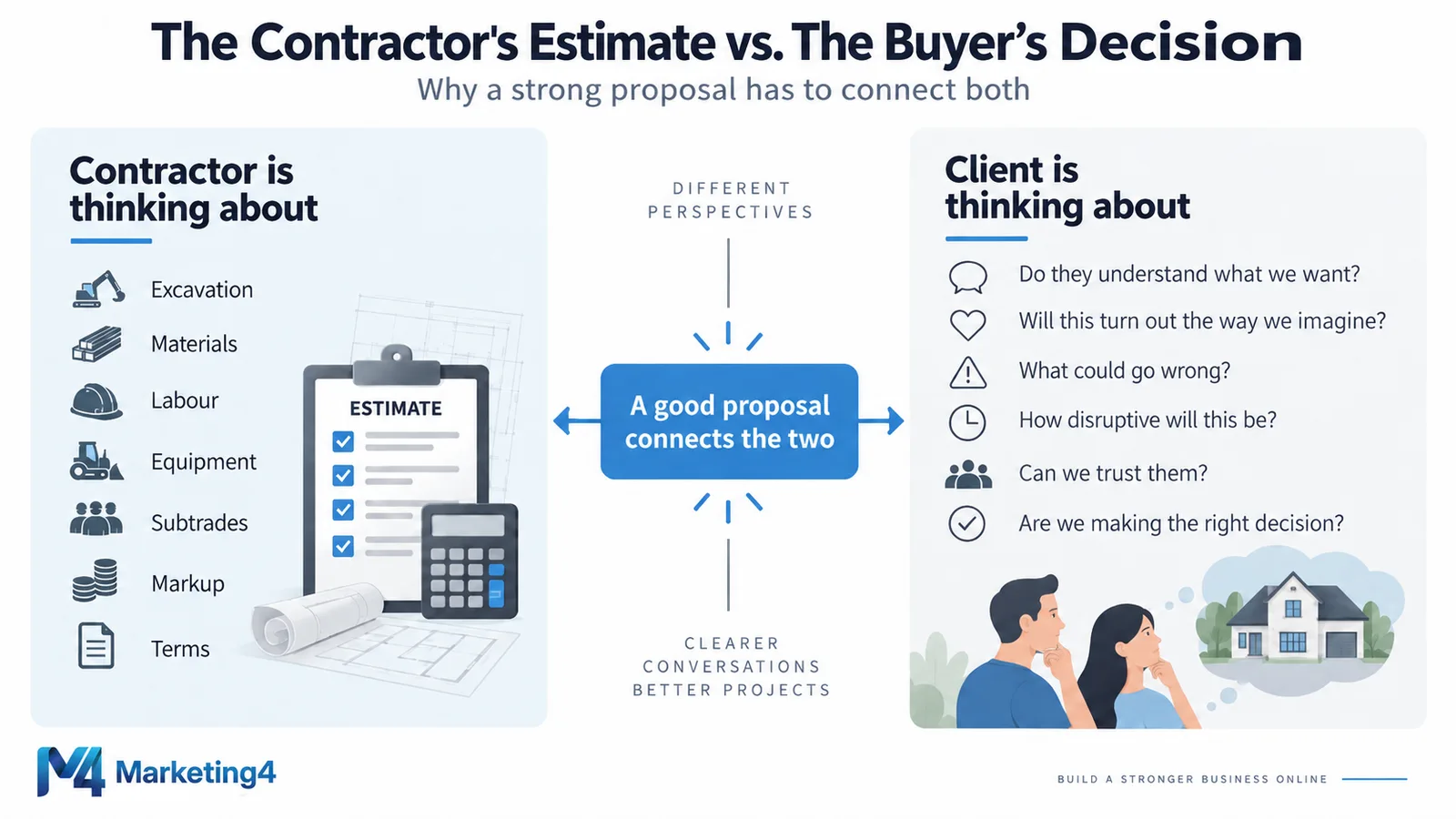
Most proposals are organized around the contractor’s internal process:
- Excavation
- Base preparation
- Framing
- Materials
- Labour
- Equipment
- Subtrades
- Markup
- Terms
Those items are important, but they are not how the buyer experiences the decision.
The buyer is usually moving through a different set of questions:
- Do they understand what we want?
- Does this version of the project feel right?
- Where is the money going?
- What could go wrong?
- How disruptive will this be?
- Can we trust the process?
- What decision do we need to make now?
A high-end proposal should be organized around the buyer’s decision, not just the contractor’s estimate.
That means the structure, language, visuals, pricing, options, and next steps should all reduce mental friction.
This is also why strong proposal strategy connects directly to broader marketing strategy for local businesses. Marketing does not stop when the lead comes in. The sales process, proposal experience, and follow-up process all affect whether good leads become good customers.
Make the Proposal Easy to Process
People tend to trust and prefer information that is easier to understand.
There is an entire area of psychology around processing fluency, which is a technical way of saying that ease of understanding can shape how people judge information.
In plain English, a messy proposal makes the buyer work too hard.
A clear proposal makes the decision feel more manageable.
This does not mean the proposal should be simplistic. It means it should be organized.
Use:
- Clear headings
- Short paragraphs
- Plain-English scope descriptions
- Useful photos
- Simple option tables
- A clean investment summary
- Clear assumptions and exclusions
- A straightforward next step
The goal is not to remove all complexity.
The goal is to make the complexity easier to navigate.
Do Not Overwhelm the Client With Every Possible Detail
There is a common mistake in construction and service businesses: assuming that more detail always creates more trust.
Sometimes it does.
But too much detail, presented in the wrong way, can create doubt.
A high-end client does not usually need to see every screw, pipe, fixture, plant, labour hour, disposal fee, and equipment charge in the main body of the proposal.
When you give them too many line items, you may unintentionally invite them to dismantle the project.
They start asking:
- Do we need this?
- Can we reduce that?
- Why is this so expensive?
- Can I buy that myself?
- What happens if we remove this part?
Now the conversation has shifted away from the overall outcome and into a cost-cutting exercise.
That does not mean you hide information.
It means you organize information at the right level.
The proposal should give client-level transparency, not supplier-level pricing.
For example, instead of this:
- Excavation: $14,250
- Grading: $6,800
- Compaction: $2,200
- Drainage pipe: $8,500
- Base material: $11,400
- Disposal: $4,900
You might present this:
Site Preparation and Infrastructure
Includes excavation, grading, base preparation, drainage planning, compaction, and disposal required to create a stable foundation for the finished work. This phase is designed to protect the long-term performance of the project and reduce the risk of settlement, water issues, and premature failure.
That is not vague. It is clear.
It tells the client what is included and why it matters.
If the client asks for more detail, you can provide a mid-level breakdown. But the main proposal should keep their attention on the decision they are actually trying to make.
Three Options Can Help, but Only if They Are Presented Properly
Offering three options can be one of the most effective strategies for high-end proposals.
Not because you are trying to trick the client.
Because options help the client understand the project.
When a client only sees one number, they have no context. They may wonder if the proposal is too high, too low, too basic, too elaborate, or missing something.
When you present a few thoughtful options, you help them see the trade-offs.
There is research around choice overload that is useful here. The practical lesson is not that clients want no choice. The practical lesson is that choices need to be structured well.
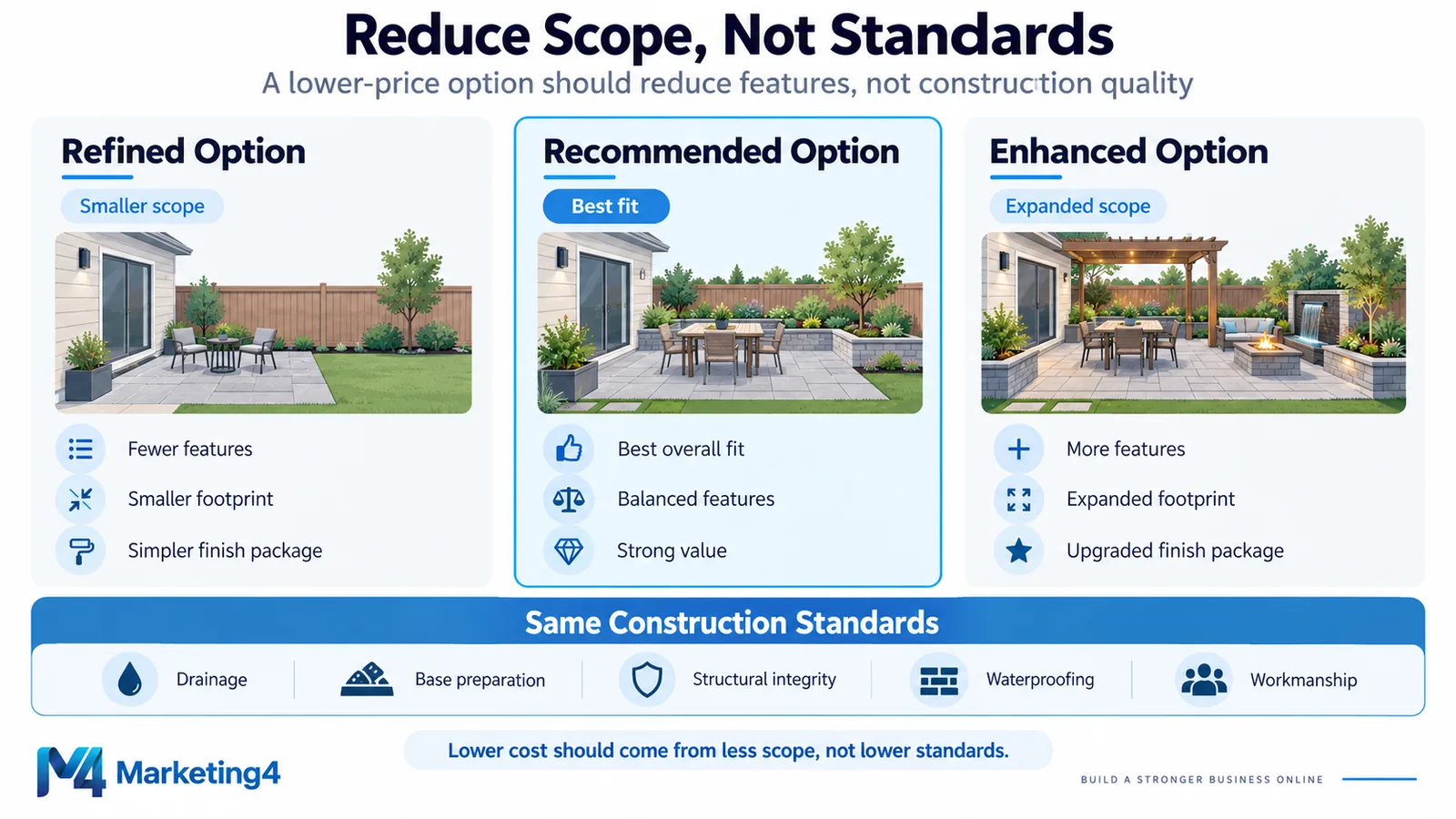
A strong three-option structure might look like this:
Option 1: Refined Scope
This is the simpler version. It still meets the main goals, still protects quality, and still reflects your professional standard.
It may reduce certain features, simplify finishes, delay non-essential items, or narrow the scope.
This should never be the “cheap” version.
Never reduce the quality of your construction method to hit a lower price. Do not cut corners on base preparation, waterproofing, drainage, structural work, safety, or anything that protects the long-term success of the project.
Option 1 should reduce scope, not standards.
Option 2: Recommended Scope
This is the version you believe best fits the client’s goals, budget, property, and desired experience.
This should be the main proposal.
If you are doing design work, concept sketches, visual layouts, renderings, or detailed scope development, this is where most of that effort should go.
The recommended option should feel like the thoughtful answer to everything discussed in the meetings.
You are not simply placing it in the middle. You are recommending it because you believe it is the best balance.
Option 3: Enhanced Scope
This is the premium version.
It may include better materials, additional spaces, upgraded lighting, more mature planting, automation, a more complete outdoor living experience, a maintenance package, or added features that would genuinely improve the result.
This option allows the client to see what is possible.
Even if they do not choose it, it can make the recommended option feel more grounded. It also gives the client permission to upgrade if they were already leaning that way.
You Do Not Need Full Drawings for Every Option
This is important.
Many companies avoid offering options because they assume each option needs a complete design package.
That can create too much unpaid work.
A better approach is to fully develop the recommended option, then explain the simpler and premium versions through written scope adjustments, upgrade notes, inspiration images, or allowance changes.
For example, Option 1 may say:
“This version keeps the main patio, walkway, privacy planting, and lighting plan, but removes the outdoor kitchen and simplifies the planting package to focus on key screening areas.”
Option 2 may include the full design direction, concept plan, materials, scope, and investment summary.
Option 3 may say:
“This version builds on the recommended scope by adding the outdoor kitchen, upgraded stone selection, integrated audio, expanded lighting zones, and more mature planting for a more finished first-year appearance.”
That keeps the decision clear without forcing your team to design three complete projects.
The Recommended Option Should Feel Recommended
A lot of companies present options without guiding the client.
They say:
“Here are three prices. Let us know what you want.”
That creates more work for the buyer.
The client is not hiring you to dump decisions back onto them. They are hiring you because you have experience, taste, judgment, and process.
So say what you recommend.
Not aggressively. Not arrogantly. Calmly.
For example:
“Based on our conversations, we believe Option 2 is the strongest fit. It achieves the outdoor living experience you described, addresses the privacy and flow concerns, and keeps the project focused on the spaces your family is most likely to use. Option 1 is a strong alternative if you would prefer to phase the work, while Option 3 reflects the more complete version of the property improvement.”
That kind of guidance helps the client.
It gives them room to choose, but it does not abandon them in the decision.
The Proposal Should Feel High-End Before the Client Reaches the Price
A high-end proposal needs to look professional.
Design matters. Layout matters. Photos matter. Typography matters. White space matters.
The proposal should not look like it was thrown together in a rush.
But premium presentation is not the same as flashy presentation.
A high-end proposal should feel calm, organized, and intentional.
Use:
- Strong project photos
- Clean section headings
- Plain language
- Enough white space
- Simple tables
- Useful captions
- A restrained design style
Avoid:
- Clutter
- Cheesy luxury language
- Stock images that do not match your work
- Design that screams for attention
- Generic proposal templates that could belong to anyone
The proposal should visually communicate the same qualities the client wants in the finished project: taste, order, care, professionalism, and restraint.
If the proposal looks chaotic, the client may wonder if the project will feel chaotic.
If the proposal looks generic, the client may wonder if their project is being treated as generic.
If the proposal looks thoughtful, the client is more likely to believe the process will be thoughtful.
The Opening Should Show Interpretation, Not Hype
Many proposals open with a generic company introduction.
“We are pleased to provide this proposal for your project. Our company has been serving the area for 20 years and takes pride in quality workmanship.”
There is nothing wrong with that, but it does not do much.
The beginning of a high-end proposal should make the client feel like the document was written for them.
For example:
“After walking the property and discussing how your family wants to use the backyard, our recommendation focuses on creating a more natural connection between the home, pool area, and lower lawn. The goal is to make the space feel more intentional and comfortable for everyday use, while still giving you a polished setting for hosting family and friends.”
That opening proves you listened.
It also frames the project around the client’s life, not your company’s resume.
You can still include company credibility later. But the first page should usually be about the client, the property, and the vision.
The Scope Should Be Written in Plain English
A proposal needs enough technical accuracy to be useful, but it should not read like an internal estimating sheet.
Most clients do not want to decode trade language.
They want to understand what is happening, why it is included, and how it affects the outcome.
Instead of:
“Install 200 LF of perforated drainage pipe with granular backfill.”
You might write:
“Drainage improvements are included to move water away from the main patio and planting areas, helping protect the finished surfaces and reduce long-term water issues.”
Instead of:
“Excavate and install compacted granular base.”
You might write:
“The patio areas will be built on a properly prepared base to support the finished stonework and reduce the risk of settlement over time.”
Instead of:
“Install low-voltage fixtures.”
You might write:
“The lighting plan is designed to make the space comfortable and usable in the evening, with subtle illumination for key pathways, gathering areas, and feature planting.”
You can still include technical notes where required.
But the main proposal should translate the work into client meaning.
Risk Reducers Belong in High-End Proposals
High-end clients often worry about things they may not say out loud.
They may worry about crews damaging the property. They may worry about delays. They may worry about change orders.
They may also worry about communication, disruption, neighbours, family routines, or whether the project will be professionally managed once the deposit is paid.
A good proposal addresses those concerns before they become objections.
Project Communication
Explain how updates will be handled. Weekly emails, scheduled site meetings, a dedicated project manager, shared photos, or progress milestones can all help.
Site Protection
Explain how access, staging, dust, cleanup, landscaping protection, driveway protection, and neighbouring properties will be managed.
Schedule and Phasing
Give a realistic schedule range, identify dependencies, and explain what can affect timing.
Allowances and Selections
Clarify what has been assumed, what still needs to be selected, and how upgrades or changes are handled.
Warranty and Aftercare
Explain what happens after the project is complete. High-end clients often care deeply about support after the final invoice.
Exclusions and Assumptions
Do not bury these in legal language. Make them clear, calm, and professional.
These sections are not just administrative. They reduce anxiety.
They tell the client:
“We have done this before. We know what can go wrong. We have a process to manage it.”
Social Proof Should Be Specific
Testimonials can help, but generic testimonials are weak.
A quote that says, “Great company, highly recommend,” is fine. But for a high-end proposal, specific proof is stronger.
People often look to the actions of others when they are uncertain, which is the basic idea behind social proof.
In a proposal, stronger proof might include:
- A similar project in a similar neighbourhood
- A project with a similar budget
- A client who had the same concern
- A before-and-after example showing the change
- A short case study explaining the problem, recommendation, and result
- A note about how your team handled a difficult site condition
High-end buyers want to know that people like them have trusted you with projects like theirs.
A testimonial from a small maintenance job will not carry the same weight as a short story from a complex, high-value project.
This is especially true in industries where the sales cycle is longer, such as marketing for contractors, marketing for landscapers, marketing for home builders, and marketing for construction companies.
In these industries, proof needs to feel relevant to the project being sold.
The Proposal Should Not Feel Like Pressure
Some sales advice pushes contractors to create urgency, scarcity, and aggressive next steps.
Be careful with that.
High-end clients usually do not want to feel cornered. They want clarity.
The next step should be simple, but not pushy.
Instead of:
“Sign today to lock in this price.”
Try:
“To move forward, the next step is to approve the recommended scope and provide the project deposit. Once approved, we will schedule the next planning meeting, confirm selections, and prepare the project timeline.”
Or:
“If you would like to refine the scope before approval, we recommend a follow-up meeting to review Options 1, 2, and 3 and confirm which direction best fits your goals.”
The close should feel like a continuation of the process, not a sudden sales move.
Do Not Just Email the Proposal and Hope It Sells Itself
For high-end work, the proposal should usually be presented.
That could be in person. It could be over video. The key is that you guide the client through the thinking.
If you simply email the PDF, the client reads it alone, possibly out of order, possibly while distracted, possibly starting with the price.
When you present it, you control the sequence:
- First, remind them of the goals.
- Then explain the recommended direction.
- Then walk through the major scope.
- Then show the options.
- Then explain the investment.
- Then outline the next step.
This allows the client to understand the proposal the way it was intended.
After you present the price, stop talking for a moment.
Many people rush to fill the silence because they are uncomfortable. That often weakens the price.
Present the investment calmly, then give the client room to process.
High-end buyers are allowed to think.
A Simple Framework for High-End Proposals
Here is a practical structure many contractors and premium service businesses can use.
1. Personalized Cover
Use the client’s name, project name, property name, or a tasteful project title. Avoid generic labels like “Estimate 2478.”
2. Project Vision
Summarize what the client is trying to create. Reflect both the stated goals and the implied goals.
3. Recommended Direction
Explain your professional recommendation in plain English.
4. Scope by Phase
Break the work into logical phases. Describe what is included and why it matters.
5. Options
Present a refined option, recommended option, and enhanced option when appropriate.
6. Investment Summary
Use clear categories. Avoid excessive line-item detail in the main proposal.
7. Assumptions and Allowances
Clarify what has been assumed and what decisions still need to be made.
8. Process and Communication
Show how the project will be managed.
9. Proof
Include relevant testimonials, similar projects, project photos, credentials, or short case studies.
10. Next Step
Make the next step clear, simple, and natural.
This structure works because it follows the buyer’s decision process, not just the contractor’s pricing process.
Where This Fits in the Bigger Sales Process
Many contractors spend a lot of money trying to generate better leads.
That can be valuable.
But there is often a major opportunity sitting later in the sales process.
If your company already gets good opportunities, already meets with qualified clients, already prepares serious proposals, and already has the ability to do high-quality work, improving the proposal experience can improve your close rate.
Not by manipulating people.
By helping the right clients feel more confident choosing you.
This is one reason proposal strategy should not be separated from lead generation, sales process, website messaging, and service business marketing.
A better lead matters. A better sales process matters too.
If the website creates interest but the proposal creates confusion, the business is still leaking opportunity.
Key Takeaways
- High-end proposals should be treated as decision tools, not just pricing documents.
- By the proposal stage, the client has often already done some level of vetting.
- The proposal’s deeper job is to prove understanding, not simply competence.
- Premium buyers are often consequence-sensitive, not just price-sensitive.
- The proposal should reflect what the client said and what they meant.
- Plain-English scope descriptions usually work better than trade-heavy language.
- Too much line-item detail can shift the conversation into cost-cutting.
- Three options can help when they are structured around real trade-offs.
- Option 1 should reduce scope, not construction quality.
- The recommended option should be clearly recommended.
- Specific proof is stronger than generic testimonials.
- The proposal should be presented whenever possible, not just emailed cold.
- The next step should feel clear, calm, and professional.
FAQs About High-End Proposals
What is the difference between a quote and a high-end proposal?
A quote usually gives a price for a defined scope. A high-end proposal does more than that.
It explains the project vision, recommended approach, major scope, options, assumptions, investment, proof, process, and next step. It helps the client understand the decision, not just the cost.
Should high-end proposals include detailed line items?
Sometimes, but not always in the main proposal.
For many premium residential projects, it is better to use client-level categories with clear descriptions. You can provide more detail if the client requests it, but too many line items can invite the client to dismantle the project piece by piece.
Should contractors present three options in a proposal?
Three options can work very well when they are presented properly.
A simple structure is refined scope, recommended scope, and enhanced scope. The important part is that each option must be legitimate, and the recommended option should be clearly explained.
Should Option 1 be a cheaper version of the project?
Option 1 can be lower cost, but it should not be lower quality.
The better approach is to reduce scope, simplify features, or phase non-essential items. Do not reduce important construction standards just to hit a lower number.
How much design work should go into each option?
Usually, the recommended option should receive the most design effort.
The simpler and enhanced options can often be explained through written adjustments, upgrade notes, inspiration images, or allowance changes. That keeps the proposal useful without creating three complete design packages.
Should a high-end proposal use the word “investment” instead of “price”?
“Investment” can work, but it should not feel forced.
Terms like “Project Investment Summary” or “Recommended Scope and Investment” often feel more professional than “Cost.” The key is not the word itself. The key is whether the proposal clearly connects the investment to the outcome, process, and value.
Should a proposal be emailed or presented in person?
For high-end projects, it is usually better to present the proposal in person or over video.
If the client reads it alone, they may start with the price, skip the reasoning, or misunderstand the options. A guided presentation helps them understand the recommendation in the right sequence.
How can a contractor make a proposal feel more high-end without making it flashy?
Use clean design, strong photos, simple headings, plain language, useful captions, clear pricing categories, and enough white space.
A high-end proposal does not need to be flashy. In many cases, restraint feels more premium than decoration.
What should the first page of a high-end proposal do?
The first page should make the client feel recognized.
Instead of starting with a generic company introduction, summarize the project vision and the goals discussed during the meetings. Show that the proposal came from real conversations, not a template.
Can better high-end proposals really improve close rate?
There is a fair case to be made that they can.
A better proposal will not fix bad leads, poor pricing, weak operations, or lack of skill. But if the business already does good work and is meeting with qualified prospects, a clearer and more buyer-focused proposal can help more of those prospects feel confident moving forward.
High-End Proposal Strategy Comes Down to Understanding
High-end proposals are a different ball game because the client is not buying a small task.
They are making a meaningful decision about their home, property, lifestyle, business, or long-term investment.
By the proposal stage, they probably already believe you can do the work. Now they need to believe you understood the assignment.
The strongest proposal does not simply say, “Here is what we will do.”
It says:
“We heard what you want. We understand what you are trying to create. We have organized the options. We have thought through the risks. We have a professional path forward. Here is the version of the project we recommend.”
That is how a proposal becomes more than a price.
It becomes a decision tool.
And for companies selling high-end services, that can be the difference between being considered and being chosen.