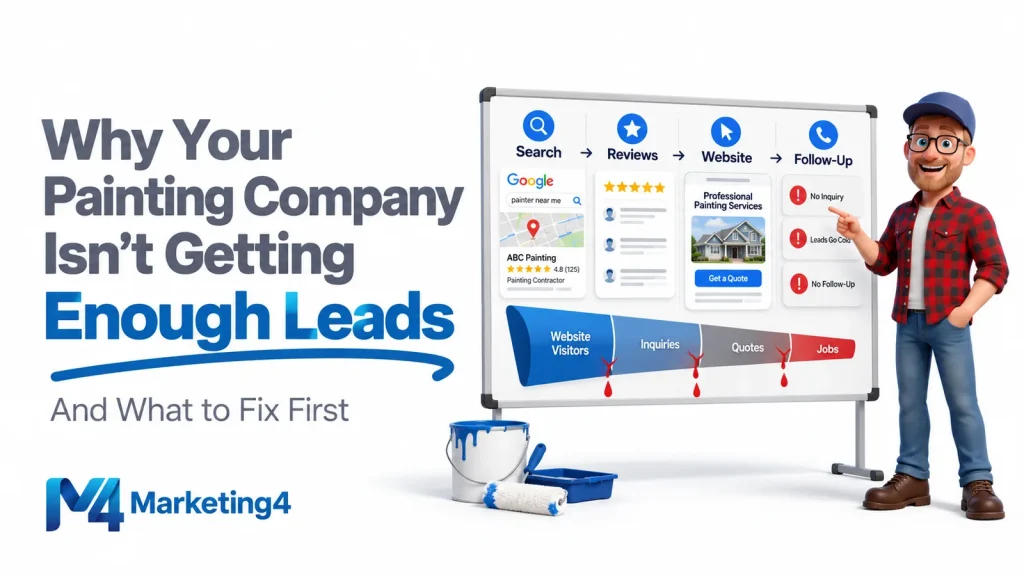

A painting company can do excellent work and still have an unpredictable calendar. One month the phone rings constantly. The next month, the owner is calling past customers, chasing estimates, and wondering whether to spend more money on advertising.
It is tempting to describe this as a lead-generation problem. Sometimes it is. But there is a difference between a business nobody can find, a business that attracts the wrong inquiries, and a business that receives good opportunities but fails to turn them into booked work. Spending more on ads can make all three problems more expensive without fixing any of them.
For residential and commercial painting contractors, there is another complication: not every job is worth winning. An inquiry for a small repair outside the service area has a different business value from a whole-home repaint or a recurring commercial maintenance account. A company that wants to grow needs enough profitable, suitable work, not merely an impressive number of form submissions.
If your painting company isn’t getting enough leads, start by working out where the opportunity is being lost. Then decide whether the answer is better visibility, a more convincing website, stronger local relationships, faster follow-up, or a different service focus. This article is a practical way to make that diagnosis. Our broader guide to painting company marketing, sales, and growth covers how these pieces fit into the entire business.
First, Decide What “Not Enough Leads” Actually Means
Owners often use the word leads to describe several different things. Keeping them separate makes the problem easier to solve.
Not enough inquiries
Very few potential customers are contacting you. Your business may be difficult to discover, competitors may be more visible, or you may be relying on referrals from a small group of people. This is the situation where additional marketing reach might genuinely be needed.
Enough inquiries, but not enough suitable projects
The phone rings, but the jobs are too small, too far away, outside your specialty, or focused entirely on finding the cheapest possible quote. A contractor wanting full interior repaints may be receiving requests to touch up a single wall. Someone trying to build commercial accounts may have a website that mostly attracts homeowners.
Generating more of these inquiries will add administrative and estimating work without necessarily producing enough revenue.
Good opportunities are arriving, but few turn into jobs
You receive worthwhile inquiries and visit properties, yet an unusually high share of estimates goes nowhere. The problem may be slow response times, vague proposals, weak trust signals, poor follow-up, unsuitable pricing, or a mismatch between what the customer expects and what you offer.
That is primarily a conversion or sales-process problem. Our article on building a sales process for trade businesses explains the broader process. For now, the task is simply to distinguish this problem from a shortage of demand.
Work Backward From the Jobs Your Painting Company Actually Needs
Before picking a marketing channel, decide how much new work you want and what kinds of projects will help you get there.
Imagine an owner with a small crew who would like to book four additional interior repainting projects each month. If the business historically wins one out of three qualified estimates, it needs roughly twelve suitable estimates to win those four jobs. If only half of inquiries are qualified and lead to an estimate, the business might need approximately twenty-four inquiries.
Those numbers are an illustration, not an industry benchmark. The contractor should replace them with its own actual conversion rates.
Now imagine the same owner hires another crew. It is easy to say the business needs twice as many leads. But what if the additional crew is intended for larger commercial projects, where one contract may occupy workers for weeks? The required pipeline, sales cycle, and marketing effort may be completely different.
Start with capacity and service mix
Write down the types of work you want to sell. For example, an Ontario painting company might prioritize full-home interior repaints, exterior repaints within a defined service area, and commercial repainting for property managers. It might deliberately avoid small standalone touch-ups or new-construction tenders that do not fit its pricing and capacity.
Be specific about desired project size, geography, season, and customer type. A business that needs two profitable large projects can make very different marketing decisions from one that needs twenty small jobs.
Include gross profit, not just revenue
Two painting projects with the same selling price can have very different labour requirements. Extensive preparation, detailed trim, occupied rooms, access equipment, travel, and callbacks all affect what remains after the job is completed.
If marketing brings in projects the business consistently underestimates, revenue can rise while profit falls. Review completed jobs before spending heavily to attract more of the same work. Our article on setting a service-business marketing budget explores why affordability depends on business economics rather than a universal percentage.
Follow the Lead From First Contact to Booked Job
Most painting businesses already have enough information to conduct a useful initial diagnosis. The information may be scattered across email, phone logs, text messages, estimate software, and the owner’s memory, but it is there.
Take the most recent thirty to sixty days of inquiries and build a basic record. For each one, note the date, source, residential or commercial project type, approximate location, project scope, whether you responded, whether it was qualified, whether an estimate was produced, and what happened afterward.
Don’t invent missing outcomes. Mark them unknown. A surprising number of “lost leads” are simply leads nobody followed through to a conclusion.
Look at the stages separately
| Stage | Question to answer | Possible problem |
|---|---|---|
| Inquiry | Are enough people contacting the company? | Low visibility or insufficient demand generation |
| Response | Are inquiries answered promptly? | Missed calls, delayed replies, inaccessible forms |
| Qualification | Do the projects fit your business? | Wrong services, area, scope, or customer expectations |
| Estimate | Do suitable leads become timely, credible proposals? | Scheduling delays, poor handoff, incomplete scope |
| Sale | Do customers accept enough of those proposals? | Price, trust, follow-up, or weak differentiation |
| Delivery | Are won projects profitable and completed well? | Estimating errors, labour overruns, scheduling or quality issues |
Suppose you receive thirty inquiries in one month. Eighteen appear to fit your target work, twelve reach an estimate, and three become paying jobs. It would be premature to declare that advertising is the answer. Six qualified inquiries never became estimates, and nine of the twelve estimates did not close. Those are useful places to investigate.
The right marketing report should show movement through the process, not merely the number of website visitors or calls.
If People Can’t Find You, Start With Local Visibility
Painting is a strongly local service for many residential buyers. When a homeowner decides to repaint an interior or exterior, they may search Google for a painting contractor, ask someone they trust, or look at local recommendations. The company needs to be visible in at least some of those places when the decision becomes active.
Check your Google Business Profile before buying more advertising
Search for your business name. Then check for terms a prospective customer would realistically use, such as interior house painters or exterior painting contractor in the areas you actually serve. Search from different relevant places, because local results change with location.
If the company has no verified Google Business Profile, an incorrect category, conflicting contact details, an outdated service area, or little relevant information, start there. Use the actual business name, an accurate address or service-area setup, appropriate services, and real photographs.
Google explains that local results are primarily influenced by relevance, distance, and prominence. Complete business details, customer feedback, and accurate information can support local visibility; paying an agency cannot guarantee a particular Maps position. See Google’s own guidance on local ranking.
Don’t create a fictional storefront, fill the business name with location keywords, or list communities you have no intention of serving just to attract more searches. Those tactics can leave customers with the wrong impression and create unnecessary platform risks.
Make sure your website explains the work you actually want
Many painting websites have a homepage, a gallery, and a contact form, but provide little meaningful information about individual services. A potential customer looking for cabinet refinishing or commercial common-area repainting sees “Residential and Commercial Painting” and has to guess whether the contractor has relevant experience.
Pages should reflect distinct services when they have different customers, questions, sales processes, or project evidence. A strong residential interior page might explain how the crew protects furniture and floors, handles preparation, plans occupied rooms, and manages the final walkthrough. A commercial page might address site coordination, work outside operating hours where available, insurance, access, and representative project experience.
The same applies to locations. If Burlington is a valuable market, a Burlington page could make sense when the company has genuine Burlington projects and useful local information to show. Producing nearly identical pages for every city in Ontario is not a substitute for demonstrating real service coverage. We explain the underlying decision in our guide to deciding whether a service deserves its own page.
Think beyond the phrase “painter near me”
Homeowners don’t all begin with that search. Some look for a contractor to repaint before moving in, restore a peeling exterior, refinish kitchen cabinets, or paint after drywall repairs. Others spend time researching the work before they are ready to request a quote.
There is little value in pursuing every possible painting keyword. Focus on the services you want, the locations you can serve profitably, and the language customers use. Our local SEO guide for service businesses explains how that can work without treating search visibility as a collection of tricks.
If People Visit Your Website but Don’t Contact You, Examine the Buying Experience
A website can receive search traffic without generating many inquiries. Sometimes the visitors are not the right audience. Sometimes the website doesn’t give them enough reason to choose the company.
Make the next step obvious
Someone ready to request a quote should not have to search for a phone number or guess whether the form is working. Put a clear contact option near the top of relevant service pages and again after the information the visitor needs to make a decision.
For a residential inquiry, ask for enough information to decide whether the job fits: location, type of painting, approximate scope, desired timing, and contact details. Optional photos can help. A form that requires the homeowner to measure every wall before they can send it may discourage perfectly suitable customers.
A commercial project may need a different route. A project manager could be trying to send drawings, a specification, a bid invitation, or a description of work across multiple suites. A homeowner-oriented “tell us about your dream room” form is a poor fit for that request.
Give buyers evidence before asking them to trust you
A painted living room can look like an ordinary real-estate photograph. It might show a beautiful room without showing anything about the painting contractor’s workmanship.
Include genuine in-progress photographs: protected floors, masking, repaired surfaces, a wall partway through application, painters actively working, and close-ups of completed trim or other details. Add a few concise project stories explaining the scope, the challenge, and how the company handled it. For commercial work, show the building type and the constraints of performing the job.
Finished photographs still have a role. Customers want to imagine the result. But preparation and process images help explain why the result is likely to be good. Our article on the photos contractors should use on Google Business Profile covers the types of visual proof that can support credibility.
Get appropriate permission before using photos taken on private property. Interior photos should avoid family photographs, documents, personal identifiers, and other belongings unrelated to the work.
Check the website on a phone, not only on your office computer
Open the site using a phone. Can you immediately tell what the company does and where it works? Can you see a real project? Can you tap to call? Is the estimate form readable and easy to complete?
Then submit a test inquiry and check what happens. Does it arrive at the correct email or CRM? Does anyone get notified? Does the visitor receive an appropriate confirmation? A broken form can look like a lack of market demand until someone tests it.
If You Receive the Wrong Leads, Look at Your Positioning
Not all inquiries are interchangeable. The customer looking for the lowest possible price to paint a single small wall is not necessarily a fit for a company set up to deliver carefully managed whole-home renovations. That doesn’t make either customer or business unreasonable. They are looking for different services.
Show what you do more of, not simply everything you are willing to do
Imagine a painting company in the Hamilton-Burlington area whose most profitable work is medium-to-large residential repaints. Its website gives equal prominence to fence staining, minor patching, single-door jobs, commercial tenders, furniture painting, and general handyman services.
Someone visiting the site cannot tell what the company specializes in. The business may continue receiving inquiries, but its message is diluted and its sales time is spent sorting through a wide range of small opportunities.
That company might be better served by making full interior repaints and exterior painting its primary services, with smaller work handled selectively. Another company with a reliable commercial crew might sensibly do the opposite.
Qualification should be useful, not hostile
It is reasonable to ask about the project, desired schedule, property location, and budget expectations where relevant. It is not necessary to treat every caller like they are wasting your time. A homeowner may not know how much repainting will cost, but could still become a valuable customer once the scope is explained.
Clearly communicate minimum project sizes or service limitations when they exist. For unsuitable requests, a respectful referral or honest explanation is better than promising an estimate you never intend to deliver.
Separate residential and commercial messaging
Residential customers often judge the contractor partly by how carefully the company will work inside their home. Commercial buyers may be more concerned about operational disruption, schedule, documented qualifications, specifications, coordination, and future maintenance needs.
If the company genuinely does both, the website can support both, but each audience should see relevant examples and a suitable inquiry process. A single generic gallery and estimate form makes both groups do extra work.
If Good Leads Are Going Cold, Repair the Sales Process
A painting inquiry has a life outside your marketing report. A customer may contact several contractors within an hour. A lead that comes in while the owner is on a ladder still needs a response. A detailed site visit that never produces a quote has consumed time without moving the project closer to a decision.
Audit the first response
Look at calls, website inquiries, social messages, and emails from the past month. How many received a response? How long did it take? How many were never contacted again when the first call was missed?
Choose a response standard the business can actually meet. An automated acknowledgement can confirm receipt, but it is not a substitute for a real conversation or useful next step. If the owner cannot consistently handle inquiries while supervising jobs, someone else may need responsibility for intake and scheduling.
Stop letting estimates disappear after the site visit
A common failure is to measure the job, promise a proposal, and leave the customer waiting. Sometimes the estimate arrives with a single price and very little scope detail. The customer then tries to compare that quote with another company that has explained preparation, materials, protection, and scheduling more clearly.
The quote should help the customer understand what will happen. This doesn’t mean producing an elaborate brochure for every small job. It means making the areas covered, preparation, coats, products, inclusions, exclusions, timeline, and terms understandable for the project’s complexity.
Our article on high-end proposals for contractors explains why showing the work behind a price can be more persuasive than dressing up an unclear quote.
Follow up while the decision is still active
Some homeowners need to coordinate schedules or discuss the project with a partner. A property manager may need internal approval. No immediate response does not automatically mean the customer has rejected the proposal.
Use a simple process to confirm the customer received the estimate, answer questions, and agree on a sensible next contact. Record the result in a CRM or a well-maintained spreadsheet. Don’t send an endless sequence of generic “just checking in” messages. A relevant follow-up should help the person move toward a decision or confirm that the opportunity is no longer active.
When customers decline, record the reason as accurately as possible. “Lost on price” should not become the default explanation for every unanswered proposal.
Reviews and Reputation Can Be the Difference Between Being Found and Being Chosen
Consider two local painting companies appearing in search results. Both say they do interior and exterior work. One has identifiable staff, current photographs, detailed project examples, and a history of customer feedback. The other has an old logo, a few pictures of empty rooms, and little information about who will actually arrive at the house.
The second business might be just as capable. The potential customer has no easy way to know that.
Ask customers for honest Google reviews as part of a normal closeout process, after you have confirmed the work is complete and addressed reasonable concerns. Make the link easy to access, and respond professionally to the feedback you receive. Google’s policies prohibit review incentives and selectively asking only for positive feedback; see Google’s review and contribution policies.
Don’t assume every customer will write a review. And don’t rely entirely on star ratings. A real photograph of a crew handling a complicated preparation job or a clear explanation of how an occupied commercial office was repainted may answer questions a rating cannot.
Good customer experience also creates recommendations that never appear in an analytics dashboard. Return calls, arrive when promised, communicate changes, protect the property, and address deficiencies. Marketing can make a promise, but the completed job determines whether the customer is comfortable recommending the company.
Choose Lead Sources That Match the Business You’re Trying to Build
Once the company knows which part of the pipeline needs work, it can make sensible choices about where to invest. Different channels solve different problems.
Google Search and local SEO capture existing intent
A homeowner searching for a local interior painter may be actively comparing contractors. A useful service page and accurate Google Business Profile can help the business participate in that search. Paid Search ads may also make sense when the company can handle the response and knows which projects are worth acquiring.
SEO takes work and time, and paying for an ad does not guarantee a qualified customer. A company with a weak website, unanswered calls, or unprofitable pricing should repair those issues before increasing spending.
Meta ads can introduce customers to work they hadn’t planned yet
Someone scrolling Facebook or Instagram may not be shopping for a painting contractor that afternoon. A credible transformation video or a well-photographed exterior project could prompt them to consider a job they have been putting off.
That can work particularly well for visual residential services, but the buyer’s urgency may be lower than someone searching “house painter near me.” Judge the campaign on qualified opportunities and actual bookings rather than cheap lead-form submissions or video views.
Paint stores can be valuable referral partners
Paint-store managers and manufacturer representatives speak with homeowners, decorators, and contractors who are thinking about paint projects. A dependable local painter may earn referrals by building genuine relationships with those people.
Introduce the business, explain its actual capabilities, provide a few useful project examples, and ask whether the store maintains contractor lists or refers customers. A good supplier relationship can also provide product guidance and training. Evaluate the total value, including paint prices and service, rather than treating possible referrals as guaranteed free leads.
Existing projects can create neighbourhood visibility
With the customer’s permission, a lawn sign at an active exterior repaint can give nearby homeowners a reason to notice the company. A brief flyer distributed in an appropriate area, or a local project case study, can reinforce the same message. Municipal rules govern signs and distribution, so don’t assume a public corner is available for advertising.
Consider a contractor painting three homes on the same street over a season. Documenting those jobs and making the business recognizable in that neighbourhood can be more credible than generic advertising claiming it serves every nearby municipality.
Commercial leads often come from relationships, not residential search tactics
For commercial repainting, the decision-maker may be a property manager, building operator, facilities director, or business owner. For new-construction work, it may be a general contractor’s estimator or project manager.
Commercial opportunities may require prequalification, a capability package, drawings, specifications, and a longer follow-up cycle. Networking with repeat buyers, supplying useful project examples, and maintaining contact with property managers can be more appropriate than trying to generate every opportunity through a homeowner-focused advertising campaign.
Companies that pursue both markets should measure them separately. An exterior residential lead and a commercial maintenance lead may have different values, sales cycles, and costs to close.
How to Tell Whether a Lead Source Is Actually Working
A marketing channel shouldn’t be judged solely by how many names it adds to a CRM.
Imagine two hypothetical campaigns for a residential painter:
| Measure | Campaign A | Campaign B |
|---|---|---|
| Campaign cost | $600 | $900 |
| Inquiries | 30 | 12 |
| Qualified estimates | 6 | 8 |
| Won projects | 1 | 3 |
| Total actual project gross profit | $1,800 | $6,000 |
| Gross profit less campaign cost | $1,200 | $5,100 |
These figures are illustrative, not published painting-industry benchmarks. They also exclude internal sales time and any other customer acquisition costs. But they show why a $20 inquiry isn’t necessarily better than a $75 inquiry. Campaign B brought in fewer contacts and produced substantially more gross profit from won work.
For a useful comparison, track the marketing source, project type, quote amount, result, campaign cost, time spent estimating, and actual job cost when the work is completed. Do not rely on a single month if the commercial sales cycle spans several months, and do not pretend an uncertain lead source is known. A customer may have seen a truck, received a referral, and later searched Google before contacting you.
Marketing attribution is imperfect. A consistent, honest system is still far better than making spending decisions using clicks alone.
A 30-Day Plan to Diagnose and Improve Your Painting Leads
If your calendar is becoming uncertain, you don’t need to rebuild your entire marketing operation this week. Work in an order that lets one improvement support the next.
Days 1–7: Find the leak
- Review the last thirty to sixty days of calls, emails, form submissions, messages, quotes, and won jobs.
- Assign a known source and result where the information exists. Mark unknown information honestly.
- Identify the project types, service areas, and job sizes you actually want more of.
- Test your website’s contact form and phone experience from a mobile device.
- Work out whether the primary problem is inquiry volume, qualification, estimating, or closing.
Days 8–14: Fix credibility and response
- Verify Google Business Profile ownership, business details, services, and website link.
- Add several genuine project photographs, including preparation and in-progress work.
- Make contact information and a straightforward quote request easy to find.
- Assign responsibility for returning calls, scheduling consultations, and replying to requests.
- Set a repeatable request for honest customer reviews after completed work.
Days 15–21: Improve the offer and the quote journey
- Clarify the primary residential or commercial services on the relevant website pages.
- Remove confusing claims and make service-area coverage accurate.
- Review a few recent estimates for clarity of preparation, coatings, scope, and exclusions.
- Follow up on legitimate open proposals with useful questions, not generic pressure.
- Contact a handful of promising referral partners, such as paint-store managers or complementary contractors.
Days 22–30: Test one additional source
- Choose a channel that matches the business’s actual need: local Search Ads, neighbourhood outreach, past-client referrals, a focused commercial account list, or another appropriate test.
- Limit the initial commitment to an amount and workload the business can support.
- Track qualified estimates and eventual projects instead of only inquiry volume.
- Review what changed and decide whether to continue, refine, or stop the test.
Some changes will not produce measurable results inside thirty days. Local SEO and commercial relationship development usually need longer observation than a simple form repair. The purpose of the first month is to remove obvious weaknesses, establish a baseline, and stop spending money without knowing what problem it is supposed to solve.
Questions Painting Company Owners Commonly Ask
Should a new painting company spend money on SEO immediately?
It should establish a credible online presence early, but that does not require an expensive long-term program. A simple website, accurate Google Business Profile, real project photos, and a way to respond promptly may be enough to support early referrals. More ambitious SEO investment makes sense when the business knows what services it wants to grow and can afford the effort.
Is Google Ads better than Facebook Ads for painters?
Neither is automatically better. Search ads can reach people already looking for a contractor. Meta ads can introduce a visual project to someone who hasn’t decided to hire yet. The economics depend on the service, audience, market, lead quality, close rate, and gross profit of the jobs won. Start with the buying behaviour you’re trying to reach.
How many leads should a painting company get each month?
There isn’t a responsible universal answer. Start with the number and type of projects needed, the company’s capacity, and its own qualified-lead-to-sale conversion rate. A commercial painter pursuing larger contracts needs a different pipeline from a residential contractor filling many short jobs.
What if my leads disappear during the Ontario winter?
Review the service mix and how far ahead customers plan projects. Marketing interior repaints, suitable occupied-space work, commercial refreshes, or upcoming spring exteriors may help balance seasonal demand. But only promote work the crews can execute profitably and according to coating specifications and site conditions.
What if I am getting estimates but losing jobs?
Investigate the estimating and sales process before increasing marketing spend. Review how quickly estimates are delivered, whether scope is clear, whether relevant project evidence is presented, and whether anyone follows up. Talk to customers when possible. Not every lost quote is a pricing problem.
Fix the Part of the Business That Is Actually Losing the Work
If your painting company has a visibility problem, better local search presence and deliberate lead generation may be the answer. If customers find you but don’t contact you, improve how the website demonstrates credibility and makes inquiries easy. If the leads are unsuitable, reconsider which customers and services your marketing attracts. If good prospects go quiet after contacting you, inspect the response, estimate, and follow-up process.
Each diagnosis calls for a different investment. More traffic won’t repair a broken contact form. More estimates won’t repair poor job costing. A high Google ranking won’t make a customer confident about a vague quote.
The best place to start is with thirty to sixty days of your own inquiries and projects. Find the point where suitable opportunities are being lost, fix that constraint, and measure what happens. A painting company that understands which work it wants and how that work becomes profitable is in a much better position to decide how to market itself.