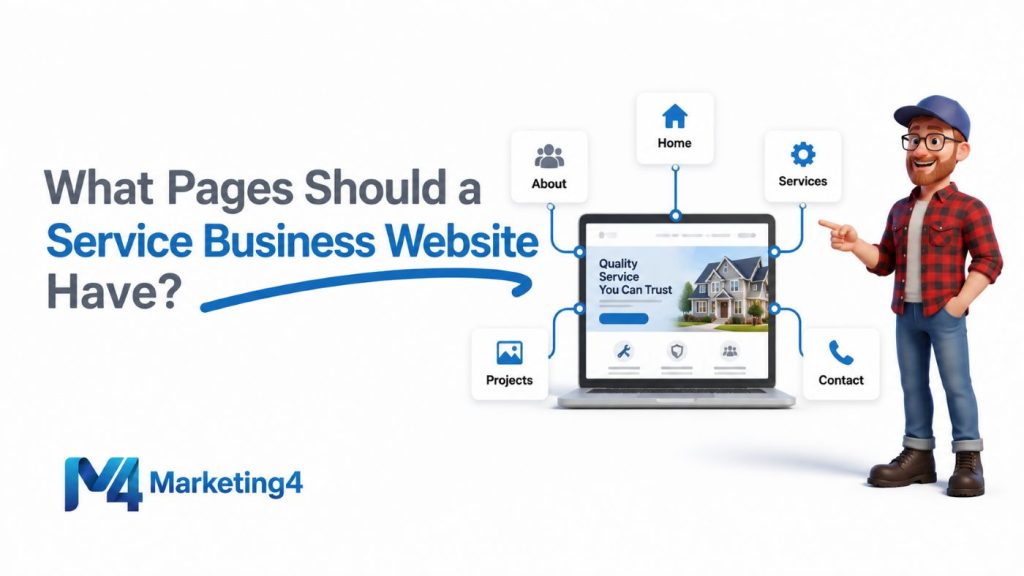

If you ask a web designer what pages a business website needs, you will probably hear some version of:
Home. About. Services. Contact.
That is not necessarily wrong.
But it is not a particularly useful way to think about website structure either.
A service business website should not be built around a standard website template. When deciding which service business website pages to include, start with the questions a potential customer needs answered before they are comfortable hiring you.
Someone considering a landscaper, electrician, contractor, accountant, lawyer, consultant, or other service provider is usually trying to determine:
- Do they provide what I need?
- Do they work with customers like me?
- Do they serve my area?
- Do they actually know what they are doing?
- Have they done this before?
- Can I trust them?
- What will it be like to work with them?
- What do I do next?
Your website should make those answers easy to find.
That means there is no single correct number of pages for a service business website.
A five-page website might be completely appropriate for a new one-person business.
An established contractor offering multiple services across several markets may legitimately need 50, 100, or more useful pages.
The goal is not to have more pages.
The goal is to have the right pages.
TL;DR
A service business website does not need a predetermined number of pages. It needs enough useful pages to explain what you do, prove you can do it, answer the questions customers actually ask, and give the right prospects a clear next step.
For a small business, that may mean a homepage, About page, Services page, and Contact page. As the business grows, individual service pages, case studies, location pages, helpful resources, FAQs, and stronger sales-support content may become worthwhile.
The best test is simple: does each page perform a useful job for the customer or the sales process?
Which Service Business Website Pages Do You Actually Need?
One way we think about service business websites at Marketing4 is in terms of Good, Better, and Best.
Good: Establish a Credible Online Presence
At the most basic level, a service business needs enough information for someone to understand who you are, what you do, and how to contact you.
A simple website might include:
- Home
- About
- Services
- Contact
For a new or very small business, this can be perfectly reasonable.
The problem is not that the website only has four or five pages.
The limitation is that one Services page can only explain so much.
If you provide five meaningfully different services, work with different types of customers, or need to demonstrate significant expertise before someone hires you, you will eventually outgrow this structure.
Better: Give Important Services and Proof Their Own Space
As the business grows, the website should usually become more specific.
Instead of one Services page containing a few sentences about everything you do, important services get individual pages.
You might also add:
- Individual service pages
- Projects or case studies
- Helpful articles and resources
- Relevant service-area information
- Testimonials and other proof throughout the site
Now the website can answer much more specific customer questions.
An electrician does not have to send someone interested in an EV charger to a generic page covering generators, panel upgrades, commercial wiring, lighting, and electrical repairs.
They can send them directly to a useful page about EV charger installation.
Best: Build the Website Around the Business and Customer Journey
The strongest service business websites go another step. They are built around the customer journey for local service businesses, not just a standard navigation template.
The architecture reflects:
- The services the company wants to grow
- The customers it wants to attract
- The markets it actually serves
- The questions customers ask
- The proof customers need before buying
- How the company qualifies and sells work
- The expertise the company has accumulated
At this stage, the website is no longer an online brochure.
It becomes part of the sales system.
Every Page Should Have a Job
One of the simplest tests we use when thinking about website architecture is:
What job does this page perform?
A page can perform one or several important jobs.
Discovery
Help the right person find the business through search, links, referrals, or other channels.
Education
Help a potential customer understand a service, problem, process, or decision.
Trust
Demonstrate experience, expertise, qualifications, reputation, or past work.
Qualification
Help customers determine whether the company is a good fit for what they need.
Conversion
Give someone a clear next step, such as calling, requesting a quote, or booking a consultation.
Sales Support
Give your sales team something useful to send to a prospective customer after a conversation.
If you are considering creating a new website page and cannot explain what useful job it performs, it is worth asking whether that page needs to exist at all.
1. Your Homepage
Your homepage should quickly orient someone who has just discovered the company.
It should normally make several things obvious:
- What you do
- Who you do it for
- Where you work
- Why someone should consider you
- Your primary services
- Evidence that you are credible
- What the visitor should do next
This sounds obvious, but many homepages make people work surprisingly hard to figure out what the company actually does.
A headline such as:
Quality You Can Trust.
might sound nice, but it could describe a roofer, accountant, mechanic, lawyer, landscaper, or bakery.
Clarity is more useful.
If you are a landscape design and construction company serving Hamilton and Burlington, say so.
If you build custom homes for clients planning large residential projects, make that obvious.
If you specialize in commercial work rather than residential work, do not make people dig through the website to discover it.
2. Individual Service Pages
For many service businesses, individual service pages are some of the most important pages on the website.
A common mistake is putting every service on one page with a picture, heading, and two sentences underneath each one.
That might technically tell people what you offer.
It does not give you much opportunity to demonstrate that you actually understand the service.
An electrical contractor, for example, might have separate pages for:
- Electrical panel upgrades
- EV charger installation
- Backup generators
- Commercial electrical services
- Residential electrical services
Someone researching an EV charger may want to know about charger types, available electrical capacity, panel upgrades, installation location, permits, available incentives, and what the installation process involves.
A dedicated page gives you space to answer those questions properly.
When Does a Service Deserve Its Own Page?
This is where website architecture becomes more useful than simply saying, “Create a page for every service.”
A service probably deserves its own page when several of the following are true:
- Customers actively look for the service independently.
- It represents meaningful revenue or strategic importance to the business.
- Customers have unique questions about it.
- The sales or buying process differs from your other services.
- You have specific expertise, projects, or proof related to it.
- It represents meaningfully different search intent.
- You would want to send a prospective customer directly to information about that service.
That final test is particularly useful.
Would someone on your team ever want to send a customer a link directly to this subject?
If the answer is yes, there is a good chance it deserves a meaningful page.
For a more detailed framework, use our 5-part test for deciding whether a service needs its own website page.
3. Your About Page
For service businesses, the people behind the company matter.
You are asking customers to trust your judgment, workmanship, advice, employees, or professional expertise.
In some cases, they may be giving you access to their home.
In others, they may be trusting you with a six-figure construction project, sensitive financial information, or an important legal decision.
Your About page should help answer:
- Who are these people?
- How did the business get here?
- What experience do they have?
- What are they qualified to do?
- What do they care about?
Depending on the company, that could include:
- Company history
- Founder story
- Team members
- Professional qualifications
- Licences
- Certifications
- Associations
- Awards
- Values
- Relevant industry experience
The goal is not to publish a corporate biography.
The goal is to let customers see the competent and accountable people behind the logo.
4. Projects and Case Studies
You can tell someone that you are experienced.
It is considerably stronger to show them.
For contractors and project-based service companies, project pages can be some of the strongest trust-building content on the website.
A landscaping company should show landscapes.
A home builder should show homes.
A contractor should show completed projects.
A marketing company should show client work.
But a useful case study can go much further than a gallery of finished photographs.
Where appropriate, explain:
- What the customer needed
- The constraints or challenges
- What work was completed
- Why certain decisions were made
- Which services were involved
- The outcome
Now a prospective customer can find a project similar to what they are considering and think:
They have done this before.
That is genuine authority.
5. Contact Page
Your Contact page should make it easy for the right customer to start the sales process.
Exactly what that looks like depends on the business.
An emergency plumbing company might prioritize a very prominent phone number.
A custom home builder may want to collect:
- Project location
- Type of project
- Approximate budget
- Desired timeline
A consultant may want someone to book an introductory call.
Do not blindly copy the same contact form used on every other website.
The contact process should reflect how your business actually qualifies and sells work.
6. Location and Service-Area Pages
If your business serves a defined geographic area, your website should make that clear.
Sometimes a service-area section is enough.
Sometimes individual location pages are useful.
But location pages should exist because the location meaningfully changes the content or because you have something legitimate to say about working there.
Creating 50 copies of the same page and replacing “Hamilton” with “Burlington,” “Oakville,” and “Ancaster” does not create 50 useful resources.
A strong location page might include:
- Services genuinely offered in that market
- Projects completed nearby
- Neighbourhoods or communities served
- Relevant local experience
- Customer testimonials from that area
- Local photos
- Common types of work in the market
- Geographic or regulatory considerations when relevant
There should be a genuine reason for the page to exist beyond inserting the name of a city into another URL.
7. Helpful Articles and Resources
Not everyone who visits a service business website is ready to request a quote.
Some people are still trying to understand their problem.
Others are comparing options.
Some are trying to figure out whether they need your service at all.
Useful articles allow your business to help during that research.
A landscaper might explain:
- Interlock versus poured concrete
- How much a backyard renovation costs
- When a pool should be installed during a landscape project
An HVAC contractor might explain:
- Heat pump versus furnace
- Why a furnace keeps short cycling
- Whether a heat pump works in a Canadian winter
These articles can help with SEO and search visibility, but that should not be the only reason they exist.
A useful test is:
Would we still be happy to send this article directly to a customer who asked us this question?
If the answer is no, the article probably needs to be better.
8. Reviews, Testimonials, and Trust Signals
Reviews and testimonials matter, but that does not necessarily mean you need a dedicated Testimonials page.
Often the strongest approach is to put proof close to the claim it supports.
A testimonial about an outdoor living project belongs naturally near landscaping work.
A commercial client’s comments can support a commercial service page.
A homeowner describing how clean and respectful the crew was can help overcome concerns about inviting workers into the home.
The same applies to:
- Certifications
- Licences
- Associations
- Awards
- Warranties
- Guarantees
Do not hide all of your proof on one page.
Put proof where the customer needs it.
9. Frequently Asked Questions
An FAQ can be valuable, but you do not necessarily need one enormous FAQ page.
Whenever possible, answer a question where it naturally belongs.
Questions about EV charger installation should probably appear on the EV charger page.
Questions about landscape design should appear with landscape design.
General questions about deposits, scheduling, warranties, or how the company operates may make sense elsewhere.
One of the best sources of website content is your own team.
If your receptionist, salesperson, estimator, technician, or owner keeps answering the same question, consider whether the website should help answer it too.
Three Examples of Service Business Website Architecture
There is no universal sitemap because different service businesses sell differently.
Here are three simplified examples.
Example 1: Solo Electrician
- Home
- About
- Services
- Electrical Repairs
- Panel Upgrades
- EV Charger Installation
- Service Area
- Contact
This business does not necessarily need a huge website. Clear service pages, local relevance, proof, and an easy way to call may be enough.
Example 2: Established Landscaping Company
- Home
- About
- Services
- Landscape Design
- Interlock
- Pools
- Outdoor Kitchens
- Landscape Lighting
- Projects
- Service Areas
- Resources
- Contact
Here the website needs to demonstrate design ability, workmanship, project experience, and the range of services involved in larger landscape projects.
Example 3: Commercial Contractor
- Home
- About
- Capabilities
- Design-Build
- Preconstruction
- Construction Management
- Markets
- Industrial
- Institutional
- Commercial
- Projects
- Insights
- Contact
This company may need to establish technical capability and experience long before a potential client is ready to issue an RFP or start a project.
The important point is not that one structure is better than the others.
The architecture should reflect how the business actually operates and how its customers buy.
The Five Stages of a Service Business Website
Another useful way to think about website growth is maturity.
Stage 1: Presence
We exist.
The website establishes the basics: who you are, what you do, and how someone can contact you.
Stage 2: Relevance
We specifically do what you need.
The website expands into meaningful service pages, customer types, markets, and geographic coverage.
Stage 3: Proof
We have done this before.
Projects, case studies, reviews, qualifications, team expertise, and other evidence become more prominent.
Stage 4: Expertise
We understand this problem.
The company starts publishing genuinely useful resources, explanations, guides, technical information, and answers to customer questions.
Stage 5: Sales Enablement
The website actively helps us sell.
The website becomes useful throughout the sales process.
Salespeople send prospects to relevant service pages and case studies.
Customers educate themselves before meetings.
Qualification improves.
Follow-up resources answer objections.
The website, marketing, and sales process begin working as one system.
Pages You Probably Do Not Need
Once businesses realize that website content can improve search visibility, another problem sometimes appears.
They start creating pages for everything.
More pages do not automatically create more authority.
You probably do not need:
- 50 nearly identical city pages
- A separate page for every tiny variation of a service
- Five pages targeting slightly different versions of the same search
- A generic “Why Choose Us?” page filled with claims every competitor could make
- A huge FAQ page that removes useful answers from the service pages where customers actually need them
- Pages created solely because an SEO tool found another keyword
Every page should earn its place on the website.
How Many Pages Should Your Website Have?
There is no ideal number of service business website pages.
A credible new business may need only a handful.
An established company with multiple services, locations, customer groups, projects, and years of accumulated expertise may legitimately need hundreds.
What matters is whether those pages are useful.
A good test is:
If someone landed directly on this page from Google, a referral, an email, or your sales team, would the page be useful on its own?
If the answer is no, improve it or reconsider whether it needs to exist.
Your Website Should Grow With Your Business
A service business website should not be treated as something you build once and forget about.
Your company accumulates experience.
You complete new projects.
You enter new markets.
You learn which services you want more of.
Customers ask new questions.
Your sales team learns what helps customers make decisions.
Your website should become better as the business becomes better.
That does not mean publishing content for the sake of publishing content.
It means capturing useful knowledge, experience, proof, and information as the company accumulates it.
Start With What Your Customer Needs to Know
If you are planning a new service business website, do not begin with:
How many pages should we have?
Start with:
What does the right customer need to understand before they are comfortable hiring us?
Then ask:
- What services need to be clearly explained?
- What questions do customers regularly ask?
- What experience can we prove?
- What concerns prevent customers from moving forward?
- What geographic information actually matters?
- What information would our sales team want to send someone?
Build the website around those answers.
The goal is not to have the biggest website.
It is to create a website where every important page has a job and the pages work together to help the right customer move from:
Who are these people?
to:
They understand what I need, they have done it before, and I am comfortable talking to them.
That is what a service business website is supposed to do.
Main Takeaways
- There is no ideal page count for a service business website.
- Start with the pages customers need to understand the company, services, fit, credibility, and next step.
- Give important services their own pages when the customer questions, buying process, search intent, or proof are meaningfully different.
- Use projects, case studies, reviews, qualifications, and useful resources to build trust instead of relying on generic claims.
- Create location pages only when you can add genuine local relevance rather than duplicating the same page across multiple cities.
- As the business grows, the website should grow into a sales tool that supports discovery, education, qualification, conversion, and follow-up.
- Every important page should have a clear job. If it does not, reconsider why it exists.