
When was the last time you sat down on a Saturday morning and decided to learn more about the plumbing companies in your area?
Probably never.
You likely don’t spend much time thinking about electricians, roofers, HVAC contractors, or landscaping companies either. You might go several years without giving any of these businesses much thought.
But the moment your basement starts flooding, your perspective on plumbing companies changes quite dramatically.
This is one of the fundamental challenges of marketing a service business. Most of your potential customers have very little interest in your business until they have a reason to need your services.
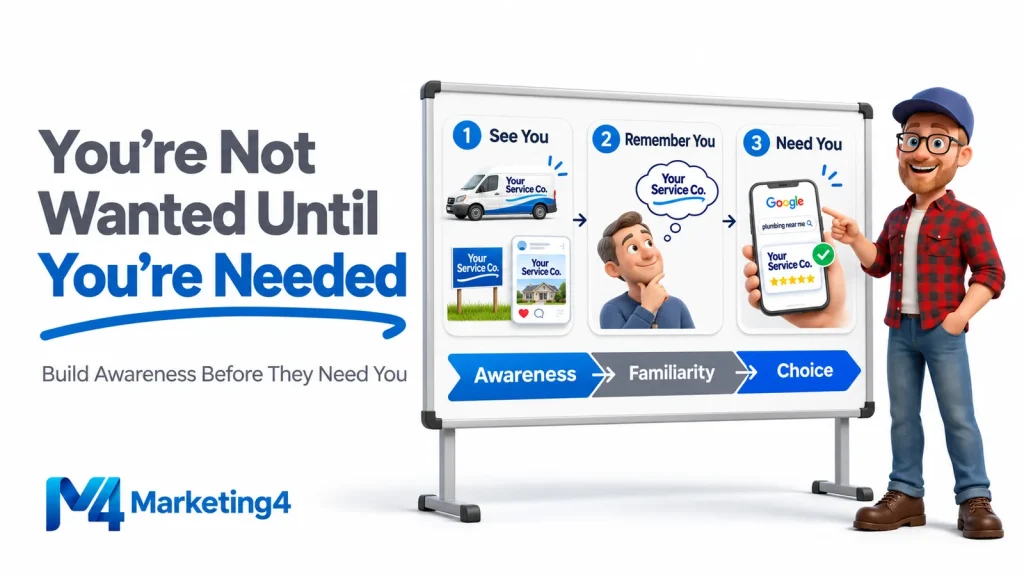
You’re not wanted until you’re needed.
The challenge is that when you’re finally needed, you want to be the business they think of, recognize, trust, and ultimately choose. And much of the work required to make that happen begins long before they need you.
Your customers don’t want to hear from you today, but you need them to remember you tomorrow.
TL;DR
For most service businesses, customers only become actively interested when a need arises. However, the impressions they form before that moment can influence which businesses they consider and ultimately hire. An effective marketing strategy builds awareness and familiarity before customers need you, while making your business easy to find and choose when they do.
Most People Aren’t Looking for Your Services Today
Imagine you own a residential electrical company. There may be tens of thousands of homeowners within your service area who could eventually become customers.
Some will need an electrical panel upgrade. Others will install an EV charger, renovate their basement, build an addition, or experience an electrical problem.
But most of those homeowners aren’t thinking about any of those things today.
You could put an advertisement in front of them explaining why your electrical company is the best in the area, offer them a discount, and tell them to call for a free estimate. If they don’t need electrical work, they’re unlikely to do anything with that information.
That doesn’t necessarily mean the advertisement was unsuccessful.
They may have noticed your company name, recognized your logo, or made a mental association between your business and electrical services in their community. They might not consciously remember seeing the advertisement, but that exposure can contribute to a sense of familiarity the next time they encounter your business.
The problem is that none of this necessarily results in a lead today. And when businesses evaluate all their marketing based on immediate lead generation, they can overlook the value of reaching future customers.
Your Customers Are Forming Impressions of Your Business Before They Need You
Imagine that, over the course of two years, a homeowner has had several encounters with a local landscaping company.
- They’ve seen its trucks driving around the neighbourhood.
- They’ve noticed its lawn signs outside a few properties.
- They’ve come across some of its completed projects on social media.
- They’ve seen its logo at a local community event.
- They’ve heard a neighbour mention the company.
At no point during those two years did the homeowner actively seek out information about the landscaping company. They weren’t interested in hiring a landscaper.
Then one spring, they decide it’s time to renovate their backyard.
They start searching Google for local landscaping companies. They find several businesses, but one of them feels familiar.
Oh yeah, I’ve seen those guys around.
They may not remember the individual encounters that created that familiarity. They may not even know exactly why they recognize the company. But amongst a group of unfamiliar businesses, there is now one they feel they know something about.
That company has a potential advantage before the homeowner has even visited its website.
This is also why your logo should feel familiar when customers need you. A consistent and recognizable visual identity helps connect all those individual encounters with the same business.
Recognition and Recall
There are two particularly useful outcomes of brand awareness for service businesses.
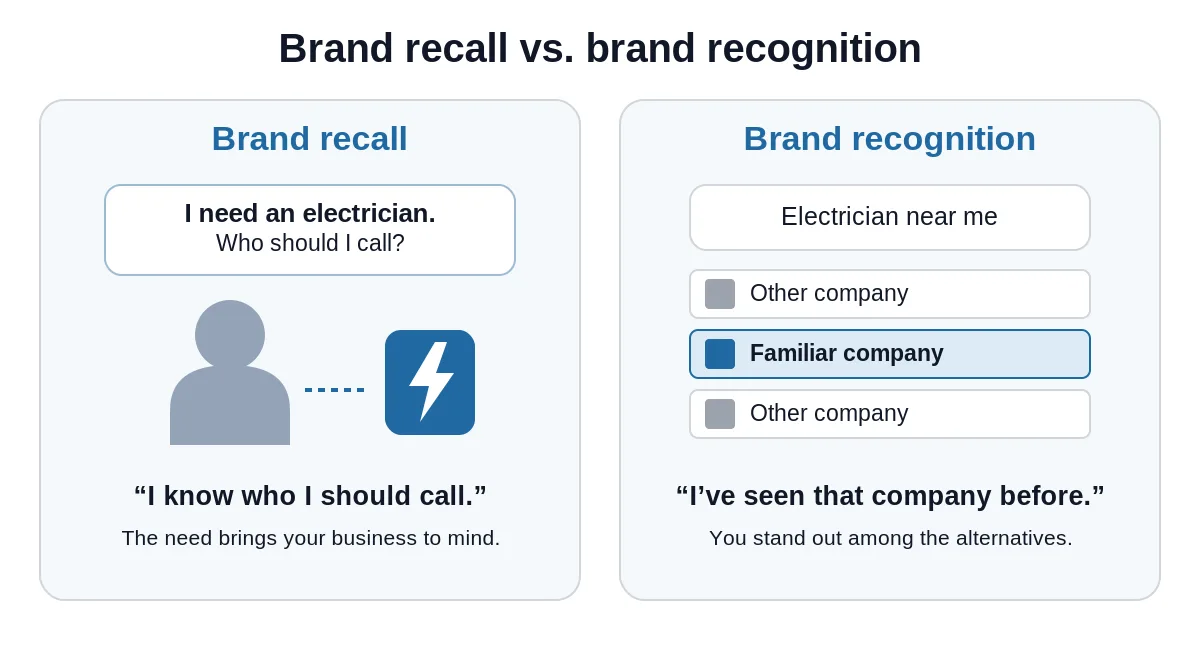
The first is brand recall. This happens when someone thinks of your business without having to see it first.
A homeowner realizes they need a new furnace and immediately thinks of a particular HVAC company. They might search for that company by name or go directly to its website rather than starting with a generic Google search.
The second is brand recognition. This happens when someone encounters your business and realizes they’ve seen or heard of it before.
They might not have been able to tell you the name of a single landscaping company yesterday, but when presented with five landscaping companies in their Google search results, they recognize one of them.
Both outcomes have value.
For a local service business, becoming the first company everyone thinks of is an ambitious goal. Becoming one of the companies people recognize and feel comfortable considering is often a more attainable starting point.
Marketing Before the Need vs. Marketing After the Need
A good marketing strategy for local service businesses accounts for two fundamentally different customer situations.
In the first situation, the customer doesn’t currently need your services. You’re trying to establish awareness, familiarity, and a positive impression of your business.
In the second situation, the customer has recognized a need and is actively looking for someone to help. You’re trying to make your business easy to discover, evaluate, and contact.
These are different marketing objectives, and they often require different approaches.
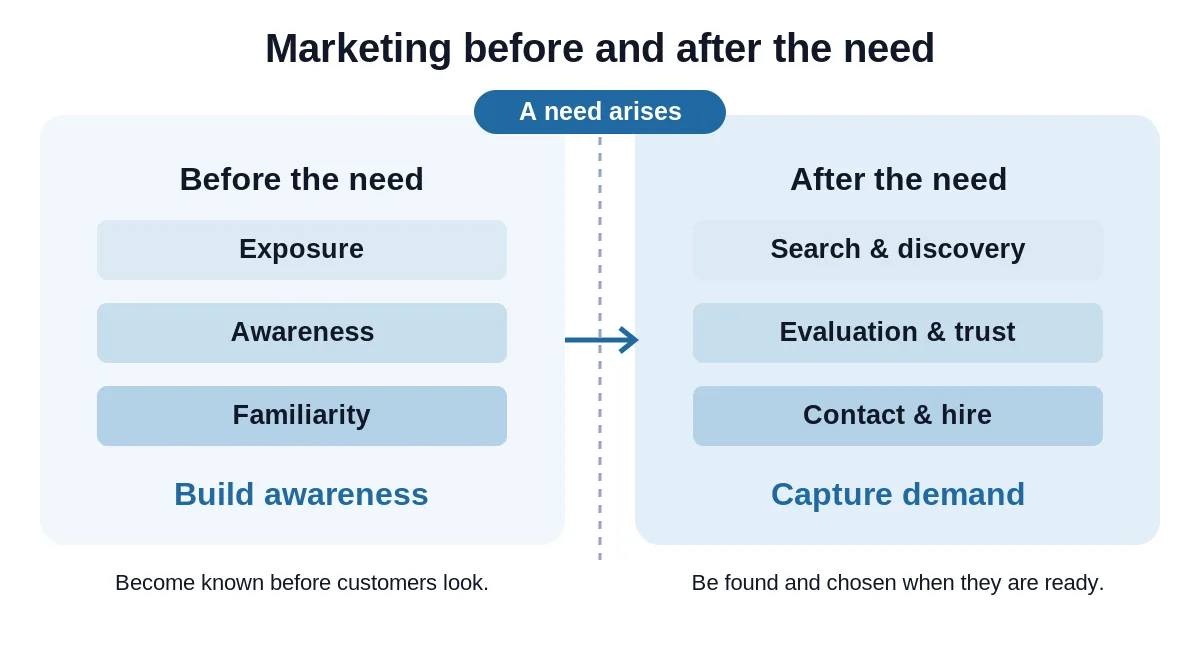
| Marketing before the need | Marketing after the need |
|---|---|
| Branded vehicles | Search engine optimization |
| Job site and lawn signs | Google Search Ads |
| Social media exposure | Google Business Profile |
| Community involvement | Customer reviews |
| Local sponsorships | Service-specific website pages |
| Educational newsletters | Project portfolios and case studies |
There is considerable overlap between these activities. A project photo on social media might create awareness with one person while helping another decide whether to hire you. Reviews might help build your reputation before a customer needs you and then influence their decision when they do.
The objective of each activity should help determine how you approach it and how you measure its effectiveness.
Stop Trying to Sell to People Who Aren’t Ready to Buy
One of the mistakes service businesses make is treating every marketing activity as an opportunity to sell something.
Every social media post ends with a request to book an appointment. Every email contains a promotion. Every advertisement asks someone to call for a quote.
But if the majority of the people seeing your marketing don’t currently need your services, constantly asking them to buy something may accomplish little beyond becoming an annoyance.
There are other ways to make your business visible.
An electrician can share information about when homeowners should consider upgrading their electrical panels. A landscaper can showcase a beautifully completed backyard. An HVAC company can explain how to recognize when a furnace is nearing the end of its useful life. A contractor can share photos showing the progression of a construction project.
People may find some of that information interesting, useful, or worth remembering without having any immediate intention of hiring the business.
You’re creating opportunities for people to encounter your business without demanding something from them every time.
That is a much more sustainable way to build awareness.
The Problem With Only Measuring Immediate Leads
Imagine a homeowner sees your company’s trucks around town for three years. They’ve driven past several of your job sites, seen your social media posts, and recognized your logo on a community sponsorship sign.
Eventually, they need your services.
They search Google, find your website, and submit a contact form.
Your website analytics might attribute that lead to organic search. If you were running Google Ads and they clicked one of your advertisements, the lead might be attributed to paid search.
But did Google generate that customer entirely on its own?
Perhaps the reason they clicked on your business instead of one of your competitors was because of those previous encounters. Google was simply the place where they went to find you when they finally needed you.
This creates a challenge when measuring marketing performance. The marketing activity that captures a lead isn’t necessarily the only activity that contributed to generating it.
If you eliminate every marketing activity that doesn’t directly produce measurable leads, you could be eliminating some of the activities that make your other marketing efforts more effective.
That doesn’t mean you should spend money on awareness campaigns without any accountability. Branded Google searches, direct website visits, local reach, customer feedback, and asking new customers whether they had heard of you before contacting you can all help you understand whether your business is becoming better known.
None of these measurements is perfect, but together they can provide a more complete picture.
Being Known Isn’t the Same as Being Wanted
Brand awareness can work against you if the impressions you’re creating are negative.
A homeowner might recognize your company because they’ve seen your employees driving recklessly through their neighbourhood. They might remember your name because of a bad experience a neighbour had with your business.
In both cases, you’ve successfully created awareness. Unfortunately, you’ve also given that person a reason not to hire you.
Even positive familiarity doesn’t guarantee that a customer will choose your company. When someone starts evaluating their options, they still need to establish confidence in your ability to do the work.
Your website, reviews, project photos, qualifications, reputation, and interactions with your employees all contribute to that decision. These are some of the reasons trust and credibility play such a large role in service business marketing.
As we explain in our article about the customer journey for local service businesses, customers often narrow their options considerably before contacting anyone. Familiarity can help get your business onto that shortlist, but credibility helps keep it there.
This is why building awareness and building a reputation should happen together.
Don’t Stop Marketing When You’re Busy
For many service businesses, marketing is something they start doing when work slows down and stop doing when they get busy again.
It’s understandable. When you’re booked several months in advance, spending money on generating more leads might seem unnecessary.
However, there’s a difference between reducing your spending on immediate lead generation and stopping your marketing altogether.
If you’re a landscaping company that’s fully booked for the summer, you may not need to spend heavily on advertising for immediate landscaping projects. But you probably still want homeowners in your community to see your work, recognize your company, and develop a positive impression of your business.
Some of those homeowners will become next year’s customers.
In fact, being busy can create some of your best opportunities to build awareness. You have active job sites, vehicles travelling through your service area, projects to photograph, customers to collect reviews from, and real work to showcase.
You’re already doing the work. You might as well make sure the right people know about it.
How to Build Brand Awareness for a Local Service Business
Building awareness doesn’t necessarily require a massive advertising budget. Local service businesses have an advantage because the geographic area in which they need to become known is often relatively small.
A landscaping company serving three neighbouring communities doesn’t need everyone in Ontario to recognize its brand. It needs to become recognizable among the types of homeowners it wants to work with in those communities.
There are several practical ways to accomplish this.
Make your branding consistent
Your trucks, trailers, uniforms, lawn signs, website, social media profiles, proposals, and printed materials should look like they belong to the same business.
Every time someone encounters your company, you’re creating another opportunity to reinforce their memory of it. If your visual identity changes considerably across those different encounters, you make that association harder to establish.
Make your existing work visible
Service businesses create physical evidence of their expertise every day. Landscapers transform properties. Painters restore buildings. Contractors build structures. Mechanics solve problems.
Documenting and sharing this work gives people a reason to notice your business while demonstrating what you’re capable of doing.
You don’t need to manufacture marketing content when your business is already producing something worth showing.
Be visible in the right places
A local business doesn’t necessarily benefit from reaching the largest possible audience. It benefits from repeatedly reaching the right audience.
Consider where your ideal customers live, work, drive, shop, and spend their time online. A well-placed job site sign or a sponsorship within the right community might be more valuable than thousands of social media impressions from people outside your service area.
Give people a reason to remember you
Recognition alone has limited value if people don’t know what your business actually does.
Your marketing should help people associate your company with a particular service, type of work, area of expertise, or customer experience.
Ideally, when someone encounters a problem that your business solves, there’s already an association between that problem and your company.
When You’re Needed, You Need to Be Wanted
Think about the customers you want to work with over the next three years.
Many of them probably have no idea that they’re going to become customers of a business like yours. They haven’t decided to renovate their home, replace their roof, redesign their backyard, or upgrade their electrical system.
They’re not looking for you, and they may have very little interest in hearing about your services today.
But you can still be building familiarity with those people. You can be demonstrating your expertise, establishing your reputation, and making your business a recognizable part of their community.
Then, when the day comes that they finally need your services, you won’t necessarily be introducing yourself for the first time.
That’s what a well-rounded marketing strategy should accomplish.
You’re not wanted until you’re needed. But when you’re needed, you need to be wanted.