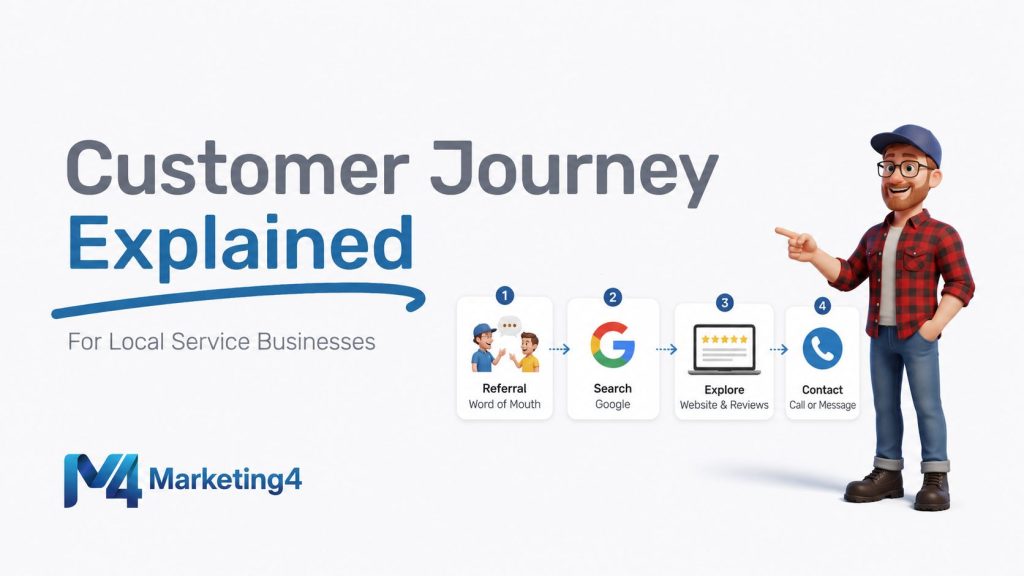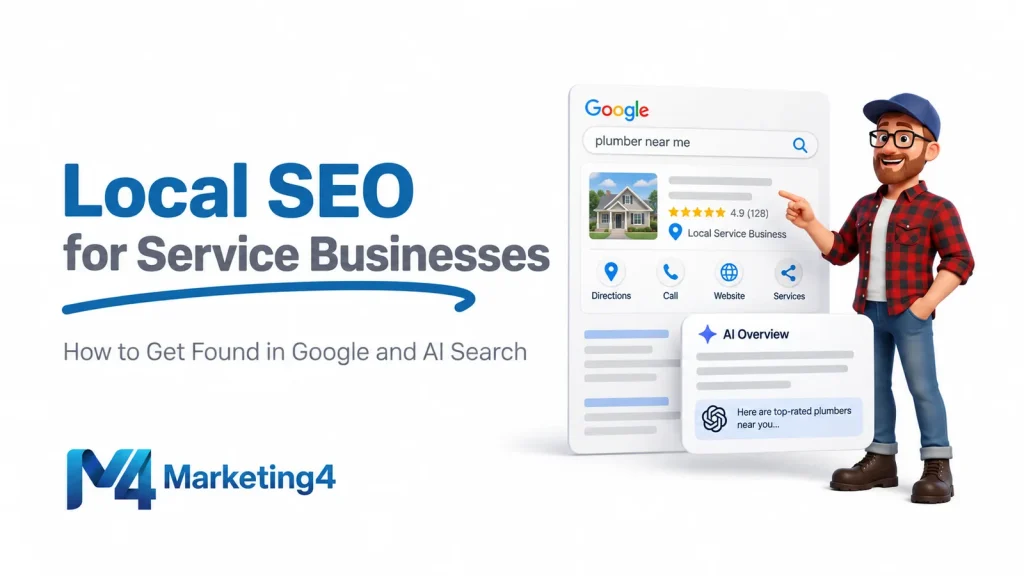

If someone in Burlington needs a plumber for a sewer line replacement, they may not start by clicking through ten websites.
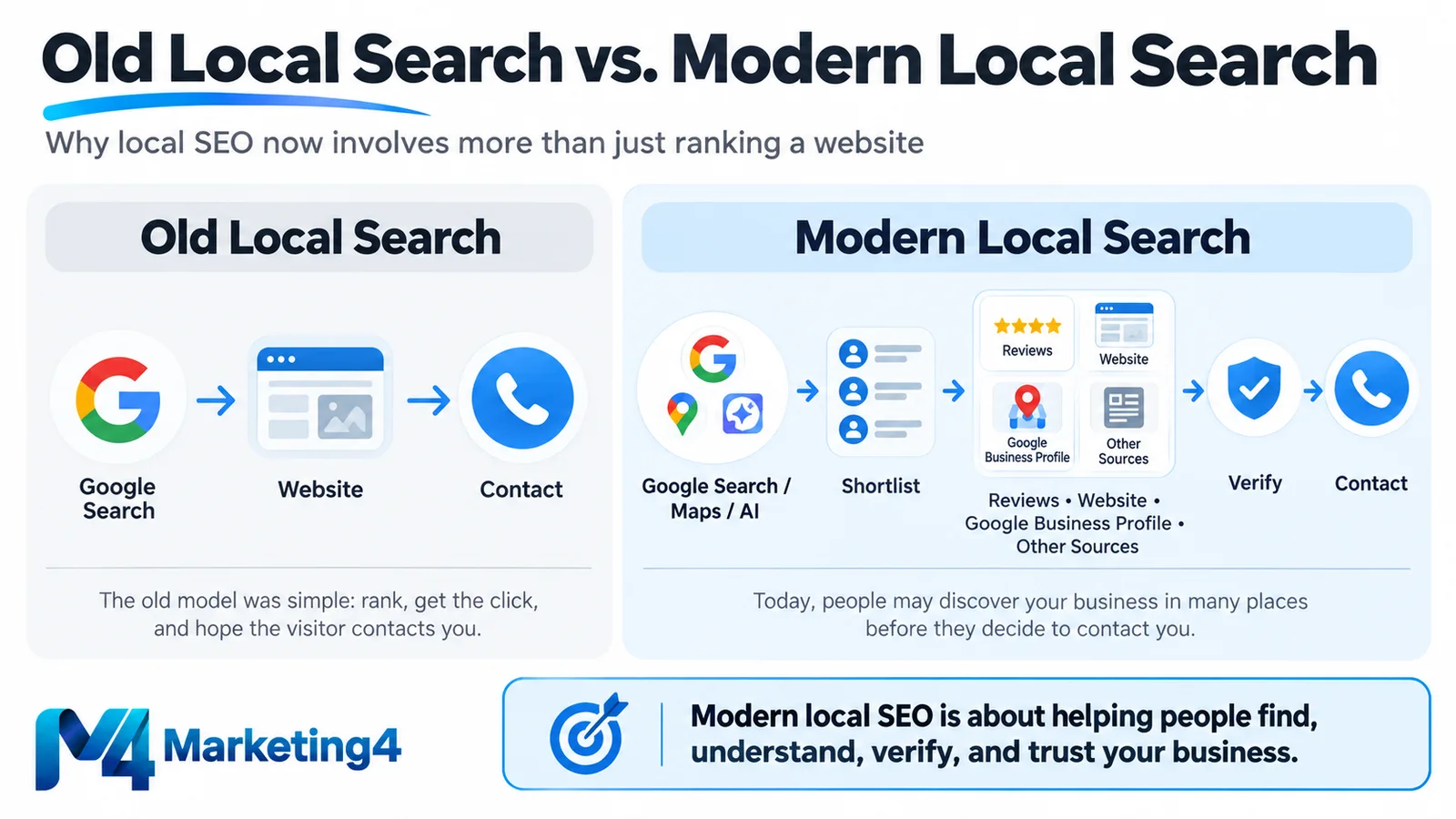
They might see a Google Map with nearby companies. They might read reviews directly in the search results. Google might give them an AI-generated answer. They might ask an AI assistant for a shortlist, then look up two or three of those businesses before deciding who to call.
That changes how a local service business should think about search engine optimization, or SEO.
SEO used to be explained mostly as getting your website higher in Google. That is still part of it, but it is too narrow for how people find businesses now.
For a service business, modern local SEO is really about making your company easy for nearby customers, Google, and AI systems to find, understand, verify, and trust.
TL;DR
Local SEO helps people in your service area find your business when they need what you offer. Today, that includes more than your website. Your Google Business Profile, reviews, real project photos, service pages, reputation, community presence, and information on other credible websites can all help people and search systems understand whether your business is relevant and legitimate.
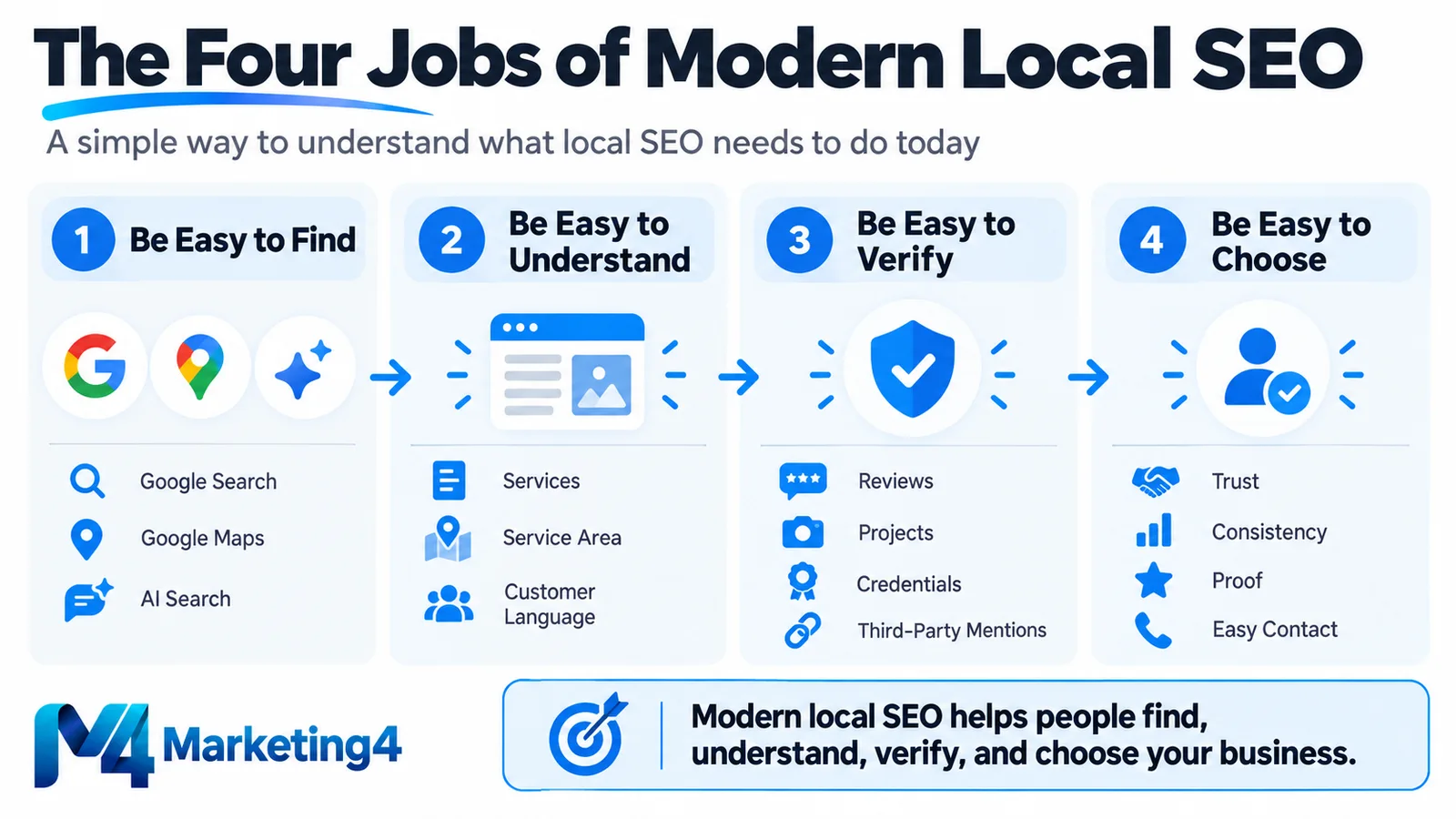
A useful way to think about it is simple: be easy to find, easy to understand, easy to verify, and easy to choose.
What Local SEO Means Today
SEO stands for Search Engine Optimization. In plain English, it means helping search engines understand when your business is a useful result for what someone is looking for.
The local part adds another question: is this business relevant to someone looking for that service in this area?
A Hamilton electrician does not need to appear when someone in Vancouver searches for an electrician. They want to be visible when the right customer in Hamilton, Burlington, Ancaster, or another area they genuinely serve needs electrical work.
Google describes local ranking mainly in terms of relevance, distance, and prominence. Those words can sound technical, but the basic ideas are straightforward:
- Relevance: Does your business actually match what the person needs?
- Distance: Is your business reasonably close to the person searching?
- Prominence: Does your business appear to be established and well known?
That second point is worth understanding. You can make it clear where you work, but you cannot completely SEO your way around geography. A business that is genuinely close to the person searching may have an advantage, especially in Google Maps.
This is one reason creating dozens of nearly identical city pages is not a magic solution. Good local landing pages can be useful, but they should exist because there is something meaningful to say about serving that market.
Make It Easy to Understand Your Business
Search engines should not have to guess what your business does. Neither should customers.
Your website and online profiles should make a few things obvious:
- What services do you provide?
- Where do you provide them?
- What kinds of customers do you serve?
- What problems are you especially good at solving?
- Which services are actually important to your business?
This sounds simple, but service businesses often describe their work using language that makes sense inside the industry and not to the customer.
A plumber may use a technically correct term such as trenchless lateral rehabilitation. A homeowner might search for something closer to repair sewer pipe without digging up my yard.
Your website needs enough technical accuracy to show expertise, but it also needs to use the words normal customers understand. We will go deeper into that in our guide to choosing keywords for a local service business.
The same principle applies to website structure. If an important service has its own customer questions, proof, sales process, or search demand, it may deserve a dedicated page. Our 5-part test for deciding whether a service needs its own website page can help with that decision.
Your website is more than somewhere to send traffic
A website is also a source of evidence about your company.
If you are a landscape contractor, your website can show the types of projects you actually build. If you are an HVAC contractor, it can explain the systems you work on and the problems your technicians regularly solve. If you are an accountant, it can explain the types of clients and situations your team works with.
Useful evidence might include:
- Clear service pages
- Real projects and case studies
- Real team members
- Licences, qualifications, and certifications
- Questions customers actually ask
- Original explanations based on your experience
- Real photos of your work
The website also has to function properly. It should work well on a phone, load reasonably quickly, make contact information easy to find, avoid broken pages, and allow search engines to access the important content. You do not need to become a technical SEO expert to understand the principle: do not make customers or Google fight with your website.
Your Google Business Profile matters too
For a local service business, your Google Business Profile can be just as important to the customer journey as your website.
Keep the basics accurate: your business category, services, hours, phone number, website, service area, and other relevant information. Add real photos of your work, crews, equipment, and projects where appropriate.
And keep the information consistent. If your website says you serve Hamilton and Burlington, one directory says Toronto, and another has an old phone number, you are making the business harder to understand.
A simple rule works well: tell the same truthful story everywhere.
Give Google and Customers Real Evidence
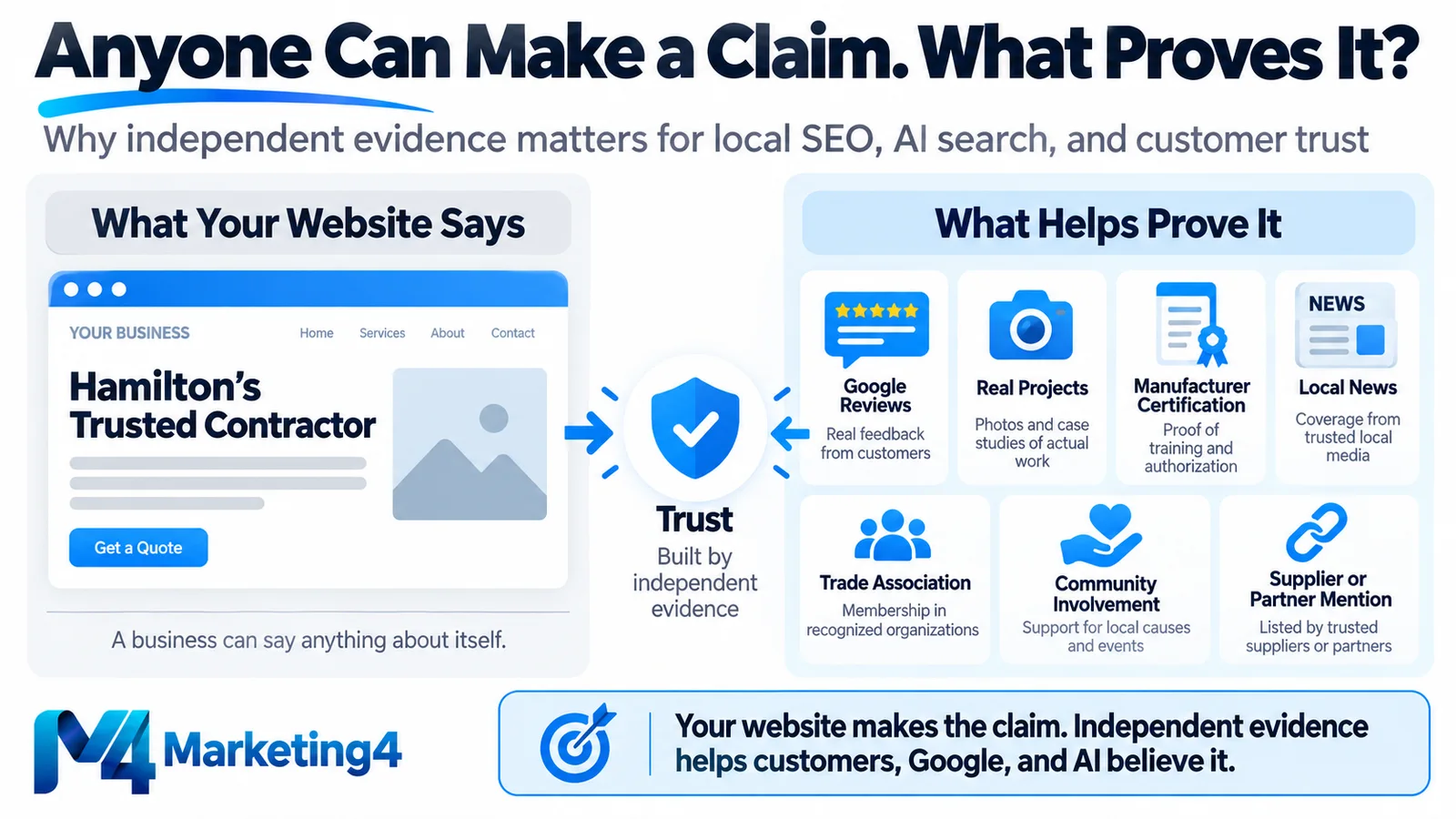
Your own website can say almost anything about your business.
You can write, “Hamilton’s most trusted contractor,” but writing the sentence does not make it true.
Evidence is stronger than claims.
For a service business, evidence can include:
- Genuine customer reviews
- Completed projects
- Before-and-after photos
- Real employees and team biographies
- Licences and professional qualifications
- Manufacturer certifications
- Association memberships
- Customer testimonials
- Useful case studies
Reviews are particularly valuable because they do two jobs at once. Google says reviews and positive ratings can contribute to local visibility, while customers use those same reviews to decide whether they are comfortable contacting you.
Build reviews naturally over time. Ask real customers about real experiences. Respond to reviews like a real person. Do not buy reviews, create fake ones, or offer incentives in exchange for positive ratings.
The goal is not to manufacture the appearance of trust. It is to make genuine trust visible.
Build a Real Reputation Beyond Your Website
Your online reputation does not stop at your own domain.
Imagine a roofing contractor that sponsors a local minor hockey team, supports a local charity, belongs to a legitimate construction association, is listed by a roofing manufacturer as a certified installer, and is quoted by a local newspaper after a major storm.
Those activities may create mentions or links on several independent websites. More importantly, they create places where someone can independently confirm that this is a real company participating in its industry and community.
That does not mean you should sponsor a hockey team because you want a backlink.
If supporting the team makes sense for your company and your community, do it for that reason. Then make sure the legitimate relationship has an online footprint too.
The same thinking can apply to:
- Local news coverage
- Charities and community organizations
- Sports teams and event sponsorships
- Chambers of commerce
- Trade associations
- Manufacturer directories
- Suppliers and project partners
- Legitimate local or industry directories
Google specifically includes links from other websites as one of the signals that can contribute to local prominence. But the better strategy is not “get links at any cost.”
Build a business worth referencing.
Your real-world reputation can become part of your online reputation. We will explore that idea more deeply in a separate article about building local authority beyond your own website.
How AI Changes Local Search
AI adds another layer to how people find businesses.
Someone can now ask a much more specific question than “plumber near me.” They might ask:
Find me a reputable plumber near Burlington that specializes in sewer replacement and has experience with older homes.
An AI-powered search experience can try to assemble an answer before the customer visits any individual company’s website.
Google says its AI search features still rely on the same underlying search systems and that there is no special “AI SEO” trick required. Its newer guidance also encourages businesses to publish unique, useful information based on real knowledge and first-hand experience rather than material that could easily be produced by any generative AI system.
For service businesses, that is encouraging.
AI can write a generic article about sewer backups. It does not automatically know the three causes your plumbers most commonly find in 70-year-old houses in your service area unless someone with that experience documents it.
AI can explain what an interlock patio is. It does not automatically have the lessons your landscape crew learned after installing hundreds of them.
AI can summarize furnace maintenance. It does not have the field photos, service history, and recurring problems your HVAC technicians actually see.
The easier generic content becomes to create, the more valuable real experience becomes.
AI may create the shortlist, but you still have to survive the verification
Even when an AI tool recommends a business, a customer may still Google the company name, read reviews, look at the website, inspect project photos, check social media, or compare another provider.
That is why the whole online footprint matters.
The AI recommendation gets you considered. The rest of your reputation helps determine whether you get chosen.
Use AI to explain your business, not to fake your business
AI can be extremely useful in marketing. It can help create diagrams, illustrations, infographics, layouts, and clearer explanations.
The problem starts when an illustration is presented as evidence.
Imagine a company uses AI to generate a beautiful image of a product. Someone sees the image in search, an ad, or social media and clicks because they want that product. Then they arrive at the website and discover the real product looks completely different.
Whether or not an algorithm ever penalizes that image, the business has already created a problem. It attracted the wrong click, disappointed the customer, and damaged trust.
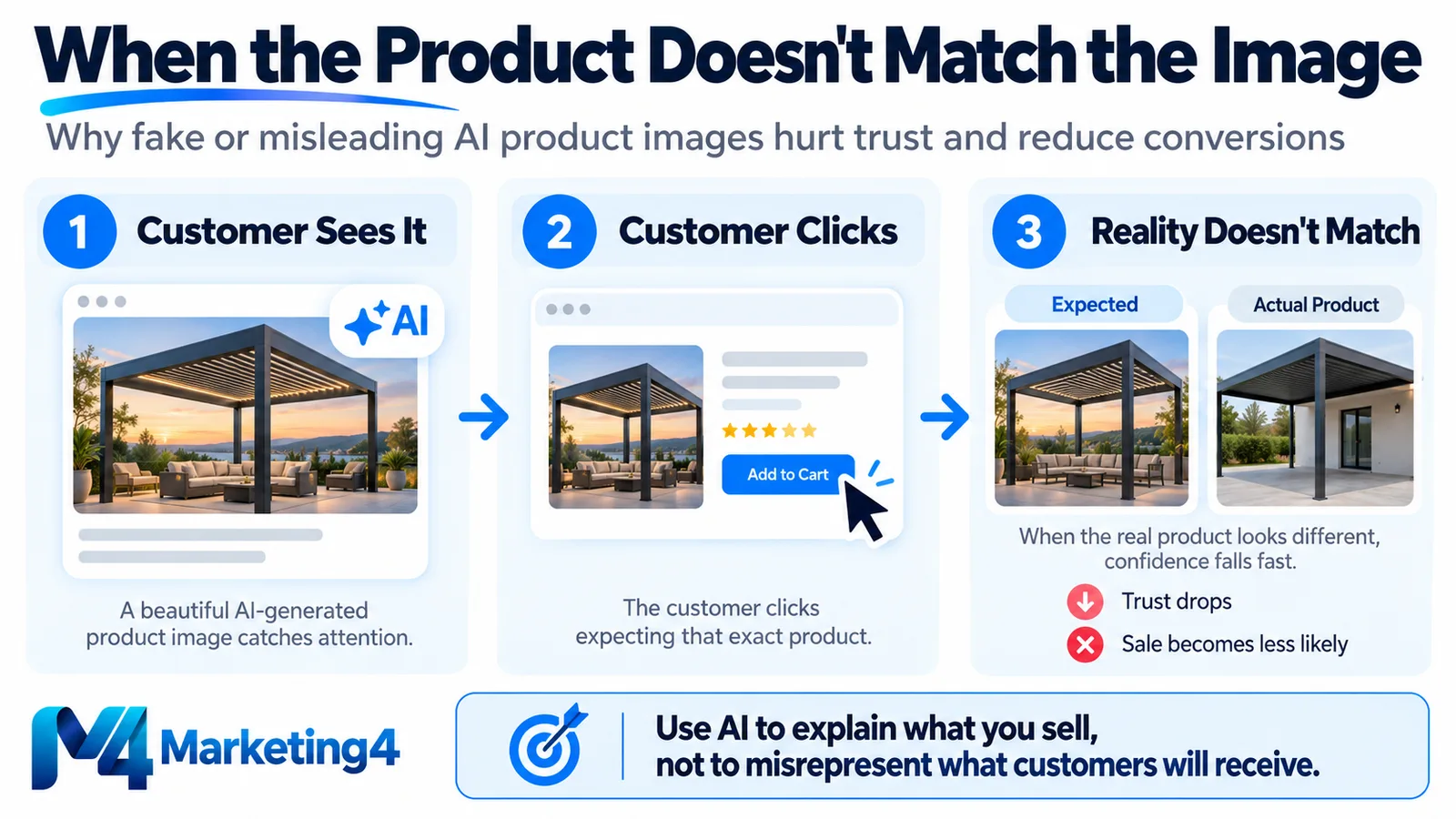
The same applies to service businesses. Do not present an imaginary renovation as your completed project. Do not create fake employees and let people assume they work for you. Do not show an AI-generated landscape as evidence of what your crew built.
Google’s own Business Profile photo guidance says images should have no significant alterations or excessive AI use and, very simply, that the image should represent reality.
A clearly labelled concept rendering or explanatory illustration is different. The test is simple: are you improving the presentation of something real, or allowing someone to believe something fake is real?
What Local SEO Cannot Fix
Good SEO can put your business in front of more potential customers. It cannot turn a weak business into a strong one.
If your reviews are poor, nobody answers the phone, quotes take two weeks, your website does not explain the service, or customers routinely have bad experiences, more visibility can simply expose those problems to more people.
SEO can get you considered. The business still has to get chosen.
It also cannot completely overcome distance. If you are trying to rank in a market far from where your business is genuinely located and active, adding the city name to more pages does not change geography.
And paying Google does not buy better organic rankings. Google is explicit that investment in paid search has no impact on organic search ranking.
Advertising can still be useful. It can create visibility, customers, awareness, reviews, and future branded searches. But that is different from buying SEO authority.
The same separation is becoming important in AI products. For example, ChatGPT can show sponsored placements, but OpenAI states that ads are separate from the answer and advertisers cannot pay to shape or rank ChatGPT’s responses.
That is why sustainable local SEO should not be built around tricks such as:
- Dozens of thin, nearly identical city pages
- Buying junk backlinks
- Fake reviews
- Publishing hundreds of generic AI-written articles
- Stuffing city names or keywords unnaturally into copy
- Creating pages for services you do not really offer or want
- Using fake projects, products, people, or experience as proof
Good SEO Should Bring You the Right Work
More traffic is not automatically better.
Imagine a contractor whose website generates lots of calls for $500 repair jobs while the company is trying to grow $100,000 renovation projects. The SEO might look successful in a traffic report while working against the business strategy.
Or imagine a landscaper generating dozens of lawn-cutting enquiries while trying to build a landscape construction division.
A good local SEO strategy should reflect the business you are trying to build.
Think about:
- Which services are most profitable?
- Which services do you want more of?
- Which customers are the best fit?
- Where do you genuinely want to work?
- How much capacity do you have?
- What direction is the company trying to grow?
This is why we treat SEO as part of the wider marketing and business strategy, not as an isolated technical exercise.
Measure customers, not just clicks
Rankings, impressions, and website traffic are useful diagnostic numbers. They can tell you whether visibility is changing.
They are not the final business outcome.
Pay closer attention to things such as:
- Qualified phone calls
- Useful website enquiries
- Booked estimates or consultations
- Google Business Profile actions
- Which services people are asking for
- Lead quality
- Opportunities and quotes
- Sales and revenue where you can measure them
- Growth in genuine reviews and branded demand
This becomes even more important as Google and AI systems answer more questions before someone ever visits a website. A customer may discover you through search, verify you through reviews and Maps, and call directly without creating the website session your analytics report was expecting.
What a Service Business Should Actually Do
If all of this feels like a lot, the starting point is simpler than it sounds.
- Make sure Google has accurate information about your business. Claim and maintain your Google Business Profile.
- Clearly explain what you do and where you work. Use language your customers actually understand.
- Build useful pages around important services. Do not create pages merely because an SEO tool found another phrase.
- Make the website easy to use. It should work on phones, load properly, and make contacting you easy.
- Gather genuine reviews. Ask real customers and respond thoughtfully.
- Show real evidence. Publish projects, photos, people, qualifications, and useful expertise.
- Build a legitimate reputation outside your website. Make genuine industry and community relationships visible online.
- Keep your information consistent. Your website, Google profile, social accounts, and legitimate listings should describe the same business.
- Create content based on things you actually know. Real experience becomes more valuable as generic AI content becomes easier to produce.
- Measure whether the right customers are finding you. Traffic is useful, but qualified work is the objective.
The strongest local SEO strategy is increasingly not about manufacturing a version of your company that an algorithm might like.
It is about making the internet accurately reflect a legitimate, capable business.
Do good work. Explain it clearly. Show real evidence. Build a real reputation. Make that reputation visible online.
When customers, Google, and AI systems can all look at the available information and independently reach the same conclusion about your business, you are building something much stronger than a temporary ranking trick.