
A contractor’s Google Business Profile can tell a potential customer a lot about the company before they ever visit the website.
Unfortunately, a lot of contractor profiles don’t give them much to work with.
There might be a logo, a photo of the company truck, a manufacturer-supplied image of a product and a couple of finished jobs from three years ago. The customer still doesn’t really know what kinds of projects the company works on, what the quality of the work looks like, who is going to show up at their property, or whether the business is even particularly active.
For contractors, photos shouldn’t just decorate a Google Business Profile. They should provide evidence.
TL;DR
The best Google Business Profile photos for contractors are real photos of real work: completed projects, work in progress, crews on site, equipment, detail shots, before-and-after photos and the people behind the company. You don’t need professional photography for every job. You do need a habit of documenting the work your company actually does, particularly the types of projects you want to do more often.
Think of Your Photos as Proof
Someone searching Google Maps for a contractor is usually comparing several businesses at once. They may look at your reviews and how you respond to them, website, years in business, services and photos before deciding who deserves a phone call.
The photos can answer questions that are difficult to answer with marketing copy alone.
Do these people actually do this kind of work? Do their projects look professional? Do they have the equipment required? Does the crew look organized? Have they completed projects similar to mine?
This is particularly useful for service businesses because customers aren’t buying a product they can inspect before making a decision. They’re buying confidence that a company can solve a problem properly. We talk about this more in our article on trust and EEAT in service business marketing.
A gallery full of genuine project photos won’t answer every question, but it can remove quite a bit of uncertainty.
1. Finished Project Photos
Completed projects are the most obvious place to start.
A landscaper might show patios, retaining walls, gardens and finished properties. A roofer might show completed roofs from several angles. An HVAC contractor might photograph finished mechanical installations. A renovation contractor might show completed kitchens, bathrooms, additions and basements.
The goal isn’t simply to prove that you’ve completed a project. Over time, the collection should give someone a reasonably accurate picture of the work your company does.
That means variety helps. Fifty slightly different photos of the same deck don’t say as much about a general contractor as photos from ten different projects showing several types of work.
There is also a strategic decision here that often gets missed: show the work you want more of.
Suppose a contractor historically did mostly small residential renovations but is actively trying to grow its larger addition and custom renovation work. If almost every photo on the profile shows small repair jobs, the visual evidence is working against the direction the business wants to go.
Your photo library doesn’t have to perfectly represent your revenue mix, but it should increasingly represent the company you are trying to become.
2. Work-in-Progress Photos
Don’t wait until the project is finished to take out your phone.
For a lot of contractors, the most convincing evidence is actually hidden behind the finished product.
A beautifully finished basement doesn’t show the framing, insulation, electrical work or preparation that went into it. A finished patio doesn’t show the excavation, base preparation and drainage. A clean mechanical room doesn’t explain how much piping, layout and installation work happened before the system was commissioned.
Progress photos give potential customers a glimpse into the actual work.
They can also help demonstrate parts of a service that customers may not fully understand. If your company takes extra steps preparing a site, protecting an existing home, waterproofing a foundation or organizing a mechanical installation, photograph those steps.
Those pictures can become useful well beyond your Google Business Profile. The same images may later support service pages, project profiles, case studies, proposals and articles on your website.
3. People Actually Doing the Work
A lot of businesses take a team photo once and consider the people side of their photography finished.
A team photo is useful, but contractors have another opportunity: photograph people actually working.
Show the electrician wiring a panel. Show the carpenter installing cabinetry. Show the excavator operator working on the site. Show the technician servicing equipment. Show the project manager walking the job.
Google’s own Business Profile guidance specifically recommends photos of teams providing different services, along with photos of management and employees.
There is a practical reason this works well for contractors. Customers aren’t just hiring a company name. Eventually, an actual person is going to arrive at their home, building or jobsite.
Seeing real people doing competent work makes the business less abstract.
4. Detail Shots That Show Workmanship
Not every useful photo needs to capture an entire project.
Sometimes a close-up tells the story better.
A tile contractor can show clean grout lines and difficult transitions. A carpenter can photograph millwork details. An electrician can show an organized panel. A concrete contractor can show finished edges, joints or forming details. A landscape contractor can show stonework, drainage details or planting.
These images are particularly useful when there are aspects of your work that someone in your industry would immediately recognize as good workmanship, even if the average customer doesn’t know the technical terminology for it.
You can then use your website and other content to explain what the customer is looking at and why it was done that way.
5. Before-and-After Photos
For the right type of contractor, before-and-after photos can communicate a tremendous amount very quickly.
They work especially well for renovations, landscaping, painting, roofing, restoration, concrete repair, cleaning and other services where the visual condition changes significantly.
Try to take the before and after photos from roughly the same location and angle. That makes the comparison easier to understand.
The before image also needs enough context to be useful. A random close-up of damaged drywall followed by a photo of an entire renovated room doesn’t create a very meaningful comparison.
If you know a project is going to make a good portfolio piece, spend an extra minute at the beginning thinking about which shots you’ll want to recreate when it’s finished.
6. Trucks, Equipment and Your Shop
Yes, you can post the truck.
Just don’t let half the profile become truck photography.
Vehicles, equipment, a shop, specialized tools and other operational photos can help establish that there is a real business behind the listing. They can be particularly useful for contractors whose equipment helps communicate capability.
A large excavation contractor’s equipment tells you something about the scale of work it can handle. A clean service vehicle can reinforce professionalism. A fabrication shop can show capabilities that a finished project photo doesn’t reveal.
These images work best as supporting evidence around the actual project photography.
The work should still be the star.
7. Photos of the Owner and Team
Customers often want to know who they’re dealing with.
That doesn’t mean everyone needs a perfectly staged corporate headshot. For many contractor businesses, something a little more natural is actually more appropriate.
Photograph the owner on site. Get a good team photo. Take a picture when a new apprentice joins. Photograph the estimator looking over drawings with a client, assuming the client is comfortable being included.
If your company has been built around particular people, let customers see them.
Google recommends team photos as part of a Business Profile, but there is a broader marketing reason to do it too. People tend to trust businesses that feel like actual businesses populated by actual people.
What If Your Work Isn’t Very Photogenic?
Some contractors have an easier job here than others.
A landscape transformation is inherently easier to photograph than a furnace repair. A custom kitchen is more visually dramatic than troubleshooting an electrical problem.
That doesn’t mean the less glamorous trades have nothing to show.
An HVAC company can photograph clean installations, mechanical rooms, equipment replacements, technicians at work and interesting commercial systems. A plumber can show new piping, fixtures, boilers, water heaters and larger plumbing projects. An electrician can show panels, lighting installations, EV chargers, generators and commercial electrical work.
You aren’t trying to become an architectural photography account. You’re documenting evidence that your company regularly performs the services it claims to perform.
What Contractor Photos Should You Avoid?
The opposite side of this strategy is being selective about what goes onto the profile.
- Generic stock photography: A picture of a smiling person in a hard hat who has never worked for your company proves very little.
- AI-generated project images: Don’t manufacture projects that never happened. Google also recommends that Business Profile photos represent reality and not use excessive alterations, filters or AI.
- Manufacturer images presented like your own work: Product imagery can have a purpose, but don’t let someone mistake a manufacturer’s photo for a project you installed.
- Blurry or poorly lit photos: You don’t need a professional camera, but people should be able to clearly understand what they’re looking at.
- Photos that make the site look unsafe or careless: A marketing photo probably shouldn’t accidentally document something you wouldn’t want a customer, safety inspector or prospective employee examining closely.
- Customer information you don’t have permission to share: Pay attention to house numbers, licence plates, people, documents and anything else that shouldn’t be published publicly.
- Endless versions of the same thing: Ten useful project photos generally tell a better story than forty nearly identical shots from the same position.
You Probably Don’t Need a Professional Photographer for Every Job
Professional photography can absolutely be worthwhile for major projects, website photography, flagship case studies and other high-value marketing assets.
It isn’t necessary every time someone replaces an air conditioner.
Modern phones are more than capable of producing useful Google Business Profile photos. Google recommends that photos be clear, well lit and representative of reality. Their current technical guidance recommends a 720 by 720 pixel resolution, with 250 by 250 pixels as the minimum.
The practical standard for your crew can be much simpler:
- Clean the camera lens.
- Make sure there is enough light.
- Keep the phone relatively straight.
- Take a few steps back when the photo needs context.
- Remove obvious garbage or clutter when practical.
- Take several shots so someone can choose the best one later.
Five extra seconds of thought can make a phone photo significantly more useful.
Create a Five-Photo Habit on Every Good Project
The biggest problem usually isn’t knowing which photos would be useful. It’s remembering to take them.
Instead of telling everyone on the team to “take more marketing photos,” give them something concrete.
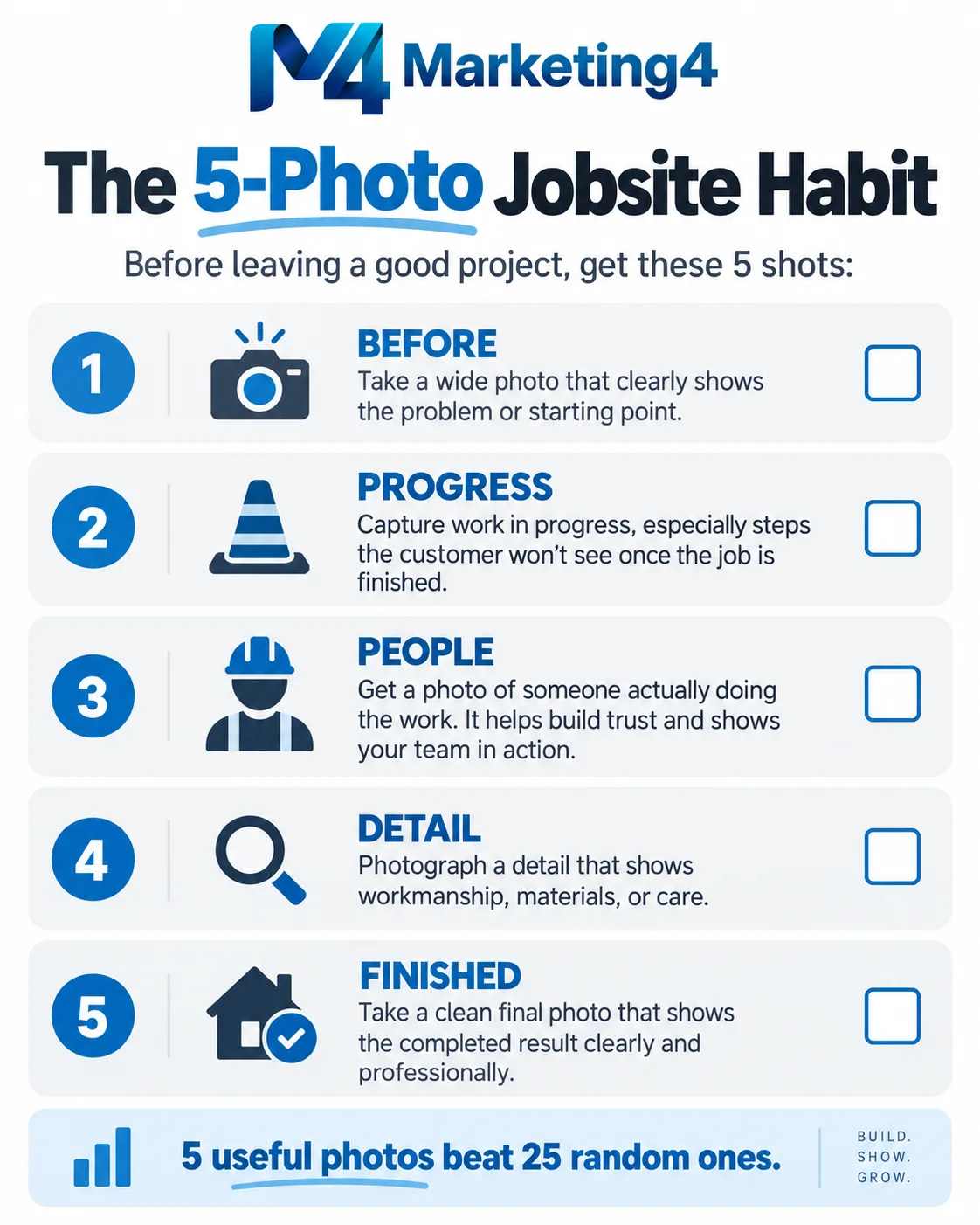
For a project worth documenting, try collecting these five photos:
- Before: What did the project or problem look like when you arrived?
- Progress: What does the work look like while it’s happening?
- People: Can you show someone from the company actually doing the work?
- Detail: Is there a particular part of the project that demonstrates workmanship or expertise?
- Finished: What does the completed project look like?
Here’s the same five-photo habit as a simple crew checklist you can save or share with your team:
Not every job will produce all five. That’s fine.
The purpose of the system is to make documentation a normal part of doing the job instead of a marketing task everyone remembers two weeks later.
Do More Photos Make Your Google Business Profile Rank Higher?
This is where marketing advice can get sloppy.
Google encourages businesses to upload useful, representative photos, and photos clearly make a Business Profile more informative to customers. That does not mean there is a simple formula where uploading 50 photos moves your company five positions higher on Google Maps.
There are many factors involved in SEO and local search visibility.
So don’t turn this into a numbers game.
If one contractor has 150 mediocre images and another has 60 excellent photos showing years of real projects, crews, equipment and finished work, there is no reason to assume the larger number has created the stronger profile.
Build a useful collection and continue adding to it as the company completes good work.
Your Photo Library Should Get Better as Your Business Grows
A good contractor can accumulate an enormous amount of useful marketing material without organizing a single professional photo shoot.
The work is already happening.
The crew is already on site. The equipment is already there. The project already has a beginning, middle and end. The expertise you’re trying to demonstrate in your marketing is visible every day inside the business.
You simply need a system for capturing it.
Start by documenting the projects you are already proud of. Show the people doing the work. Capture the interesting details. Photograph the finished result. Over time, make sure the collection increasingly represents the services, projects and customers your company wants to attract.
Your Google Business Profile shouldn’t look like a collection of marketing graphics trying to convince people you’re a good contractor.
If you want the broader foundation first, read our guide to what a Google Business Profile is and why it matters. Then use your photos to give potential customers enough evidence to start reaching their own conclusion about your work.