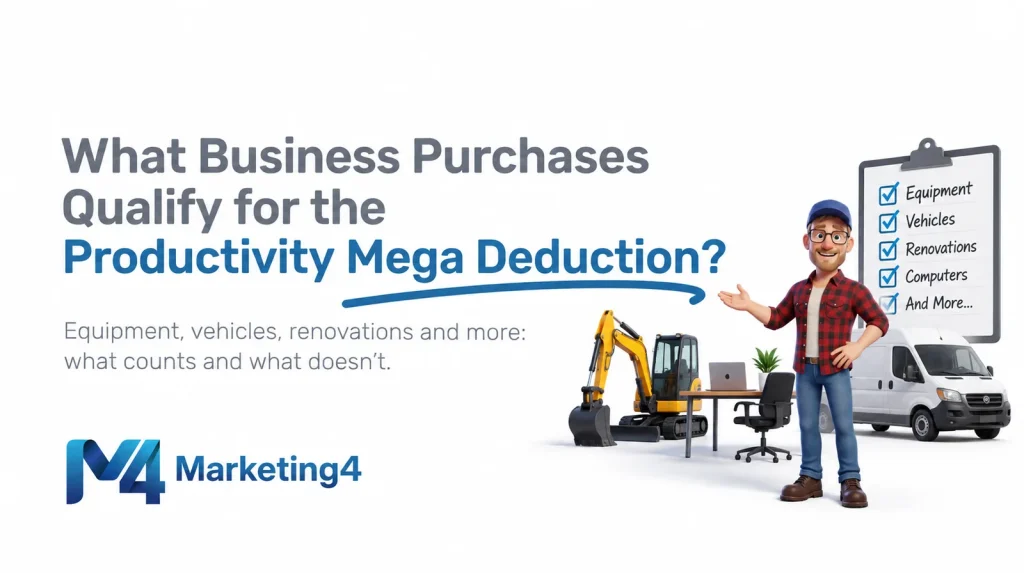

Canada’s proposed 100% business investment write-off sounds straightforward: buy something for your business and deduct the entire eligible cost. But could a landscaping company buy an excavator? Could an accounting firm replace its computers? What about a restaurant renovation, a cleaning machine or a company truck?
The answer depends on what you buy, its tax classification, when you acquire it and whether it meets the rules. The September 15, 2026 announcement is much broader than manufacturing, but it does not cover every purchase. Some items were already fully deductible before the announcement.
TL;DR
The federal government’s proposed Productivity Mega Deduction would permit immediate expensing of most eligible depreciable property acquired on or after September 15, 2026. That means deducting the qualifying capital cost in the tax year the asset becomes available for use. Business machinery, office furniture, computers and some capitalized software are potential examples. Most ordinary Class 1 and Class 3 commercial buildings, land, goodwill and certain vehicles do not qualify under this measure. Regular advertising, wages, rent and software subscriptions generally follow existing expense rules. As of September 17, 2026, the new measure is proposed, not enacted.
For an overview of the announcement, start with our guide to Canada’s new 100% business investment write-off. This article goes purchase by purchase.
What makes a purchase eligible?
Consider a cleaning company that spends $500 on chemicals, $15,000 on a commercial floor scrubber and $60,000 on a van. These do not automatically receive the same tax treatment. Chemicals are typically consumed in normal operations. The scrubber is equipment expected to last for years. The van is a longer-lasting asset, but vehicle classification and special restrictions matter.
Long-lived assets used to earn business income are often depreciable property. Normally, a business deducts their cost over time through capital cost allowance, or CCA. The Canada Revenue Agency groups assets into classes. Class 8, for example, commonly includes furniture, appliances and certain machinery at an ordinary 20% rate; Class 50 includes qualifying computers at an ordinary 55% rate; and many inexpensive tools fall into Class 12, ordinarily a 100% class. Existing accelerated-expensing rules may already change the first-year deduction.
The proposed measure covers most property subject to the CCA rules, with listed exclusions. A business must identify the actual class of each asset rather than relying on a label such as ‘equipment’ on an invoice. See the CRA’s classes of depreciable property and the Department of Finance announcement.
Business equipment and machinery: generally potential candidates
Here are tangible examples of depreciable assets that may qualify, assuming their actual classification and purchase circumstances meet the proposed rules.
| Business | Purchase | What to check |
|---|---|---|
| Cleaning company | Commercial floor scrubber | Equipment class, ownership and available-for-use date. |
| Landscaping company | Mower, compact equipment or excavator | Correct CCA class and any used-property conditions. |
| Restaurant | Commercial oven or refrigerator | Whether it is separately identifiable equipment rather than part of the building. |
| Auto repair shop | Vehicle lift or diagnostic equipment | Classification and installation-related costs. |
| Dental clinic | Dental chair or imaging equipment | Equipment class and acquisition details. |
| Photography studio | Cameras and professional lighting | Applicable classes and whether items are capital assets. |
| Fitness centre | Exercise machines | Asset class and available-for-use timing. |
| Contractor | Skid steer or specialized machinery | Class, purchase documentation and business use. |
Suppose a profitable cleaning business buys a $15,000 floor scrubber after the proposed effective date. If it is qualifying equipment and becomes available for use that tax year, the business could potentially deduct the full eligible cost in that year instead of spreading ordinary CCA deductions over multiple years. This does not mean the government pays for the scrubber, and earlier accelerated deductions may already have made some first-year savings available.
Office furniture and fixtures: often eligible, but distinguish renovations
Desks, office chairs, boardroom tables, filing cabinets and certain removable fixtures are common examples of depreciable furniture, generally in Class 8. A professional firm furnishing an office for $25,000 could potentially deduct the qualifying capital cost when the furniture becomes available for use.
A freestanding reception desk and a built-in counter that forms part of a renovation may be classified differently. The same is true of freestanding equipment versus permanent building work. Ask the accountant to separate furniture, equipment and building costs on larger invoices instead of assuming everything in an office fit-out has one treatment.
Computers and technology: eligible does not necessarily mean newly eligible
Imagine an accounting firm replacing 15 computers at $2,000 each, for a $30,000 investment. Qualifying computer equipment may be covered by the proposed measure, but earlier government measures already provided temporary immediate expensing for important computer categories. The September 2026 announcement aims to make broader expensing permanent; it does not necessarily create a new first-year saving for every computer purchased in 2026.
This distinction is important whenever a headline claims an asset can ‘now’ be written off immediately. Compare the proposed deduction with the first-year deduction already available for that particular asset.
Software: a purchase is different from a subscription
A company paying $300 per month for a cloud project-management service and a company acquiring a $40,000 software asset are not necessarily making equivalent tax purchases. A normal monthly subscription is generally an operating expense under existing rules, subject to ordinary deduction and prepaid-expense restrictions. It does not need a new capital-expensing incentive to be deductible.
Purchased software with an enduring benefit may be depreciable property. The CRA generally places qualifying application software in Class 12, while systems software may fall elsewhere. Certain other licences and intangible assets are in excluded Classes 14 and 14.1. The word ‘licence’ on an invoice is not enough to determine the class.
For a sizeable software implementation, separate the software asset, customization, setup, training, maintenance and recurring subscriptions. Whether each cost is capital or current depends on its nature and the tax rules.
Tools: some already had a full first-year deduction
The CRA generally includes tools costing less than $500 in Class 12 and tools costing $500 or more in Class 8. Many ordinary small Class 12 tools were already fully deductible in the year of purchase, although exceptions exist. A $250 hand tool therefore may receive no new benefit from this announcement. A $4,000 testing instrument may receive a different treatment if it is qualifying Class 8 equipment.
It’s not enough to ask, ‘Is this a tool?’ Ask which class applies and how much could already be deducted under the previous rules.
Vehicles: there is no universal 100% company-car deduction
The proposed legislation excludes certain vehicles in Classes 10 and 10.1. Specifically, an affected passenger vehicle, taxi or certain other specified motor vehicle is excluded if it was previously used or assembled outside Canada. Other commercial vehicles may be treated differently according to their classifications. Passenger-vehicle capital-cost ceilings and business-use limits also continue to matter.
| Vehicle purchase | What needs to be verified |
|---|---|
| Passenger car | Class, new or used status, assembly location and deductible capital-cost limit. |
| Pickup truck | Whether its configuration and actual use make it a passenger vehicle or another type of motor vehicle. |
| Cargo van or heavy truck | Correct CCA class and whether any specific exclusion applies. |
| Used vehicle | General used-property conditions plus special vehicle restrictions. |
| Zero-emission vehicle | Existing incentives, classification, cost limits and interaction with the proposed rules. |
A pickup used almost entirely to move tools and materials might be classified differently from an otherwise similar truck used as an ordinary passenger vehicle. Purchasing a vehicle through a corporation does not make personal driving a business expense. Do not commit to a vehicle purchase based solely on a ‘100% write-off’ headline.
Buildings and renovations: a significant exclusion
Most ordinary commercial buildings acquired after 1987 are in Class 1. The proposed measure excludes buildings and additions in Classes 1 and 3. Land does not qualify because it is not depreciable. Manufacturing and processing buildings may have a separate temporary immediate-expensing incentive, but that does not extend to every commercial property.
Renovations require a breakdown. A restaurant’s construction contract might cover separately identifiable kitchen equipment, dining furniture, permanent plumbing, structural work and leasehold improvements. The tax treatment may differ for each. Some leasehold interests are Class 13 property and may be potentially eligible, while an ordinary Class 1 building addition is excluded. Routine repairs may be current expenses already deductible under existing rules.
| Restaurant or office project item | Potential treatment |
|---|---|
| Freestanding commercial refrigerator | Potentially eligible equipment. |
| Tables and chairs | Potentially eligible furniture. |
| Structural building addition | Generally excluded if Class 1 or Class 3. |
| Permanent plumbing or building systems | Classification required; may be part of the building. |
| Leasehold improvements | Depends on the precise work and applicable class. |
A $150,000 renovation should not be presented as one uniformly eligible purchase. Have the invoice and scope broken down. The CRA explains the distinction in its guidance on current versus capital expenses.
What definitely is not covered by this new capital write-off?
Some spending is excluded property. Other spending simply is not a capital purchase and may already be deductible through different rules. Those are different situations.
| Purchase or cost | Why it does not use this new measure |
|---|---|
| Employee wages | Generally an operating expense under existing rules. |
| Advertising and Google Ads | Generally deducted under existing advertising-expense rules, where eligible. |
| Monthly software subscriptions and office rent | Generally ongoing operating costs, subject to ordinary rules. |
| Routine maintenance and cleaning supplies | Typically current expenses or inventory-related costs. |
| Inventory purchased for resale | Governed by inventory and cost-of-goods-sold rules rather than CCA. |
| Land | Not depreciable. |
| Goodwill, certain franchises and licences | Excluded Classes 14 and 14.1. |
| Most ordinary Class 1 and Class 3 buildings | Explicitly excluded from this deduction. |
Being excluded from the Productivity Mega Deduction does not mean a purchase has no tax deduction. Ordinary expenses can remain deductible, and excluded depreciable assets may still be eligible for normal CCA or the Accelerated Investment Incentive, as applicable. The distinction prevents double-counting the benefits of an announcement.
Can used equipment qualify?
Potentially. Under the proposed used-property rules, neither the buyer nor a person who does not deal at arm’s length with the buyer may have previously owned the asset, and the property must not have been transferred on a tax-deferred rollover basis. A used excavator bought from an unrelated equipment dealer could qualify if all other conditions are met. Moving existing equipment from an owner into their own corporation cannot simply be assumed to meet the same rules.
Keep the seller’s information and acquisition documents. Remember that used passenger vehicles may face additional exclusions even when other used equipment is potentially eligible.
When does the deduction start?
The government proposes applying the permanent deduction to qualifying property acquired on or after September 15, 2026. The claim is generally made in the taxation year the property becomes available for use. An asset ordered in October 2026 but not delivered and commissioned until February 2027 may not qualify for a 2026 claim, depending on the company’s tax year and the applicable available-for-use rules.
As of September 17, 2026, these are draft measures, not enacted law. The final legislative wording and provincial tax treatment should be checked before relying on an expected deduction.
What does a $50,000 qualifying purchase actually save?
Assume a profitable service business buys $50,000 in eligible equipment, faces an illustrative 20% income tax rate and has enough taxable income to use the entire deduction immediately.
| Equipment purchase | $50,000 |
|---|---|
| Potential first-year deduction | $50,000 |
| Illustrative tax rate | 20% |
| Illustrative first-year tax reduction from the full deduction | $10,000 |
| Illustrative after-tax purchase cost | $40,000 |
The business still pays for the equipment. The $10,000 is a simplified tax calculation, not a grant or a guaranteed refund. It is also not necessarily an additional $10,000 in lifetime savings compared with previous depreciation rules. The principal improvement is receiving eligible deductions earlier. A company with insufficient taxable income may not realize that entire benefit immediately, and later selling an asset can lead to tax consequences, including depreciation recapture.
What should a business owner check before buying?
- Identify the actual items. Separate equipment, software, installation, building work and services on a mixed invoice.
- Find the right CCA class. The class determines the relevant exclusions and existing deductions.
- Confirm new versus used and the seller. Previous ownership and tax-deferred transfers can affect eligibility.
- Record the available-for-use date. The order or payment date is not necessarily the deduction date.
- Check limits and actual deductible costs. Vehicle caps, business-use percentages, GST/HST input tax credits and other assistance may matter.
- Compare against the old rules. Some purchases already had a full or accelerated first-year deduction.
- Evaluate the investment without the tax incentive. The equipment still needs to help the business operate or earn more.
Ask a qualified tax professional to compare the existing treatment with the proposed measure for any substantial purchase. The relevant question is not merely whether an asset qualifies, but what difference the new deduction actually makes to that particular business.
Make the purchase decision first, then calculate the tax effect
A small service business can potentially benefit from the new proposal just as a large manufacturer can. What matters most is the type of purchase and its tax treatment, not the number of employees. A floor scrubber, dental chair, office desk, commercial oven, pickup truck and building addition are not interchangeable for tax purposes.
Start with a genuine business need, document the asset correctly and calculate its tax treatment using the proposed rules alongside existing deductions. A full write-off can improve cash flow, but it cannot make an unnecessary investment worthwhile on its own.
Official sources and article status
Reviewed September 17, 2026. Sources: Department of Finance Productivity Mega Deduction backgrounder; draft legislative proposals; CRA classes of depreciable property; and CRA current versus capital expenses. These federal measures are proposed and may change before enactment. This is general information, not tax advice for an individual transaction.