
TLDR
(Too, Long, Didn’t, Read)
- A sales process helps you move leads forward instead of relying on memory.
- Trade businesses need a different funnel than retail or e-commerce.
- Start simple with a whiteboard, sticky notes, or a spreadsheet.
- Keep your pipelines minimal, usually 2 or 3 at most.
- Keep each pipeline simple, usually 5 or 6 stages.
- Each stage should have a checklist and a clear next action.
- Always include a Lost stage and track the lost reason.
- The goal is not fancy software. The goal is visibility, consistency, and better follow-up.
If you’d like to hear a ‘podcast’ created by NoteBookLM, you can listen to it on Spotify.
(NoteBookLM, takes the blog info and creates an engaging podcast to listen to on the topic).
If you’d like to watch a ‘explainer video’ created by NoteBookLM, you can can watch it below or on YouTube.
(NoteBookLM, takes the blog info and creates an explainer video on the topic).
I think a lot of trade businesses rely on their memory to track leads.
Someone calls. You have a chat. You write the name on a piece of paper, maybe a sticky note, maybe the back of a napkin, maybe in your phone if you are unusually organized that day. Then the week gets busy, a crew member calls in sick, a supplier misses a delivery, two jobs run long, and suddenly that lead is gone into the void.
Not because they were a bad lead.
Not because your price was wrong.
Just because there was no process.
And this is the part a lot of good business owners miss. They think sales process is something for big companies, software firms, or online stores. They picture some polished corporate funnel with dashboards and automated emails and a sales manager saying things like “pipeline velocity.”
But in reality, a sales process for a contractor, plumber, mover, landscaper, builder, or service business is often much simpler than that.
It just needs to answer one question:
What happens to a lead after they contact you?
If the answer is “well… it depends,” that is normal. But that is also exactly why you need a process.
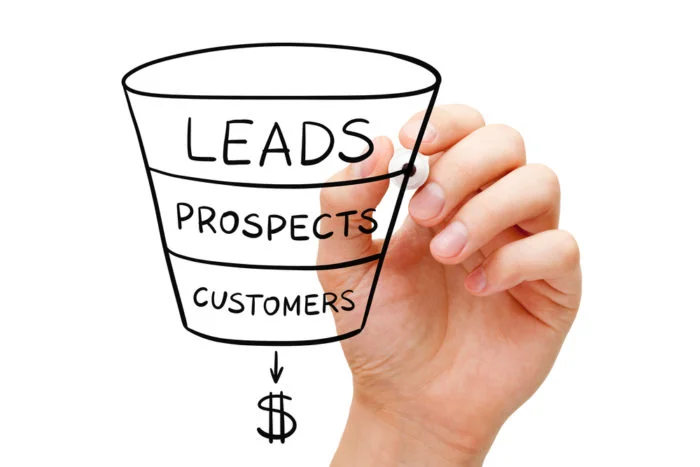
A sales funnel is just a way of seeing the work
The term sales funnel can sound a little too marketing-ish for some business owners. Fair enough. I get it.
But strip away the jargon and it is actually a very practical idea.
A funnel just means that leads move through a series of stages.
They come in at the top.
Some move forward.
Some stall.
Some get lost.
Some become customers.
That is it.
For a trade business, this matters because your sales cycle is usually not like retail or e-commerce. It should also reflect the customer journey for local service businesses, because urgent service calls and larger projects do not move through the buying process the same way.
A person buying a shirt online might see it, click it, buy it, and be done in five minutes.
A person hiring a contractor to renovate their home, install a new HVAC system, move a family across the province, or build a custom structure does not work like that. They may need time. They may get multiple quotes. They may need to talk to a spouse, a partner, a property manager, or a board. They may be interested today but not ready until next month. Sometimes next year.
So your funnel is not just about “closing.” It is about moving relationships forward over time.
That is a very different mindset.
The old-school version was not wrong
Before CRMs and apps and all the rest of it, businesses still had pipelines. They just did not call them pipelines.
A lot of companies used a whiteboard or a wall.
You would have columns. Maybe something like:
- New Lead
- Contacted
- Estimate Sent
- Follow Up
- Won
- Lost
Then every lead was a sticky note.
As the lead progressed, you physically moved the sticky note across the board.
Honestly, that is not a bad way to think about it even now.
Because it makes the process visible.
You can stand back and see the work. You can see how many leads are sitting in “Estimate Sent.” You can see whether too many are dying after follow-up. You can see whether you have a full pipeline or whether the phone has been suspiciously quiet.
The problem with the old-school method is not that the idea was bad. The problem is that it does not scale well, it is easy to forget things, and it is hard to analyze later.
Still, I would rather see a business using sticky notes on a wall than pretending they have a sales process when really they are just hoping their memory holds together.
Start simple: a spreadsheet is enough
I do think better software helps. A good CRM is powerful. It can automate reminders, assign tasks, log communication, track lost reasons, and make reporting far easier.
But that does not mean you need to start there.
A spreadsheet is enough to begin.
You can create a very useful sales tracker with columns like:
- Lead Name
- Company or Household
- Phone Number
- Service Type
- Lead Source
- Assigned To
- Current Stage
- Last Contact Date
- Next Action
- Next Follow-Up Date
- Quote Value
- Lost Reason
- Notes
And the key field is Current Stage.
That should be a dropdown list.
Why a dropdown? Because if one person writes “Quoted,” another writes “Quote Sent,” and another writes “Estimate out,” your data becomes a mess. It sounds minor, but this is how useful reporting dies. Quietly. In a spreadsheet. By a thousand tiny inconsistencies.
So pick a handful of clear stages and force consistency.
That alone will make the business more organized than most of your competitors.
Keep the number of pipelines low
This is where people often overcomplicate things.
They think, “Well, emergency plumbing is different from bathroom renovations, and commercial maintenance is different from residential installs, and new construction is different from service calls…”
That is true.
But if you create nine different pipelines with eleven stages each, no one will use them. Including you.
A good rule of thumb is to build the minimum number of pipelines needed to reflect real differences in how you sell.
For many trade businesses, that means maybe two or three pipelines.
For example:
1. Urgent or emergency work
This might be for burst pipes, no-heat calls, urgent electrical issues, broken garage doors, water delivery emergencies, things like that.
This pipeline is fast. It is more about intake, dispatch, service completion, and maybe follow-up for future work.
2. Standard estimate-based work
This might be installs, planned repairs, landscaping jobs, moving jobs, non-urgent service work, or moderate renovation projects.
This pipeline usually includes contact, qualification, estimate, follow-up, and decision.
3. Larger projects or long-cycle work
This could be major renovations, custom homes, commercial work, new builds, large mechanical installs, or bigger development-related projects.
This pipeline is slower and often more relationship-driven. There may be site visits, budgeting, revisions, multiple decision-makers, and long gaps between interactions.
The point is not to build a perfect representation of every edge case.
The point is to handle about 80% of leads cleanly, while leaving room for the other 20% to be managed with some flexibility.
If the process is too rigid, people stop using it. And once that happens, the process is dead whether the software still exists or not.
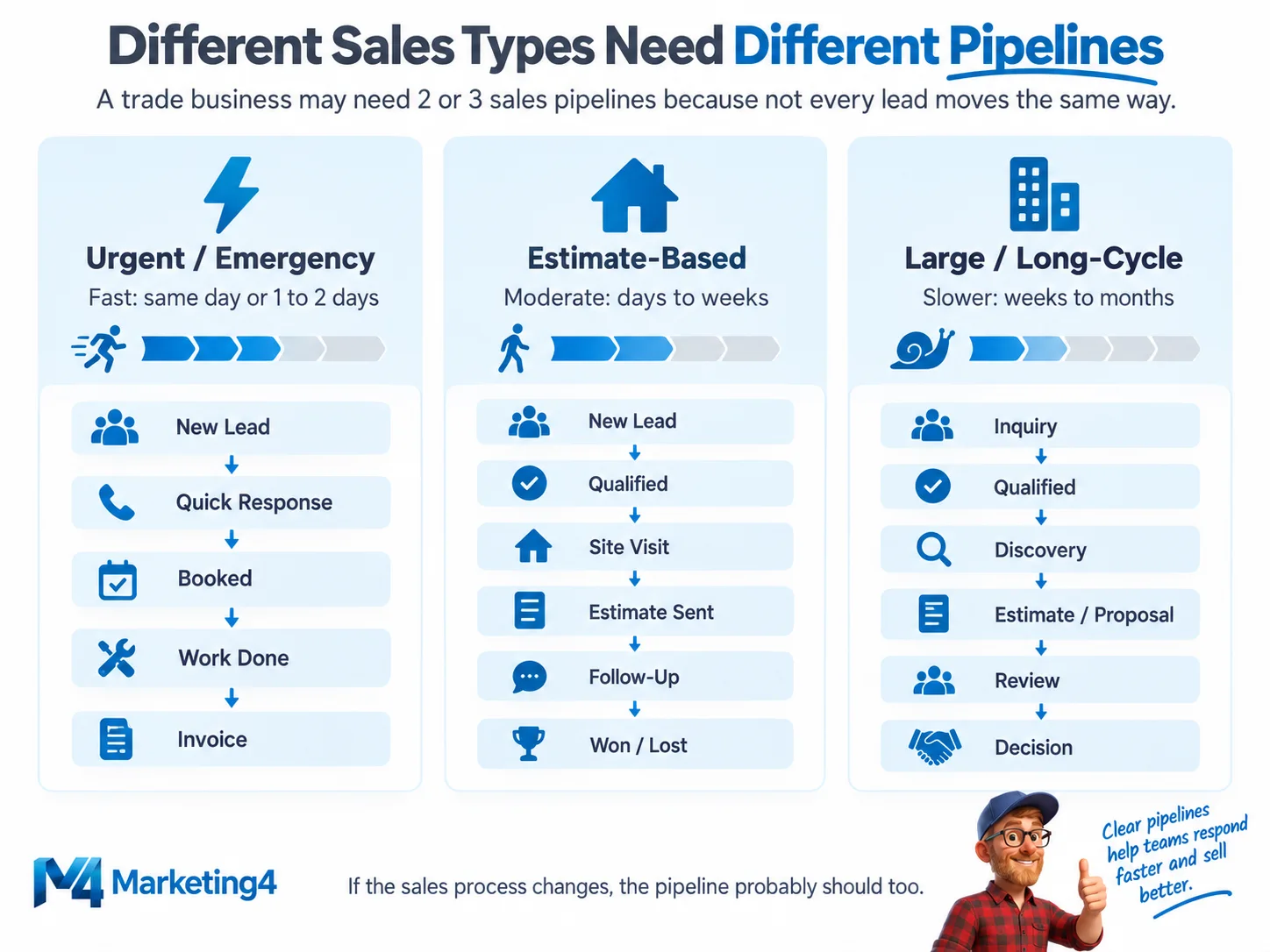
Each pipeline should only have a few stages
You do not need twenty stages.
You probably need five or six.
That is enough to tell the story of where a lead is without turning the whole thing into admin work.
A simple pipeline for estimate-based work might look like this:
New Lead
The inquiry came in. No real action yet.
Contacted / Qualified
You spoke to them or at least attempted contact. You know whether this is a fit.
Site Visit or Discovery
You gathered enough information to understand the scope.
Estimate Sent
They have pricing or a proposal. For larger or premium projects, the proposal itself becomes part of the sales process. Our guide to high-end proposals for contractors explains how to turn that document into a clearer decision tool.
Follow-Up / Decision Pending
You are waiting, checking in, answering objections, or nudging the lead forward.
Won or Lost
The job either moved ahead or it did not.
That is enough.
You can always add detail in notes or tasks. The stages should stay simple.
Think of stages like road signs, not like a full diary.
The handoff between stages is where a lot of money gets lost
A stage should not just be a label. It should mean something.
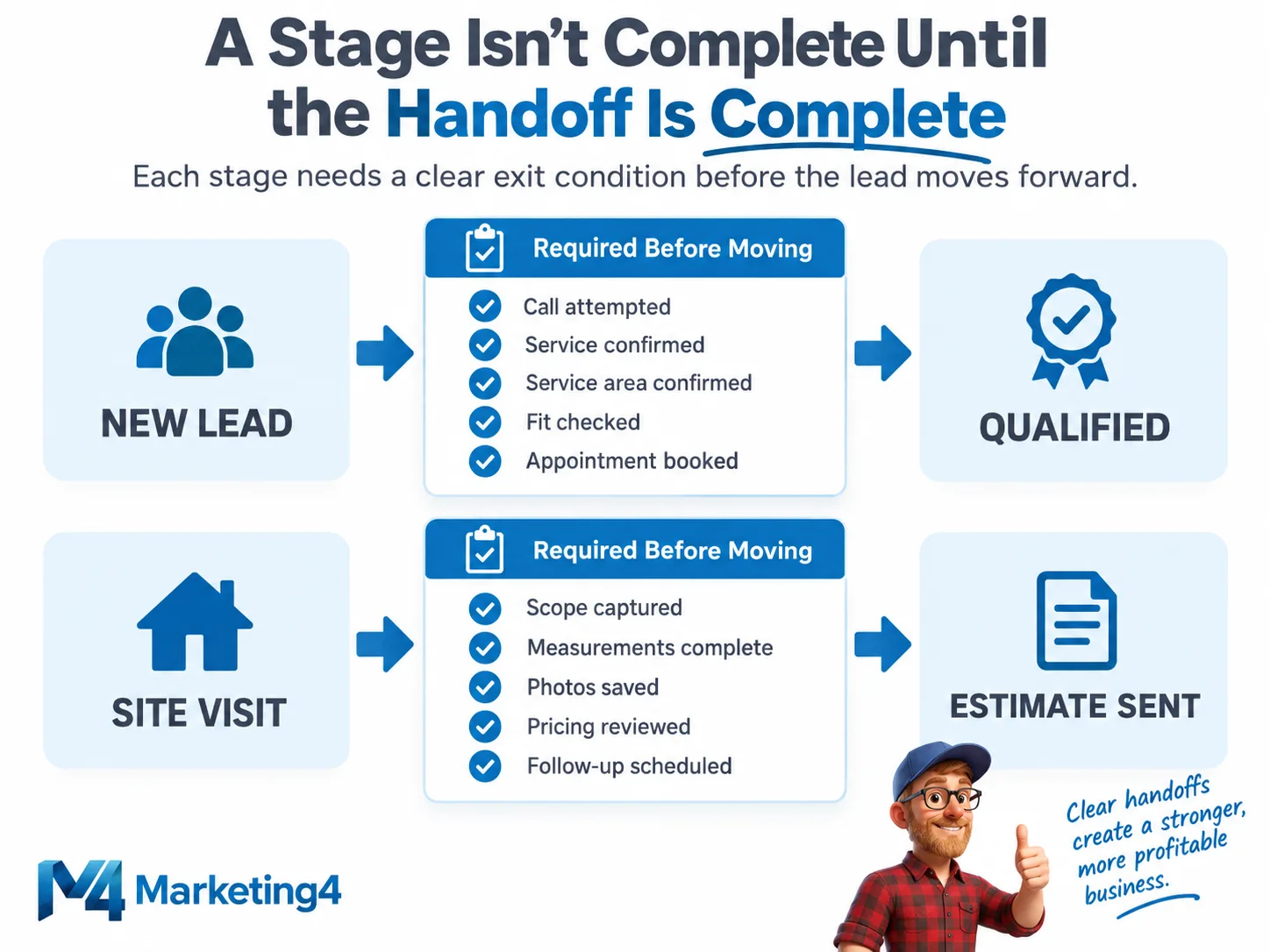
In other words, what has to happen before a lead moves from one stage to the next?
This is where checklists become useful.
For example, before moving a lead from “New Lead” to “Qualified,” maybe the checklist is:
- Call made
- Email sent if no answer
- Service type confirmed
- Service area confirmed
- Budget or rough fit checked
- Appointment booked, or no fit identified
Before moving a lead from “Site Visit” to “Estimate Sent,” maybe the checklist is:
- Scope notes completed
- Measurements gathered
- Photos saved
- Pricing reviewed
- Proposal sent
- Follow-up date scheduled
Some checklist items can be automated in a CRM.
Some will always be manual.
That is fine.
The important thing is that the transition between stages is not vague. It should be based on actions, not feelings.
Otherwise “Contacted” ends up meaning whatever someone wants it to mean that day.
Lost is a stage too, and it matters more than people think
Every pipeline should include Lost.
Not buried in notes.
Not vaguely implied.
An actual selectable outcome.
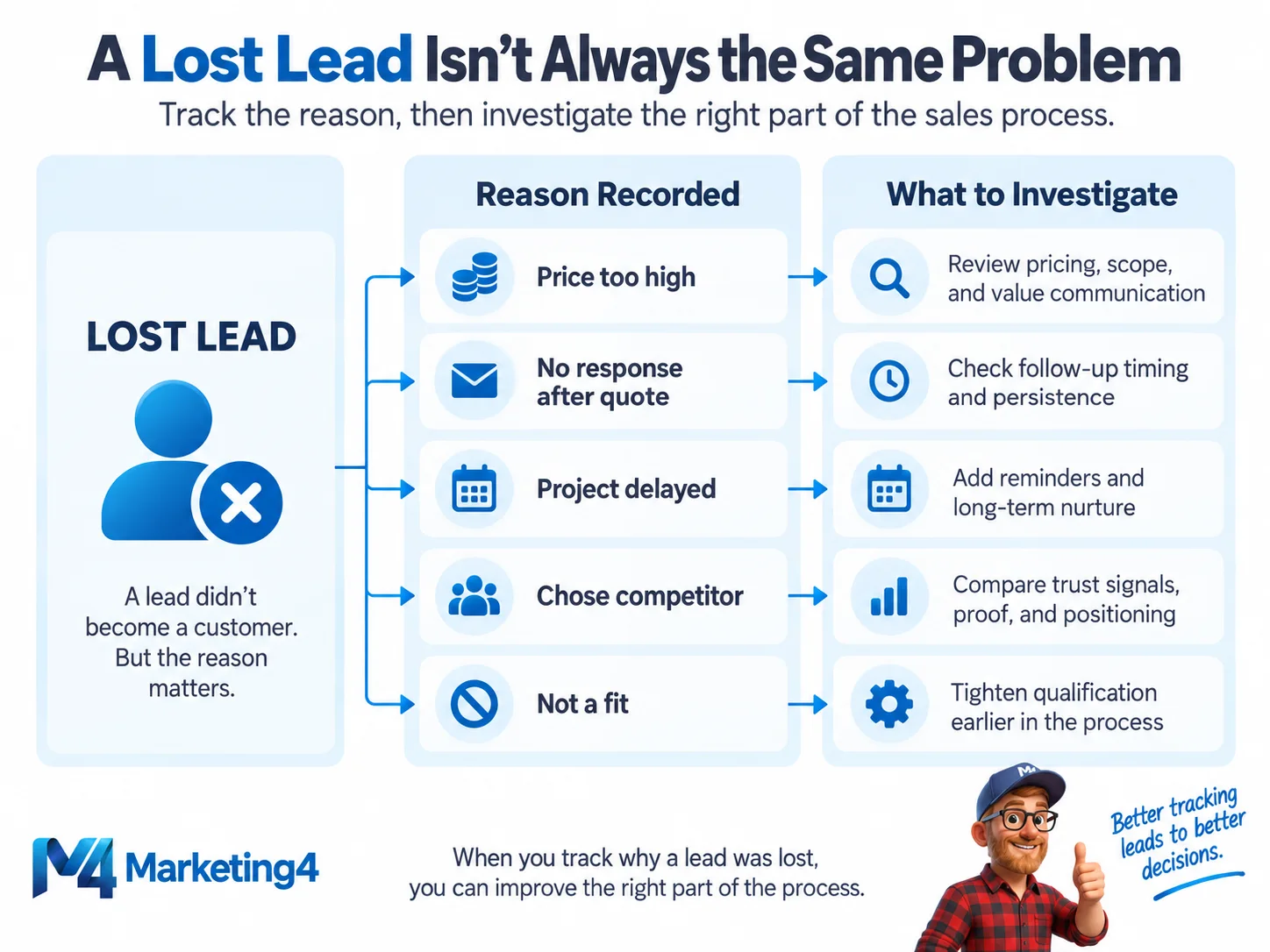
And ideally, when a lead is marked lost, the business should choose a lost reason from a standard list.
For example:
- Price too high
- Went with competitor
- No response
- Project delayed
- Scope not a fit
- Location not serviced
- Timing issue
- Chose to do nothing
This matters because businesses are often terrible at understanding why they lose work.
They guess.
They say things like “people only care about price,” which may be true sometimes, but often becomes a lazy explanation for everything.
Then six months later, if you run the numbers and see that most lost leads were actually “No response after quote” or “Project delayed,” that tells a very different story.
One suggests a pricing issue.
The other suggests a follow-up issue or a timing issue.
Those are not the same problem. Therefore, they should not produce the same solution.
Timing matters more than most people realize
A lead sitting too long in one stage is a warning sign.
This is where reminders become important.
If a quote was sent seven days ago and no one followed up, that lead is not being managed. It is being neglected politely.
If a large renovation lead has been sitting in “Decision Pending” for 45 days, maybe that is normal. Maybe it is not. The point is that someone should know.
At the very least, the system should help answer:
- How long has this lead been in this stage?
- When did we last contact them?
- What is the next action?
- When are we supposed to follow up?
Even a spreadsheet can do some of this. A simple “days in stage” field and conditional formatting can go a long way.
A CRM just does it better.
But again, better is not the same as necessary. Start where you are.
A real example: two businesses, two very different funnels
Take an HVAC company.
For emergency no-heat calls, the process might be:
New Lead → Dispatched → Job Completed → Follow-Up → Won/Lost Upsell Opportunity
Fast. Practical. Short cycle.
Now take that same company selling full system replacements.
That process might be:
New Lead → Qualified → Home Visit → Quote Sent → Follow-Up → Won/Lost
That is slower. More consultative. More dependent on trust.
Now imagine forcing both kinds of work into one identical pipeline.
It gets messy quickly.
The emergency lead does not need the same stages as the install lead.
The install lead should not be treated like a same-day service call.
This is why having two or three pipelines often makes sense.
Not because complexity is good, but because real life is messy and the pipeline should reflect that without becoming a monster.
The real goal is not software. It is visibility and consistency
I think this is the core point.
The purpose of a sales process is not to make your business look sophisticated. It is to make sure good opportunities do not disappear because no one knew what was happening.
A process gives visibility.
A process creates accountability.
A process helps train staff.
A process turns scattered effort into something you can improve.
And once you can see the pipeline clearly, better questions start to appear:
- Where do we lose most leads?
- How long do leads sit before we follow up?
- Which services convert best?
- Which estimator closes the most work?
- Which lead sources bring serious jobs versus tire-kickers?
That is when sales starts becoming something you can manage, not just react to.
Start ugly if you have to
If you are a small or medium-sized trade business and you do not really have a sales process yet, I would not overthink this.
Do not wait until you have the perfect CRM.
Do not wait until the office manager has more time.
Do not wait until the busy season ends, because it never really ends.
Start ugly if you have to.
Use sticky notes.
Use a whiteboard.
Use a spreadsheet.
Then improve it later.
Because the real risk is not that your first version will be imperfect.
Of course it will be.
The real risk is continuing to run sales out of memory, missed calls, and random scraps of paper while telling yourself the business is “too hands-on” for a proper process.
It is not.
In fact, the more hands-on the business is, the more important the process becomes.
That is how I see it, anyway. For trade businesses, sales is not some slick corporate function. It is simply the discipline of making sure opportunities are noticed, moved forward, and not forgotten. And if you can do that consistently, you will usually grow faster than the company that is just as skilled, but far less organized.
Key Takeaways
- A good sales process does not need to be complicated. It just needs to be clear and consistent.
- Trade businesses should think of sales as a funnel that moves leads through a few defined stages over time.
- Most businesses only need 2 or 3 pipelines, based on meaningful differences in how they sell.
- Each pipeline should usually have just 5 or 6 stages, so the process stays practical and usable.
- Every stage should have a purpose, a checklist, and a clear next action.
- Every pipeline should include a Lost stage, along with a lost reason, so the business can learn from missed opportunities.
- You can start with a whiteboard or spreadsheet. A CRM can come later.
- The goal is not a perfect system. The goal is to stop good leads from being forgotten.